模块更新于 2026-11-20· 浏览 0· 下载 0
AKS 自适应关键帧采样
相关性覆盖双原则:用轻量视觉-语言模型(默认 BLIP,可换 CLIP 等)计算每帧与问题的匹配分数保证"相关性";再借鉴 Ripley's K 函数,递归分宽度量所选帧在时间轴上的"覆盖",防扎堆、防遗漏
结构图
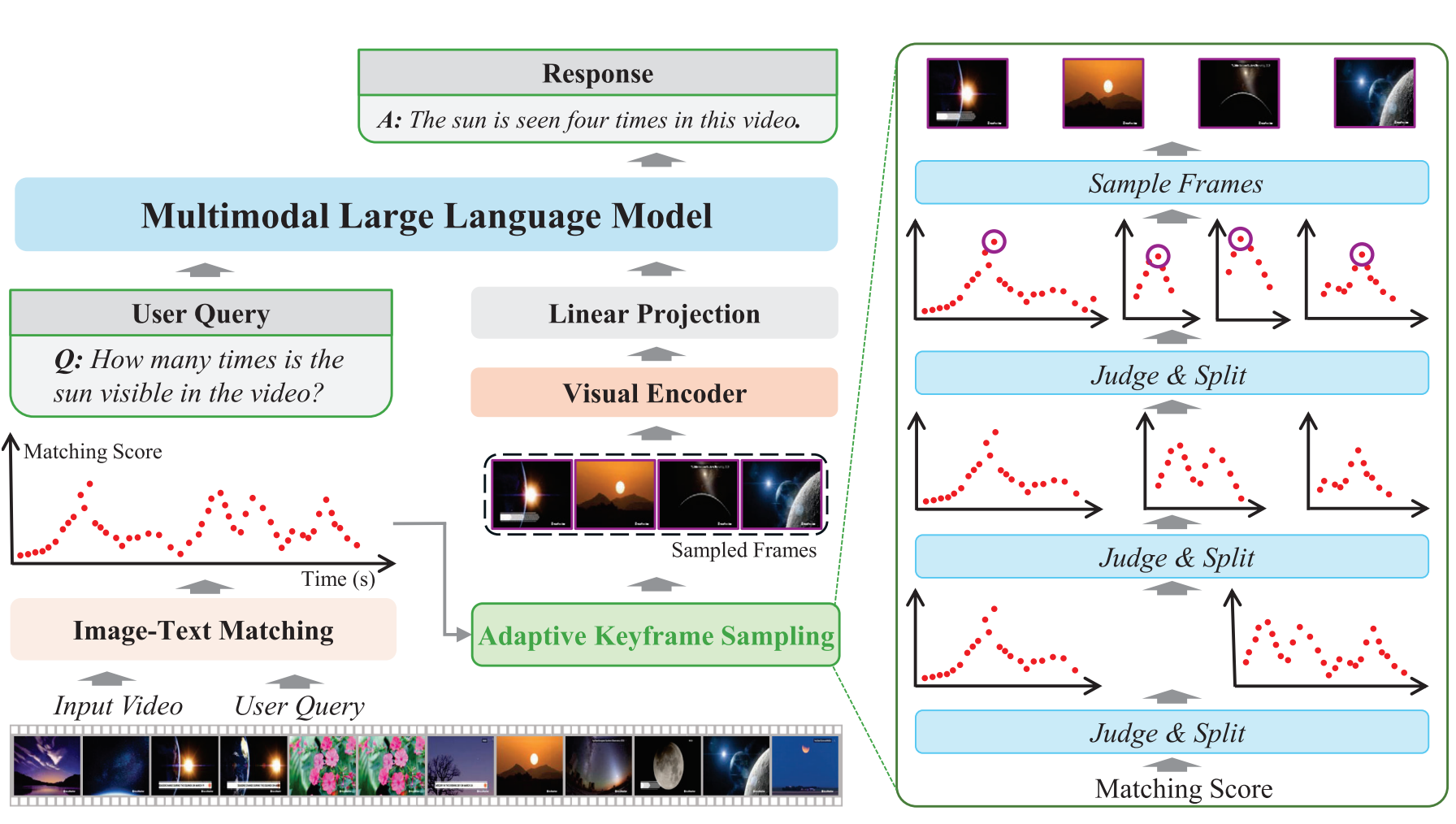
相关性覆盖双原则:用轻量视觉-语言模型(默认 BLIP,可换 CLIP 等)计算每帧与问题的匹配分数保证"相关性";再借鉴 Ripley's K 函数,递归分宽度量所选帧在时间轴上的"覆盖",防扎堆、防遗漏
论文信息
- 论文:Adaptive Keyframe Sampling for Long Video Understanding
- 出处:CVPR 2025
核心痛点
视频多模态大模型靠把视觉 token 塞进 LLM 上下文来"看"视频,但长视频 token 量远超模型容量,只能采样一小部分帧;现有方法大多沿用均匀采样(如 LLaVA-Video 默认设置),选帧不看问题内容,关键信息漏采后模型只能瞎猜。
模块亮点
- 相关性覆盖双原则:用轻量视觉-语言模型(默认 BLIP,可换 CLIP 等)计算每帧与问题的匹配分数保证"相关性";再借鉴 Ripley's K 函数,递归分宽度量所选帧在时间轴上的"覆盖",防扎堆、防遗漏
- 自适应递归分割:逐层把时间轴对半二分,若某段内 top 帧平均分与整体平均分差距超阈值,就取该段最高分帧;否则继续切分均分配额,在"只挑高分"与"均匀铺开"间权衡
- 零训练涨点:不调 MLLM 参数、只换输入帧,Qwen2-VL 上 LongVideoBench / VideoMME 分别提升 5.0% / 2.3%;消融中 ADA 拿到 62.7 / 65.3,均超均匀采样的 58.9 / 64.4
适用场景
领域为长视频理解 / 视频多模态大模型;原文在 LongVideoBench、VideoMME 上插入 Qwen2-VL、LLaVA-OV、LLaVA-Video 验证,并扩展到视频指代、视频描述;也可迁移到视频字幕生成、时序定位等选帧场景。
插入位置建议
- 放在 MLLM 视觉编码器之前,替换均匀采样,关键帧直接作为视觉 token 输入
- 打分器按需替换:默认 BLIP,也可换 CLIP 等视觉-语言模型
- 换 prompt 即可迁移任务:视频指代、视频描述只需改指令文本,AKS 按问题自适应选帧
适用任务
- 长视频理解
- 视频多模态大模型
完整代码
aks.py
import heapq
import json
import numpy as np
import argparse
import os

def parse_arguments():
    parser = argparse.ArgumentParser(description='Extract Video Feature')

    parser.add_argument('--dataset_name', type=str, default='longvideobench', help='support longvideobench and videomme')
    parser.add_argument('--extract_feature_model', type=str, default='blip', help='blip/clip/sevila')
    parser.add_argument('--score_path', type=str, default='./outscores/longvideobench/blip/scores.json')
    parser.add_argument('--frame_path', type=str, default='./outscores/longvideobench/blip/frames.json')
    parser.add_argument('--max_num_frames', type=int, default=64)
    parser.add_argument('--ratio', type=int, default=1)
    parser.add_argument('--t1', type=int, default=0.8)
    parser.add_argument('--t2', type=int, default=-100)
    parser.add_argument('--all_depth', type=int, default=5)
    parser.add_argument('--output_file', type=str, default='./selected_frames')

    return parser.parse_args()

def meanstd(len_scores, dic_scores, n, fns,t1,t2,all_depth):
        split_scores = []
        split_fn = []
        no_split_scores = []
        no_split_fn = []
        i= 0
        for dic_score, fn in zip(dic_scores, fns):
                # normalized_data = (score - np.min(score)) / (np.max(score) - np.min(score))
                score = dic_score['score']
                depth = dic_score['depth']
                mean = np.mean(score)
                std = np.std(score)

                top_n = heapq.nlargest(n, range(len(score)), score.__getitem__)
                top_score = [score[t] for t in top_n]
                # print(f"split {i}: ",len(score))
                i += 1
                mean_diff = np.mean(top_score) - mean
                if mean_diff > t1 and std > t2:
                        no_split_scores.append(dic_score)
                        no_split_fn.append(fn)
                elif depth < all_depth:
                # elif len(score)>(len_scores/n)*2 and len(score) >= 8:
                        score1 = score[:len(score)//2]
                        score2 = score[len(score)//2:]
                        fn1 = fn[:len(score)//2]
                        fn2 = fn[len(score)//2:]
                        split_scores.append(dict(score=score1,depth=depth+1))
                        split_scores.append(dict(score=score2,depth=depth+1))
                        split_fn.append(fn1)
                        split_fn.append(fn2)
                else:
                        no_split_scores.append(dic_score)
                        no_split_fn.append(fn)
        if len(split_scores) > 0:
                all_split_score, all_split_fn = meanstd(len_scores, split_scores, n, split_fn,t1,t2,all_depth)
        else:
                all_split_score = []
                all_split_fn = []
        all_split_score = no_split_scores + all_split_score
        all_split_fn = no_split_fn + all_split_fn


        return all_split_score, all_split_fn

def main(args):
    max_num_frames = args.max_num_frames
    ratio = args.ratio
    t1 = args.t1
    t2 = args.t2
    all_depth = args.all_depth
    outs = []
    segs = []

    with open(args.score_path) as f:
        itm_outs = json.load(f)
    with open(args.frame_path) as f:
        fn_outs = json.load(f)

    if not os.path.exists(os.path.join(args.output_file,args.dataset_name)):
        os.mkdir(os.path.join(args.output_file,args.dataset_name))
    out_score_path = os.path.join(args.output_file,args.dataset_name,args.extract_feature_model)
    if not os.path.exists(out_score_path):
        os.mkdir(out_score_path)

    for itm_out,fn_out in zip(itm_outs,fn_outs):
        nums = int(len(itm_out)/ratio)
        new_score = [itm_out[num*ratio] for num in range(nums)]
        new_fnum = [fn_out[num*ratio] for num in range(nums)]
        score = new_score
        fn = new_fnum
        num = max_num_frames
        if len(score) >= num:
            normalized_data = (score - np.min(score)) / (np.max(score) - np.min(score))
            a, b = meanstd(len(score), [dict(score=normalized_data,depth=0)], num, [fn], t1, t2, all_depth)
            segs.append(len(a))
            out = []
            if len(score) >= num:
                for s,f in zip(a,b):
                    f_num = int(num / 2**(s['depth']))
                    topk = heapq.nlargest(f_num, range(len(s['score'])), s['score'].__getitem__)
                    f_nums = [f[t] for t in topk]
                    out.extend(f_nums)
            out.sort()
            outs.append(out)
        else:
            outs.append(fn)

    score_path = os.path.join(out_score_path,'selected_frames.json')
    with open(score_path,'w') as f:
        json.dump(outs,f)

if __name__ == '__main__':
    args = parse_arguments()
    main(args)
环境与依赖
Python 3.9+
继续浏览
下一篇ARConv 自适应矩形卷积核形状可学习:把卷积核的高和宽当作可学习参数,每个位置都能长出 5×3 这样的自适应矩形核,随物体大小伸缩,计算开销还不随核增大而上升相关资源
模块2026-11-21
MME 遗忘指标元评估
先用受控暴露的模型池检查指标区分能力,再用量化与匹配预算再学习检验判断稳定性。调和平均将忠实度和两类鲁棒性汇总,同时保留分项结果。
多模态大模型机器遗忘模型评估
多模态MIT
模块2026-11-21
MT-NPO 模态分层遗忘
将负偏好核移入词元求和,用有界后缀证据分配词元压力;模态层分别关注残余可访问程度与保留效用退化。论文反传时固定分配权重,现有代码仅作前向结构参考,接入前要核对停止梯度。
多模态大模型机器遗忘负偏好优化
多模态MIT
模块2026-11-20
BAT 通用双向适配器
双向交叉提示:不预设主/辅模态,一个共享参数的通用适配器同时服务两条模态分支,把 A 模态特征经"降维-线性投影-升维"生成特征提示喂给 B 模态,反向同理,主导权随环境切换
目标跟踪多模态BAT
多模态MIT