模块更新于 2026-11-20· 浏览 1· 下载 0
D2ST-Adapter 解耦可变形时空适配器
双路径解耦编码:瓶颈结构下采样后分空间、时序两条路径并行适配,空间抓外观语义、时序学动态变化,融合后上采样,保持单流结构
结构图
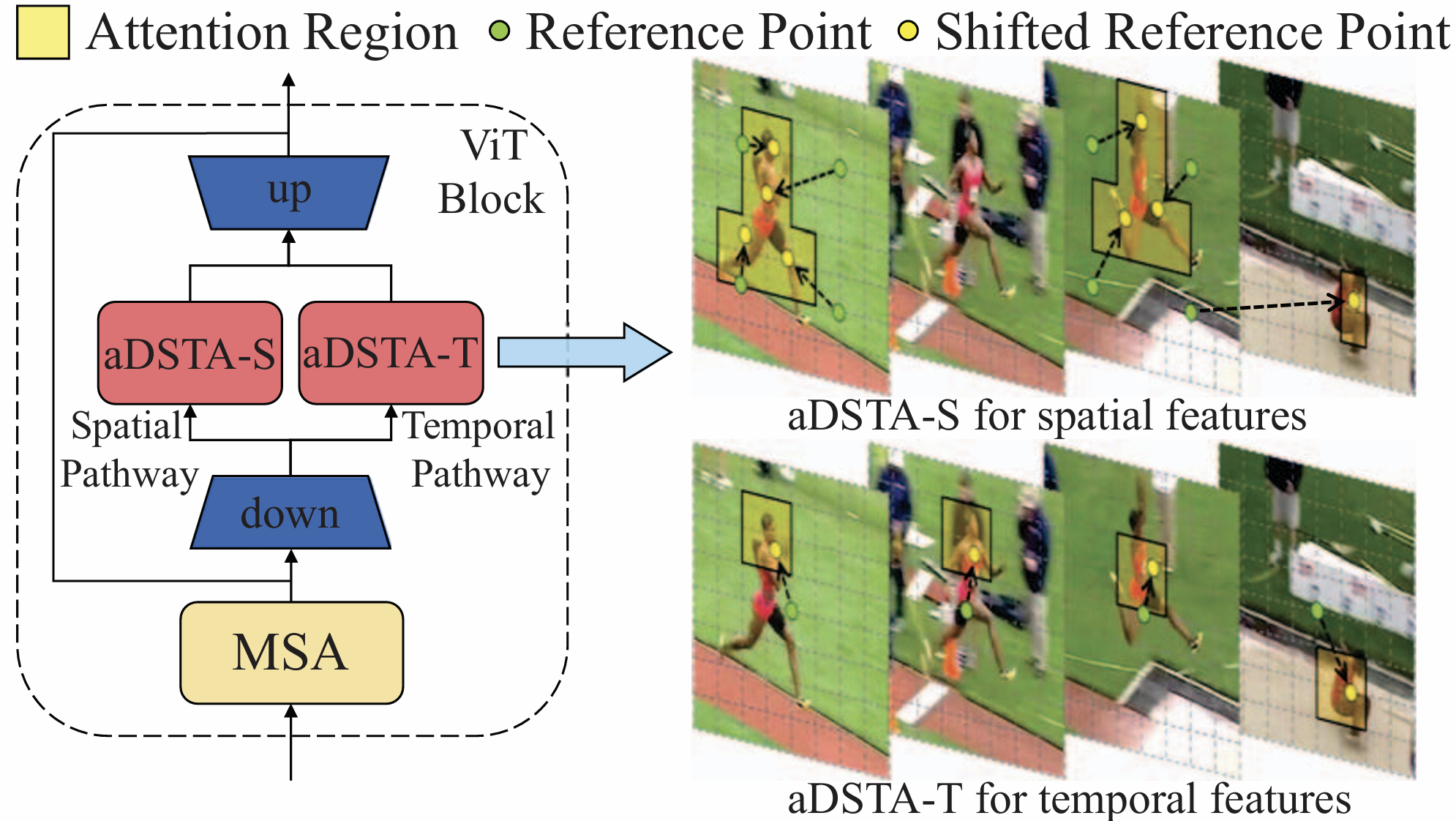
双路径解耦编码:瓶颈结构下采样后分空间、时序两条路径并行适配,空间抓外观语义、时序学动态变化,融合后上采样,保持单流结构
论文信息
- 论文:D2 ST-Adapter: Disentangled-and-Deformable Spatio-Temporal Adapter for Few-shot Action Recognition
- 出处:ICCV 2025
核心痛点
把预训练图像模型迁移到视频做小样本动作识别,全量微调易过拟合;AIM、DualPath 复制注意力分开预学空间和时序,架构重开销大;ST-Adapter 用 3D 卷积联合学时空,低数据场景不如解耦,浅层卷积感受野受限。
模块亮点
- 双路径解耦编码:瓶颈结构下采样后分空间、时序两条路径并行适配,空间抓外观语义、时序学动态变化,融合后上采样,保持单流结构
- 可变形时空注意力:核心算子 aDSTA 把 2D 可变形注意力扩展到 3D 时空,学偏移把采样挪到信息量大的区域做稀疏自注意力,全局又轻量;空间路径配 aDSTA-S,时序路径配 aDSTA-T
- 涨点又省参数:消融中 SSv2-Full 1-shot 比 ST-Adapter 高 4.8 个点(57.0 对 52.2),解耦贡献 1.5、aDSTA 再贡献 3.3;可调参数仅 7.3M、约为其他方法 14.3M 的一半
适用场景
领域为视频理解 / 小样本动作识别,原文在五个基准、三种匹配度量上验证;可迁移到视频分类、检索、时序动作定位等图像模型迁移到视频的任务。
插入位置建议
- 插进预训练图像骨干中间层,ViT 每层一个、ResNet 每个 stage 一个,骨干冻结只训适配器
- 直接替换 AIM、ST-Adapter 等已有视频适配器,输入输出都是 token 序列、形状不变
- 作为参数高效微调组件接进 CLIP-ViT 等大规模图像模型,配合 ProtoNet 类度量框架做小样本视频分类
适用任务
- 视频理解
- 小样本动作识别
- 原文在五个基准
完整代码
d2st-adapter.py
"""42_D2STAdapter_ICCV2025: 官方核心模块的单文件提取。

官方源码: https://github.com/qizhongtan/D2ST-Adapter/blob/bc99d4f2d52ac2193bced88a5d2aa00b3cb9e75d/models/base/adapter.py
源码 SHA256: e5340e52f93b5dd99ed7ffaa90f6027d001e700fcbb607af2881cc8d50bcdc9e
提取核心: LayerNormProxy, ViT_DeformAttention, ViT_D2ST_Adapter
整理说明: 完整保留论文双路径时空解耦与各向异性可变形采样注意力;去除 ResNet/CLIP 整体模型。输入 [1+H*W,B*T,C] 含 CLS,H,W 至少7、T至少4。
形状验证只说明接口可用,不代表已复现论文指标。初始化/辅助输入遵循原仓库;
需要语义特征、掩码、时间等条件的模块不能省略对应条件。
"""
from __future__ import annotations

# Upstream repository license: LICENSE
#                                  Apache License
#                            Version 2.0, January 2004
#                         http://www.apache.org/licenses/
#
#    TERMS AND CONDITIONS FOR USE, REPRODUCTION, AND DISTRIBUTION
#
#    1. Definitions.
#
#       "License" shall mean the terms and conditions for use, reproduction,
#       and distribution as defined by Sections 1 through 9 of this document.
#
#       "Licensor" shall mean the copyright owner or entity authorized by
#       the copyright owner that is granting the License.
#
#       "Legal Entity" shall mean the union of the acting entity and all
#       other entities that control, are controlled by, or are under common
#       control with that entity. For the purposes of this definition,
#       "control" means (i) the power, direct or indirect, to cause the
#       direction or management of such entity, whether by contract or
#       otherwise, or (ii) ownership of fifty percent (50%) or more of the
#       outstanding shares, or (iii) beneficial ownership of such entity.
#
#       "You" (or "Your") shall mean an individual or Legal Entity
#       exercising permissions granted by this License.
#
#       "Source" form shall mean the preferred form for making modifications,
#       including but not limited to software source code, documentation
#       source, and configuration files.
#
#       "Object" form shall mean any form resulting from mechanical
#       transformation or translation of a Source form, including but
#       not limited to compiled object code, generated documentation,
#       and conversions to other media types.
#
#       "Work" shall mean the work of authorship, whether in Source or
#       Object form, made available under the License, as indicated by a
#       copyright notice that is included in or attached to the work
#       (an example is provided in the Appendix below).
#
#       "Derivative Works" shall mean any work, whether in Source or Object
#       form, that is based on (or derived from) the Work and for which the
#       editorial revisions, annotations, elaborations, or other modifications
#       represent, as a whole, an original work of authorship. For the purposes
#       of this License, Derivative Works shall not include works that remain
#       separable from, or merely link (or bind by name) to the interfaces of,
#       the Work and Derivative Works thereof.
#
#       "Contribution" shall mean any work of authorship, including
#       the original version of the Work and any modifications or additions
#       to that Work or Derivative Works thereof, that is intentionally
#       submitted to Licensor for inclusion in the Work by the copyright owner
#       or by an individual or Legal Entity authorized to submit on behalf of
#       the copyright owner. For the purposes of this definition, "submitted"
#       means any form of electronic, verbal, or written communication sent
#       to the Licensor or its representatives, including but not limited to
#       communication on electronic mailing lists, source code control systems,
#       and issue tracking systems that are managed by, or on behalf of, the
#       Licensor for the purpose of discussing and improving the Work, but
#       excluding communication that is conspicuously marked or otherwise
#       designated in writing by the copyright owner as "Not a Contribution."
#
#       "Contributor" shall mean Licensor and any individual or Legal Entity
#       on behalf of whom a Contribution has been received by Licensor and
#       subsequently incorporated within the Work.
#
#    2. Grant of Copyright License. Subject to the terms and conditions of
#       this License, each Contributor hereby grants to You a perpetual,
#       worldwide, non-exclusive, no-charge, royalty-free, irrevocable
#       copyright license to reproduce, prepare Derivative Works of,
#       publicly display, publicly perform, sublicense, and distribute the
#       Work and such Derivative Works in Source or Object form.
#
#    3. Grant of Patent License. Subject to the terms and conditions of
#       this License, each Contributor hereby grants to You a perpetual,
#       worldwide, non-exclusive, no-charge, royalty-free, irrevocable
#       (except as stated in this section) patent license to make, have made,
#       use, offer to sell, sell, import, and otherwise transfer the Work,
#       where such license applies only to those patent claims licensable
#       by such Contributor that are necessarily infringed by their
#       Contribution(s) alone or by combination of their Contribution(s)
#       with the Work to which such Contribution(s) was submitted. If You
#       institute patent litigation against any entity (including a
#       cross-claim or counterclaim in a lawsuit) alleging that the Work
#       or a Contribution incorporated within the Work constitutes direct
#       or contributory patent infringement, then any patent licenses
#       granted to You under this License for that Work shall terminate
#       as of the date such litigation is filed.
#
#    4. Redistribution. You may reproduce and distribute copies of the
#       Work or Derivative Works thereof in any medium, with or without
#       modifications, and in Source or Object form, provided that You
#       meet the following conditions:
#
#       (a) You must give any other recipients of the Work or
#           Derivative Works a copy of this License; and
#
#       (b) You must cause any modified files to carry prominent notices
#           stating that You changed the files; and
#
#       (c) You must retain, in the Source form of any Derivative Works
#           that You distribute, all copyright, patent, trademark, and
#           attribution notices from the Source form of the Work,
#           excluding those notices that do not pertain to any part of
#           the Derivative Works; and
#
#       (d) If the Work includes a "NOTICE" text file as part of its
#           distribution, then any Derivative Works that You distribute must
#           include a readable copy of the attribution notices contained
#           within such NOTICE file, excluding those notices that do not
#           pertain to any part of the Derivative Works, in at least one
#           of the following places: within a NOTICE text file distributed
#           as part of the Derivative Works; within the Source form or
#           documentation, if provided along with the Derivative Works; or,
#           within a display generated by the Derivative Works, if and
#           wherever such third-party notices normally appear. The contents
#           of the NOTICE file are for informational purposes only and
#           do not modify the License. You may add Your own attribution
#           notices within Derivative Works that You distribute, alongside
#           or as an addendum to the NOTICE text from the Work, provided
#           that such additional attribution notices cannot be construed
#           as modifying the License.
#
#       You may add Your own copyright statement to Your modifications and
#       may provide additional or different license terms and conditions
#       for use, reproduction, or distribution of Your modifications, or
#       for any such Derivative Works as a whole, provided Your use,
#       reproduction, and distribution of the Work otherwise complies with
#       the conditions stated in this License.
#
#    5. Submission of Contributions. Unless You explicitly state otherwise,
#       any Contribution intentionally submitted for inclusion in the Work
#       by You to the Licensor shall be under the terms and conditions of
#       this License, without any additional terms or conditions.
#       Notwithstanding the above, nothing herein shall supersede or modify
#       the terms of any separate license agreement you may have executed
#       with Licensor regarding such Contributions.
#
#    6. Trademarks. This License does not grant permission to use the trade
#       names, trademarks, service marks, or product names of the Licensor,
#       except as required for reasonable and customary use in describing the
#       origin of the Work and reproducing the content of the NOTICE file.
#
#    7. Disclaimer of Warranty. Unless required by applicable law or
#       agreed to in writing, Licensor provides the Work (and each
#       Contributor provides its Contributions) on an "AS IS" BASIS,
#       WITHOUT WARRANTIES OR CONDITIONS OF ANY KIND, either express or
#       implied, including, without limitation, any warranties or conditions
#       of TITLE, NON-INFRINGEMENT, MERCHANTABILITY, or FITNESS FOR A
#       PARTICULAR PURPOSE. You are solely responsible for determining the
#       appropriateness of using or redistributing the Work and assume any
#       risks associated with Your exercise of permissions under this License.
#
#    8. Limitation of Liability. In no event and under no legal theory,
#       whether in tort (including negligence), contract, or otherwise,
#       unless required by applicable law (such as deliberate and grossly
#       negligent acts) or agreed to in writing, shall any Contributor be
#       liable to You for damages, including any direct, indirect, special,
#       incidental, or consequential damages of any character arising as a
#       result of this License or out of the use or inability to use the
#       Work (including but not limited to damages for loss of goodwill,
#       work stoppage, computer failure or malfunction, or any and all
#       other commercial damages or losses), even if such Contributor
#       has been advised of the possibility of such damages.
#
#    9. Accepting Warranty or Additional Liability. While redistributing
#       the Work or Derivative Works thereof, You may choose to offer,
#       and charge a fee for, acceptance of support, warranty, indemnity,
#       or other liability obligations and/or rights consistent with this
#       License. However, in accepting such obligations, You may act only
#       on Your own behalf and on Your sole responsibility, not on behalf
#       of any other Contributor, and only if You agree to indemnify,
#       defend, and hold each Contributor harmless for any liability
#       incurred by, or claims asserted against, such Contributor by reason
#       of your accepting any such warranty or additional liability.
#
#    END OF TERMS AND CONDITIONS
#
#    APPENDIX: How to apply the Apache License to your work.
#
#       To apply the Apache License to your work, attach the following
#       boilerplate notice, with the fields enclosed by brackets "[]"
#       replaced with your own identifying information. (Don't include
#       the brackets!)  The text should be enclosed in the appropriate
#       comment syntax for the file format. We also recommend that a
#       file or class name and description of purpose be included on the
#       same "printed page" as the copyright notice for easier
#       identification within third-party archives.
#
#    Copyright [yyyy] [name of copyright owner]
#
#    Licensed under the Apache License, Version 2.0 (the "License");
#    you may not use this file except in compliance with the License.
#    You may obtain a copy of the License at
#
#        http://www.apache.org/licenses/LICENSE-2.0
#
#    Unless required by applicable law or agreed to in writing, software
#    distributed under the License is distributed on an "AS IS" BASIS,
#    WITHOUT WARRANTIES OR CONDITIONS OF ANY KIND, either express or implied.
#    See the License for the specific language governing permissions and
#    limitations under the License.
import torch
from torch import nn
import torch.nn.functional as F
import math
from torch import einsum
from einops import rearrange
from types import SimpleNamespace


class LayerNormProxy(nn.Module):

    def __init__(self, dim):
        super().__init__()
        self.norm = nn.LayerNorm(dim)

    def forward(self, x):
        x = rearrange(x, 'b c t h w -> b t h w c')
        x = self.norm(x)
        x = rearrange(x, 'b t h w c -> b c t h w')
        return x


class ViT_DeformAttention(nn.Module):

    def __init__(self, cfg, dim, heads, groups, kernel_size, stride, padding):
        super().__init__()
        self.args = cfg
        self.dim = dim
        self.heads = heads
        self.head_channels = dim // heads
        self.scale = self.head_channels ** (-0.5)
        self.groups = groups
        self.group_channels = self.dim // self.groups
        self.group_heads = self.heads // self.groups
        self.factor = 2.0
        self.conv_offset = nn.Sequential(nn.Conv3d(in_channels=self.group_channels, out_channels=self.group_channels, kernel_size=kernel_size, stride=stride, padding=padding, groups=self.group_channels), LayerNormProxy(self.group_channels), nn.GELU(), nn.Conv3d(in_channels=self.group_channels, out_channels=3, kernel_size=(1, 1, 1), bias=False))
        self.proj_q = nn.Linear(in_features=self.dim, out_features=self.dim)
        self.proj_k = nn.Linear(in_features=self.dim, out_features=self.dim)
        self.proj_v = nn.Linear(in_features=self.dim, out_features=self.dim)
        self.proj_out = nn.Linear(in_features=self.dim, out_features=self.dim)

    @torch.no_grad()
    def _get_ref_points(self, T, H, W, B, dtype, device):
        ref_z, ref_y, ref_x = torch.meshgrid(torch.linspace(0.5, T - 0.5, T, dtype=dtype, device=device), torch.linspace(0.5, H - 0.5, H, dtype=dtype, device=device), torch.linspace(0.5, W - 0.5, W, dtype=dtype, device=device))
        ref = torch.stack((ref_z, ref_y, ref_x), -1)
        ref[..., 0].div_(T).mul_(2).sub_(1)
        ref[..., 1].div_(H).mul_(2).sub_(1)
        ref[..., 2].div_(W).mul_(2).sub_(1)
        ref = ref[None, ...].expand(B * self.groups, -1, -1, -1, -1)
        return ref

    def forward(self, x):
        n, BT, C = x.shape
        T = self.args.DATA.NUM_INPUT_FRAMES
        B = BT // T
        H = round(math.sqrt(n - 1))
        dtype, device = (x.dtype, x.device)
        q = self.proj_q(x)
        q_off = rearrange(q[1:, :, :], '(h w) (b t) c -> b c t h w', h=H, t=T)
        q_off = rearrange(q_off, 'b (g c) t h w -> (b g) c t h w', g=self.groups, c=self.group_channels)
        offset = self.conv_offset(q_off)
        Tp, Hp, Wp = (offset.size(2), offset.size(3), offset.size(4))
        n_sample = Tp * Hp * Wp
        offset_range = torch.tensor([min(1.0, self.factor / Tp), min(1.0, self.factor / Hp), min(1.0, self.factor / Wp)], device=device).reshape(1, 3, 1, 1, 1)
        offset = offset.tanh().mul(offset_range)
        offset = rearrange(offset, 'b p t h w -> b t h w p')
        reference = self._get_ref_points(Tp, Hp, Wp, B, dtype, device)
        pos = offset + reference
        x_sampled = rearrange(x[1:, :, :], '(h w) (b t) c -> b c t h w', h=H, t=T)
        x_sampled = rearrange(x_sampled, 'b (g c) t h w -> (b g) c t h w', g=self.groups)
        x_sampled = F.grid_sample(input=x_sampled, grid=pos[..., (2, 1, 0)], mode='bilinear', align_corners=True)
        x_sampled = rearrange(x_sampled, '(b g) c t h w -> b (g c) t h w', g=self.groups)
        x_sampled = rearrange(x_sampled, 'b c t h w -> b (t h w) c')
        q = rearrange(q, 'n (b t) c -> b c (t n)', b=B)
        q = rearrange(q, 'b (h c) n -> (b h) c n', h=self.heads)
        k = self.proj_k(x_sampled)
        k = rearrange(k, 'b n (h c) -> (b h) c n', h=self.heads)
        v = self.proj_v(x_sampled)
        v = rearrange(v, 'b n (h c) -> (b h) c n', h=self.heads)
        attn = einsum('b c m, b c n -> b m n', q, k)
        attn = attn.mul(self.scale)
        attn = F.softmax(attn, dim=-1)
        out = einsum('b m n, b c n -> b c m', attn, v)
        out = rearrange(out, '(b h) c n -> b (h c) n', h=self.heads)
        out = rearrange(out, 'b c (t n) -> n (b t) c', t=T)
        out = self.proj_out(out)
        return out


class ViT_D2ST_Adapter(nn.Module):

    def __init__(self, cfg):
        super().__init__()
        self.args = cfg
        self.in_channels = cfg.ADAPTER.WIDTH
        self.out_channels = cfg.ADAPTER.WIDTH
        self.adapter_channels = int(cfg.ADAPTER.WIDTH * cfg.ADAPTER.ADAPTER_SCALE)
        self.down = nn.Linear(in_features=self.in_channels, out_features=self.adapter_channels)
        self.gelu1 = nn.GELU()
        self.pos_embed = nn.Conv3d(in_channels=self.adapter_channels, out_channels=self.adapter_channels, kernel_size=(3, 3, 3), stride=(1, 1, 1), padding=(1, 1, 1), groups=self.adapter_channels)
        self.s_ln = nn.LayerNorm(normalized_shape=self.adapter_channels)
        self.s_attn = ViT_DeformAttention(cfg=cfg, dim=self.adapter_channels, heads=4, groups=4, kernel_size=(4, 5, 5), stride=(4, 3, 3), padding=(0, 0, 0))
        self.t_ln = nn.LayerNorm(normalized_shape=self.adapter_channels)
        self.t_attn = ViT_DeformAttention(cfg=cfg, dim=self.adapter_channels, heads=4, groups=4, kernel_size=(1, 7, 7), stride=(1, 7, 7), padding=(0, 0, 0))
        self.gelu = nn.GELU()
        self.up = nn.Linear(in_features=self.adapter_channels, out_features=self.out_channels)
        self.gelu2 = nn.GELU()

    def forward(self, x):
        n, bt, c = x.shape
        H = round(math.sqrt(n - 1))
        x_in = x
        x = self.down(x)
        x = self.gelu1(x)
        cls = x[0, :, :].unsqueeze(0)
        x = x[1:, :, :]
        x = rearrange(x, '(h w) (b t) c -> b c t h w', t=self.args.DATA.NUM_INPUT_FRAMES, h=H)
        x = x + self.pos_embed(x)
        x = rearrange(x, 'b c t h w -> (h w) (b t) c')
        x = torch.cat([cls, x], dim=0)
        xs = x + self.s_attn(self.s_ln(x))
        xt = x + self.t_attn(self.t_ln(x))
        x = (xs + xt) / 2
        x = self.gelu(x)
        x = self.up(x)
        x = self.gelu2(x)
        x += x_in
        return x


def main():
    """最小使用示例:创建模块,验证输入与输出形状。"""
    torch.manual_seed(0)
    config = SimpleNamespace(DATA=SimpleNamespace(NUM_INPUT_FRAMES=4), ADAPTER=SimpleNamespace(WIDTH=32, ADAPTER_SCALE=0.5))
    module = ViT_D2ST_Adapter(config)
    input = torch.randn(50, 8, 32)
    output = module(input)
    assert input.shape == output.shape, (input.shape, output.shape)
    assert torch.isfinite(output).all(), "output contains NaN/Inf"
    print("input shape:", tuple(input.shape))
    print("output shape:", tuple(output.shape))
    return module, input, output


if __name__ == "__main__":
    main()
环境与依赖
Python 3.9+
继续浏览
下一篇DCTSA 基于DCT的时空注意力全频谱空间注意力:用固定不可学习的 DCT 基底卷积替代只对应最低频的全局平均池化,提取全频谱特征生成空间注意力图,跨时间步共享参数相关资源
模块2026-11-20
HgC 沙漏卷积
沙漏形感受野:按时间偏移量决定各时间戳的空间核大小(p·|i|+1),离锚定帧越远感受野越大,专治大位移线索错位
计算机视觉视频理解HgC
计算机视觉MIT
模块2026-11-20
TAdaConv 时间自适应卷积
逐帧校准卷积核:把第 t 帧卷积核因式分解为 Wt = αt · Wb,基权重 Wb 全帧共享、可学习,校准系数 αt 自适应生成,让 2D 卷积原地获得时序建模能力
计算机视觉视频理解TAdaConv
计算机视觉MIT
模块2026-11-20
AFW 自适应帧加权模块
按质量给帧打分:对每一帧特征估计"帧质量",经 Softmax 得到权重,动态突出信息量大的帧、压低模糊 / 遮挡帧
计算机视觉姿态估计AFW
计算机视觉MIT