模块更新于 2026-11-20· 浏览 1· 下载 0
DEConv 细节增强卷积
五路卷积并联:vanilla 卷积提强度信息,中心差分 CDC、角度差分 ADC、水平差分 HDC、垂直差分 VDC 提梯度信息,把 Sobel 这类传统局部描述子先验显式编码进卷积层
结构图
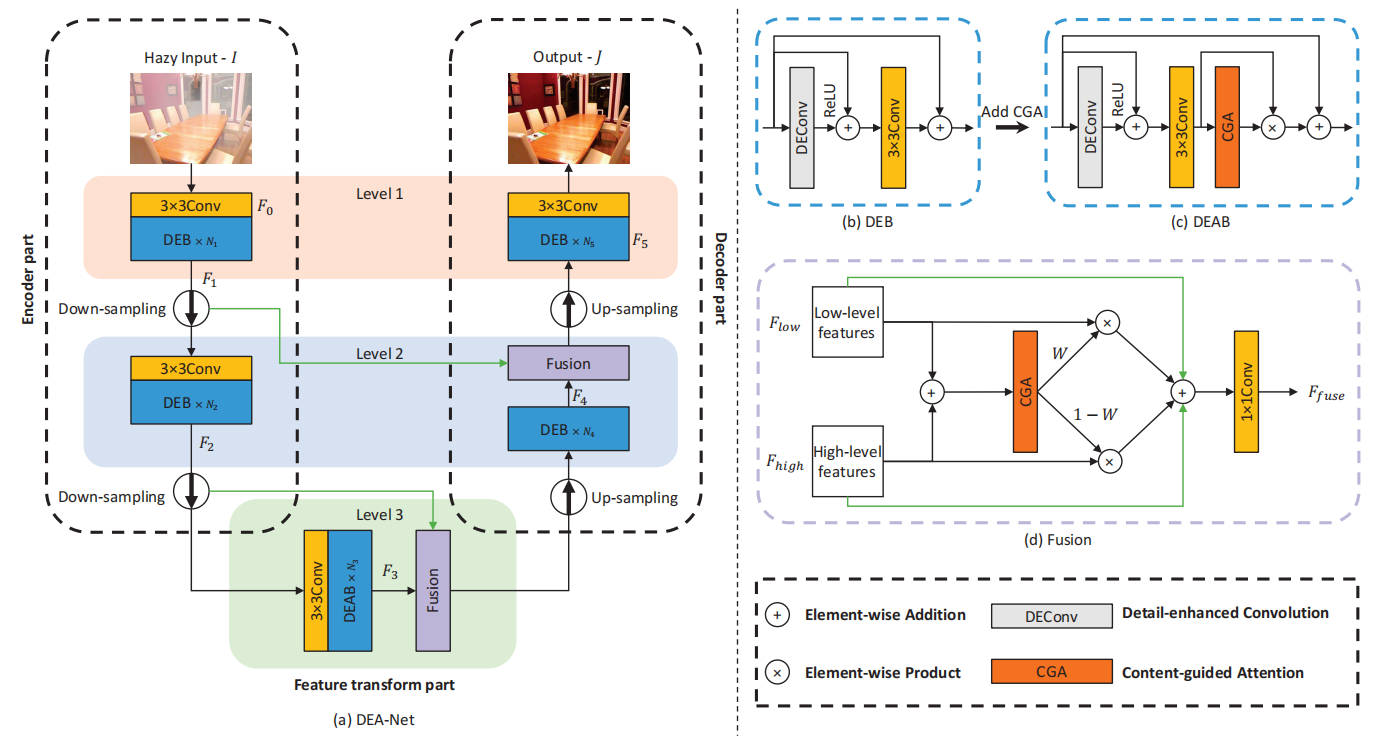
五路卷积并联:vanilla 卷积提强度信息,中心差分 CDC、角度差分 ADC、水平差分 HDC、垂直差分 VDC 提梯度信息,把 Sobel 这类传统局部描述子先验显式编码进卷积层
论文信息
- 论文:DEA-Net: Single image dehazing based on detail-enhanced convolution and content-guided attention
- 出处:arXiv 2023
核心痛点
单图去雾的 CNN 方法大多靠加深、加宽网络涨点,卷积算子本身没被充分挖掘:去雾最依赖的边缘、轮廓等高频细节,标准卷积并不显式建模;想借 Transformer 挖长距离依赖,代价又高。
模块亮点
- 五路卷积并联:vanilla 卷积提强度信息,中心差分 CDC、角度差分 ADC、水平差分 HDC、垂直差分 VDC 提梯度信息,把 Sobel 这类传统局部描述子先验显式编码进卷积层
- 消融涨点明确:SOTS-Indoor 上把 RB、FAB 里的第一个普通卷积换成 DEConv,PSNR 分别提升 0.27 dB 和 0.6 dB——涨点来自差分先验,不是堆参数
- 重参数化零成本:推理时把 5 个卷积核等价合并成一个 3×3 普通卷积,参数量从 4505K 降到 2143K,PSNR 保持 33.67 dB 不掉
适用场景
领域为底层视觉 / 单图去雾,原文在 RESIDE 及真实雾图上验证;同样适合去噪、去雨、超分等细节敏感的复原任务,以及想给卷积注入先验又不想增加部署开销的 2D 视觉网络。
插入位置建议
- 替换复原网络基础块(残差块 RB、FFA-Net 的 FAB 等)里的第一个 3×3 vanilla 卷积,原文就是这种替换方式
- 放在 U 型网络编码器和特征变换部分的基础块开头,原文 DEB / DEAB 块都以 DEConv 打头
- 与注意力串联组成新的基本块:DEConv 增强高频细节,注意力(原文 CGA)负责特征重标定
适用任务
- 底层视觉
- 单图去雾
- 原文在 RESIDE 及真实雾图上验证
完整代码
deconv.py
# https://github.com/cecret3350/DEA-Net/blob/main/code/model/modules/deconv.py

import math
import torch
from torch import nn
from einops.layers.torch import Rearrange

"""
在深度学习和图像处理领域,"vanilla" 和 "difference" 卷积是两种不同的卷积操作,它们各自有不同的特性和应用场景。DEConv(细节增强卷积)的设计思想是结合这两种卷积的特性来增强模型的性能,尤其是在图像去雾等任务中。

Vanilla Convolution(标准卷积)
"Vanilla" 卷积是最基本的卷积类型,通常仅称为卷积。它是卷积神经网络(CNN)中最常用的组件,用于提取输入数据(如图像)的特征。
标准卷积通过在输入数据上滑动小的、可学习的过滤器(或称为核),并计算过滤器与数据的局部区域之间的点乘,来工作。通过这种方式,它能够捕获输入数据的局部模式和特征。

Difference Convolution(差分卷积)
差分卷积是一种特殊类型的卷积,它专注于捕捉输入数据中的局部差异信息,例如边缘或纹理的变化。
它通过修改标准卷积核的权重或者通过特殊的操作来实现,使得网络更加关注于图像的高频信息,即图像中的细节和纹理变化。在图像处理任务中,如图像去雾、图像增强、边缘检测等,捕获这种高频信息非常重要,因为它们往往包含了关于物体边界和结构的关键信息。

重参数化技术
重参数化技术是一种参数转换方法,它允许模型在不增加额外参数和计算代价的情况下,实现更复杂的功能或改善性能。在DEConv的上下文中,重参数化技术使得将vanilla卷积和difference卷积结合起来的操作,可以等价地转换成一个标准的卷积操作。
这意味着DEConv可以在不增加额外参数和计算成本的情况下,通过巧妙地设计卷积核权重,同时利用标准卷积和差分卷积的优势,从而增强模型处理图像的能力。
具体来说,通过重参数化,可以将差分卷积的效果整合到一个卷积核中,使得这个卷积核既能捕获图像的基本特征(通过标准卷积部分),也能强调图像的细节和差异信息(通过差分卷积部分)。
这种方法特别适用于那些需要同时考虑全局内容和局部细节信息的任务,如图像去雾,其中既需要理解图像的整体结构,也需要恢复由于雾导致的细节丢失。
重参数化技术的关键优势在于,它允许模型在维持参数数量和计算复杂度不变的前提下,实现更为复杂或更为精细的功能。
"""


class Conv2d_cd(nn.Module):
    def __init__(self, in_channels, out_channels, kernel_size=3, stride=1,
                 padding=1, dilation=1, groups=1, bias=False, theta=1.0):
        super(Conv2d_cd, self).__init__()
        self.conv = nn.Conv2d(in_channels, out_channels, kernel_size=kernel_size, stride=stride, padding=padding,
                              dilation=dilation, groups=groups, bias=bias)
        self.theta = theta

    def get_weight(self):
        conv_weight = self.conv.weight
        conv_shape = conv_weight.shape
        conv_weight = Rearrange('c_in c_out k1 k2 -> c_in c_out (k1 k2)')(conv_weight)
        conv_weight_cd = torch.cuda.FloatTensor(conv_shape[0], conv_shape[1], 3 * 3).fill_(0)
        conv_weight_cd[:, :, :] = conv_weight[:, :, :]
        conv_weight_cd[:, :, 4] = conv_weight[:, :, 4] - conv_weight[:, :, :].sum(2)
        conv_weight_cd = Rearrange('c_in c_out (k1 k2) -> c_in c_out k1 k2', k1=conv_shape[2], k2=conv_shape[3])(
            conv_weight_cd)
        return conv_weight_cd, self.conv.bias


class Conv2d_ad(nn.Module):
    def __init__(self, in_channels, out_channels, kernel_size=3, stride=1,
                 padding=1, dilation=1, groups=1, bias=False, theta=1.0):
        super(Conv2d_ad, self).__init__()
        self.conv = nn.Conv2d(in_channels, out_channels, kernel_size=kernel_size, stride=stride, padding=padding,
                              dilation=dilation, groups=groups, bias=bias)
        self.theta = theta

    def get_weight(self):
        conv_weight = self.conv.weight
        conv_shape = conv_weight.shape
        conv_weight = Rearrange('c_in c_out k1 k2 -> c_in c_out (k1 k2)')(conv_weight)
        conv_weight_ad = conv_weight - self.theta * conv_weight[:, :, [3, 0, 1, 6, 4, 2, 7, 8, 5]]
        conv_weight_ad = Rearrange('c_in c_out (k1 k2) -> c_in c_out k1 k2', k1=conv_shape[2], k2=conv_shape[3])(
            conv_weight_ad)
        return conv_weight_ad, self.conv.bias


class Conv2d_rd(nn.Module):
    def __init__(self, in_channels, out_channels, kernel_size=3, stride=1,
                 padding=2, dilation=1, groups=1, bias=False, theta=1.0):

        super(Conv2d_rd, self).__init__()
        self.conv = nn.Conv2d(in_channels, out_channels, kernel_size=kernel_size, stride=stride, padding=padding,
                              dilation=dilation, groups=groups, bias=bias)
        self.theta = theta

    def forward(self, x):

        if math.fabs(self.theta - 0.0) < 1e-8:
            out_normal = self.conv(x)
            return out_normal
        else:
            conv_weight = self.conv.weight
            conv_shape = conv_weight.shape
            if conv_weight.is_cuda:
                conv_weight_rd = torch.cuda.FloatTensor(conv_shape[0], conv_shape[1], 5 * 5).fill_(0)
            else:
                conv_weight_rd = torch.zeros(conv_shape[0], conv_shape[1], 5 * 5)
            conv_weight = Rearrange('c_in c_out k1 k2 -> c_in c_out (k1 k2)')(conv_weight)
            conv_weight_rd[:, :, [0, 2, 4, 10, 14, 20, 22, 24]] = conv_weight[:, :, 1:]
            conv_weight_rd[:, :, [6, 7, 8, 11, 13, 16, 17, 18]] = -conv_weight[:, :, 1:] * self.theta
            conv_weight_rd[:, :, 12] = conv_weight[:, :, 0] * (1 - self.theta)
            conv_weight_rd = conv_weight_rd.view(conv_shape[0], conv_shape[1], 5, 5)
            out_diff = nn.functional.conv2d(input=x, weight=conv_weight_rd, bias=self.conv.bias,
                                            stride=self.conv.stride, padding=self.conv.padding, groups=self.conv.groups)

            return out_diff


class Conv2d_hd(nn.Module):
    def __init__(self, in_channels, out_channels, kernel_size=3, stride=1,
                 padding=1, dilation=1, groups=1, bias=False, theta=1.0):
        super(Conv2d_hd, self).__init__()
        self.conv = nn.Conv1d(in_channels, out_channels, kernel_size=kernel_size, stride=stride, padding=padding,
                              dilation=dilation, groups=groups, bias=bias)

    def get_weight(self):
        conv_weight = self.conv.weight
        conv_shape = conv_weight.shape
        conv_weight_hd = torch.cuda.FloatTensor(conv_shape[0], conv_shape[1], 3 * 3).fill_(0)
        conv_weight_hd[:, :, [0, 3, 6]] = conv_weight[:, :, :]
        conv_weight_hd[:, :, [2, 5, 8]] = -conv_weight[:, :, :]
        conv_weight_hd = Rearrange('c_in c_out (k1 k2) -> c_in c_out k1 k2', k1=conv_shape[2], k2=conv_shape[2])(
            conv_weight_hd)
        return conv_weight_hd, self.conv.bias


class Conv2d_vd(nn.Module):
    def __init__(self, in_channels, out_channels, kernel_size=3, stride=1,
                 padding=1, dilation=1, groups=1, bias=False):
        super(Conv2d_vd, self).__init__()
        self.conv = nn.Conv1d(in_channels, out_channels, kernel_size=kernel_size, stride=stride, padding=padding,
                              dilation=dilation, groups=groups, bias=bias)

    def get_weight(self):
        conv_weight = self.conv.weight
        conv_shape = conv_weight.shape
        conv_weight_vd = torch.cuda.FloatTensor(conv_shape[0], conv_shape[1], 3 * 3).fill_(0)
        conv_weight_vd[:, :, [0, 1, 2]] = conv_weight[:, :, :]
        conv_weight_vd[:, :, [6, 7, 8]] = -conv_weight[:, :, :]
        conv_weight_vd = Rearrange('c_in c_out (k1 k2) -> c_in c_out k1 k2', k1=conv_shape[2], k2=conv_shape[2])(
            conv_weight_vd)
        return conv_weight_vd, self.conv.bias


class DEConv(nn.Module):
    def __init__(self, dim):
        super(DEConv, self).__init__()
        self.conv1_1 = Conv2d_cd(dim, dim, 3, bias=True)
        self.conv1_2 = Conv2d_hd(dim, dim, 3, bias=True)
        self.conv1_3 = Conv2d_vd(dim, dim, 3, bias=True)
        self.conv1_4 = Conv2d_ad(dim, dim, 3, bias=True)
        self.conv1_5 = nn.Conv2d(dim, dim, 3, padding=1, bias=True)

    def forward(self, x):
        w1, b1 = self.conv1_1.get_weight()
        w2, b2 = self.conv1_2.get_weight()
        w3, b3 = self.conv1_3.get_weight()
        w4, b4 = self.conv1_4.get_weight()
        w5, b5 = self.conv1_5.weight, self.conv1_5.bias

        w = w1 + w2 + w3 + w4 + w5
        b = b1 + b2 + b3 + b4 + b5
        res = nn.functional.conv2d(input=x, weight=w, bias=b, stride=1, padding=1, groups=1)

        return res


if __name__ == '__main__':
    # 初始化DEConv模块,dim为输入和输出的通道数
    block = DEConv(dim=16).cuda()
    # 创建一个随机输入张量,假设输入尺寸为(batch_size, channels, height, width)
    input_tensor = torch.rand(4, 16, 64, 64).cuda()
    # 将输入传递给DEConv模块
    output_tensor = block(input_tensor)
    # 打印输入和输出张量的尺寸
    print("输入尺寸:", input_tensor.size())
    print("输出尺寸:", output_tensor.size())
环境与依赖
Python 3.9+
继续浏览
下一篇DFB 膨胀Transformer模块局部-全局交替:LS-MSA 把特征图划成不重叠单元、单元内做局部自注意力抓细节,GS-MSA 每隔 g 个 patch 采样拼成"膨胀单元"做全局自注意力,二者交替堆叠,细节和长程依赖全都要相关资源
模块2026-11-20
LEGM 局部特征嵌入全局特征提取模块
局部全局双路并行:卷积分支(3×3 卷积或 5×5 深度卷积)管局部细节,窗口自注意力管长程依赖,两路相加后投影输出
计算机视觉图像去雾LEGM
计算机视觉MIT
模块2026-11-20
SKF 选择性核融合模块
通道注意力选分支:借鉴 SKNet,各分支特征求和后经全局平均池化 + Linear-ReLU-Linear + Softmax,为每个通道、每个分支生成融合权重,逐通道自适应决定听纹理还是听语义,直接替换 Concat
计算机视觉图像复原SKF
计算机视觉MIT
模块2026-11-20
CoordGate 坐标门控模块
乘法门加坐标编码:特征图先过标准卷积,再与"坐标图经逐像素 MLP 编码"得到的门控图逐元素相乘,按空间位置选择性放大或衰减各通道滤波器,效果上相当于局部连接网络
计算机视觉图像复原CoordGate
计算机视觉MIT