模块更新于 2026-11-20· 浏览 3· 下载 1
DF 动态滤波器
内容感知动态滤波:在频域维护一组复数滤波器基(N=4),MLP 按输入内容给出 Softmax 系数,逐通道线性组合出专属全局滤波器,让 FFT token 混合器也具备数据依赖性
结构图
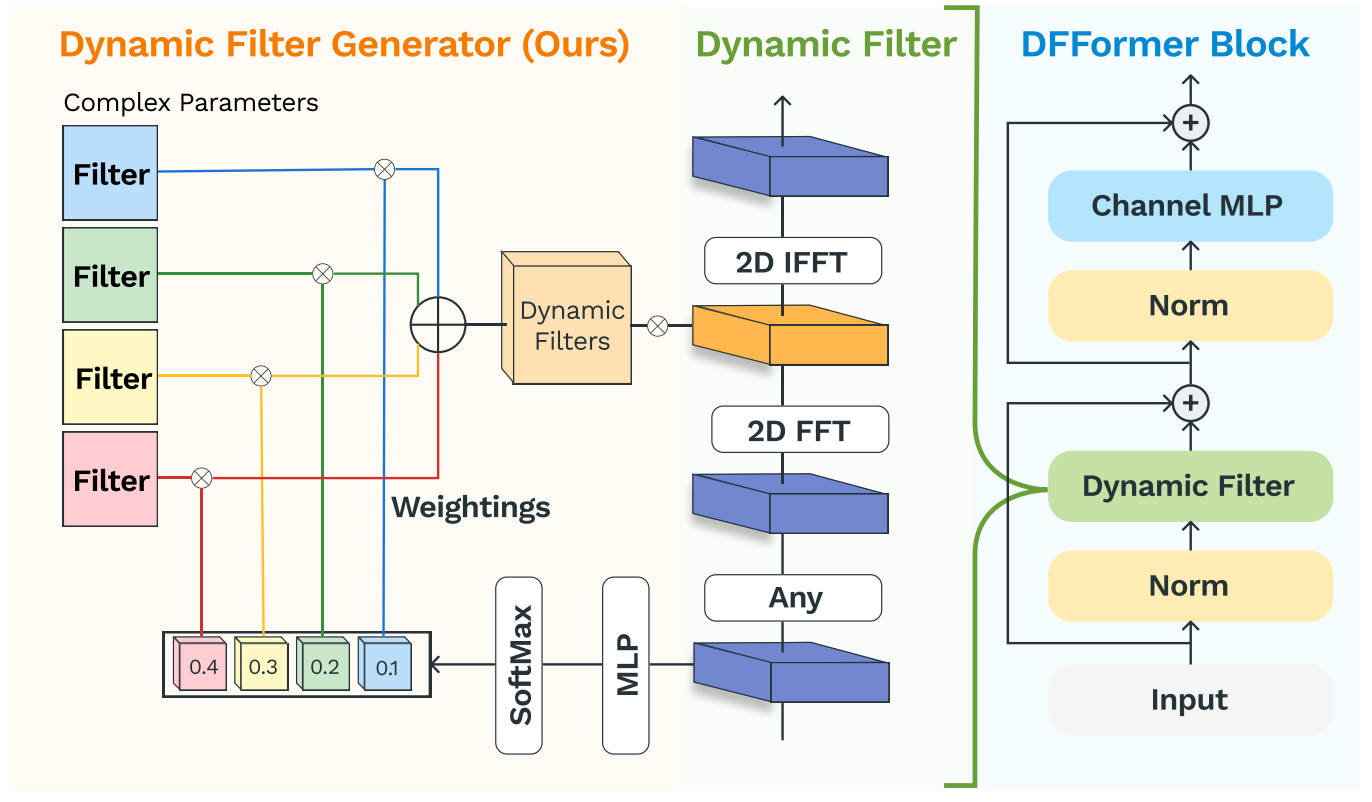
内容感知动态滤波:在频域维护一组复数滤波器基(N=4),MLP 按输入内容给出 Softmax 系数,逐通道线性组合出专属全局滤波器,让 FFT token 混合器也具备数据依赖性
论文信息
- 论文:FFT-based Dynamic Token Mixer for Vision
- 出处:AAAI 2024
核心痛点
MHSA 计算复杂度随像素数二次增长,处理高分辨率图像又慢又费显存;GFNet 这类 FFT 全局滤波器复杂度虽低,但滤波器是静态参数、缺乏数据依赖,也没对齐 MetaFormer 架构,精度追不上注意力模型。
模块亮点
- 内容感知动态滤波:在频域维护一组复数滤波器基(N=4),MLP 按输入内容给出 Softmax 系数,逐通道线性组合出专属全局滤波器,让 FFT token 混合器也具备数据依赖性
- 涨点实打实:DFFormer-S18 在 ImageNet-1K 达 83.2% top-1,换成静态全局滤波器降到 82.9%;DFFormer-B36 以 115M 参数拿到 84.8%,比其他 FFT 类模型高 0.5% 以上
- 高分辨率快又省:FLOPs 与静态全局滤波器几乎不变;分辨率升高后吞吐和峰值显存仍与 ConvFormer 相当,带注意力的 CAFormer 则明显劣化
适用场景
领域为 CV 二维图像的频域 token 混合器(MetaFormer 骨干);原文实验覆盖 ImageNet-1K 图像分类、ADE20K 语义分割、COCO 目标检测;可迁移到各类高分辨率密集预测与需要全局建模的视觉骨干。
插入位置建议
- 替换 MetaFormer 块中的 token-mixer(Norm 之后、通道 MLP 之前)
- 参照 CDFFormer 的混合设计,浅层用卷积块、深层换成动态滤波器
- 检测分割等变分辨率任务中,开启 weight_resize 对滤波器基做插值,适配任意尺寸特征图
适用任务
- CV 二维图像的频域 token 混合器
完整代码
dynamic-filter.py
import torch
import torch.nn as nn
from timm.layers.helpers import to_2tuple

"""
配备多头自注意力 (MHSA) 的模型在计算机视觉方面取得了显着的性能。它们的计算复杂度与输入特征图中的二次像素数成正比,导致处理速度缓慢,尤其是在处理高分辨率图像时。
为了规避这个问题,提出了一种新型的代币混合器作为MHSA的替代方案:基于FFT的代币混合器涉及类似于MHSA的全局操作,但计算复杂度较低。
在这里,我们提出了一种名为动态过滤器的新型令牌混合器以缩小上述差距。
DynamicFilter 模块通过频域滤波和动态调整滤波器权重,能够对图像进行复杂的增强和处理。
"""

class StarReLU(nn.Module):
    """
    StarReLU: s * relu(x) ** 2 + b
    """

    def __init__(self, scale_value=1.0, bias_value=0.0,
                 scale_learnable=True, bias_learnable=True,
                 mode=None, inplace=False):
        super().__init__()
        self.inplace = inplace
        self.relu = nn.ReLU(inplace=inplace)
        self.scale = nn.Parameter(scale_value * torch.ones(1),
                                  requires_grad=scale_learnable)
        self.bias = nn.Parameter(bias_value * torch.ones(1),
                                 requires_grad=bias_learnable)

    def forward(self, x):
        return self.scale * self.relu(x) ** 2 + self.bias

class Mlp(nn.Module):
    """ MLP as used in MetaFormer models, eg Transformer, MLP-Mixer, PoolFormer, MetaFormer baslines and related networks.
    Mostly copied from timm.
    """

    def __init__(self, dim, mlp_ratio=4, out_features=None, act_layer=StarReLU, drop=0.,
                 bias=False, **kwargs):
        super().__init__()
        in_features = dim
        out_features = out_features or in_features
        hidden_features = int(mlp_ratio * in_features)
        drop_probs = to_2tuple(drop)

        self.fc1 = nn.Linear(in_features, hidden_features, bias=bias)
        self.act = act_layer()
        self.drop1 = nn.Dropout(drop_probs[0])
        self.fc2 = nn.Linear(hidden_features, out_features, bias=bias)
        self.drop2 = nn.Dropout(drop_probs[1])

    def forward(self, x):
        x = self.fc1(x)
        x = self.act(x)
        x = self.drop1(x)
        x = self.fc2(x)
        x = self.drop2(x)
        return x


class DynamicFilter(nn.Module):
    def __init__(self, dim, expansion_ratio=2, reweight_expansion_ratio=.25,
                 act1_layer=StarReLU, act2_layer=nn.Identity,
                 bias=False, num_filters=4, size=14, weight_resize=False,
                 **kwargs):
        super().__init__()
        size = to_2tuple(size)
        self.size = size[0]
        self.filter_size = size[1] // 2 + 1
        self.num_filters = num_filters
        self.dim = dim
        self.med_channels = int(expansion_ratio * dim)
        self.weight_resize = weight_resize
        self.pwconv1 = nn.Linear(dim, self.med_channels, bias=bias)
        self.act1 = act1_layer()
        self.reweight = Mlp(dim, reweight_expansion_ratio, num_filters * self.med_channels)
        self.complex_weights = nn.Parameter(
            torch.randn(self.size, self.filter_size, num_filters, 2,
                        dtype=torch.float32) * 0.02)
        self.act2 = act2_layer()
        self.pwconv2 = nn.Linear(self.med_channels, dim, bias=bias)

    def forward(self, x):
        B, H, W, _ = x.shape

        routeing = self.reweight(x.mean(dim=(1, 2))).view(B, self.num_filters,
                                                          -1).softmax(dim=1)
        x = self.pwconv1(x)
        x = self.act1(x)
        x = x.to(torch.float32)
        x = torch.fft.rfft2(x, dim=(1, 2), norm='ortho')

        if self.weight_resize:
            complex_weights = resize_complex_weight(self.complex_weights, x.shape[1],
                                                    x.shape[2])
            complex_weights = torch.view_as_complex(complex_weights.contiguous())
        else:
            complex_weights = torch.view_as_complex(self.complex_weights)
        routeing = routeing.to(torch.complex64)
        weight = torch.einsum('bfc,hwf->bhwc', routeing, complex_weights)
        if self.weight_resize:
            weight = weight.view(-1, x.shape[1], x.shape[2], self.med_channels)
        else:
            weight = weight.view(-1, self.size, self.filter_size, self.med_channels)
        x = x * weight
        x = torch.fft.irfft2(x, s=(H, W), dim=(1, 2), norm='ortho')

        x = self.act2(x)
        x = self.pwconv2(x)
        return x


if __name__ == '__main__':
    block = DynamicFilter(32, size=64) # size==H,W
    input = torch.rand(3, 64, 64, 32)
    output = block(input)
    print(input.size())
    print(output.size())
环境与依赖
Python 3.9+
继续浏览
下一篇DyT 动态Tanh一行公式替归一化:DyT(x) = γ·tanh(αx) + β,纯逐元素操作、不算统计量;灵感是 LN 的输入-输出映射就是一条 tanh 形 S 曲线,α 是可学习标量相关资源
模块2026-11-20
CBAM 卷积块注意力模块
双池化通道注意力:通道分支同时用平均池化和最大池化聚合空间信息,过共享 MLP 后逐元素相加,最大池化补平均池化的不足;
计算机视觉注意力机制CBAM
计算机视觉MIT
模块2026-11-20
CRAT 交叉注意力多尺度融合模块
CLS当融合代理:本分支的 CLS token 作为唯一 query,与另一分支全部 patch token 做多头交叉注意力,吸收另一尺度信息后投影回本分支;计算和内存都是线性而非平方,开销极小
计算机视觉图像分类CRAT
计算机视觉MIT
模块2026-11-20
SCSA 空间与通道协同注意力
空间引导通道:SMSA 把特征沿 H/W 解耦成 4 个子特征,用 3/5/7/9 多尺度共享深度 1D 卷积提取多语义空间先验,注入 PCSA 的通道自注意力指导重校准,
计算机视觉注意力机制SCSA
计算机视觉MIT