模块更新于 2026-11-20· 浏览 5· 下载 0
GEA 图外部注意力
图间共享记忆:用与输入图无关的可学习外部 key-value 单元充当所有图共享的“记忆库”,节点、边各配一套,特征只需与外部单元做注意力,即可隐式建模图间相关性,消融显示去掉任一外部单元都会掉点
结构图
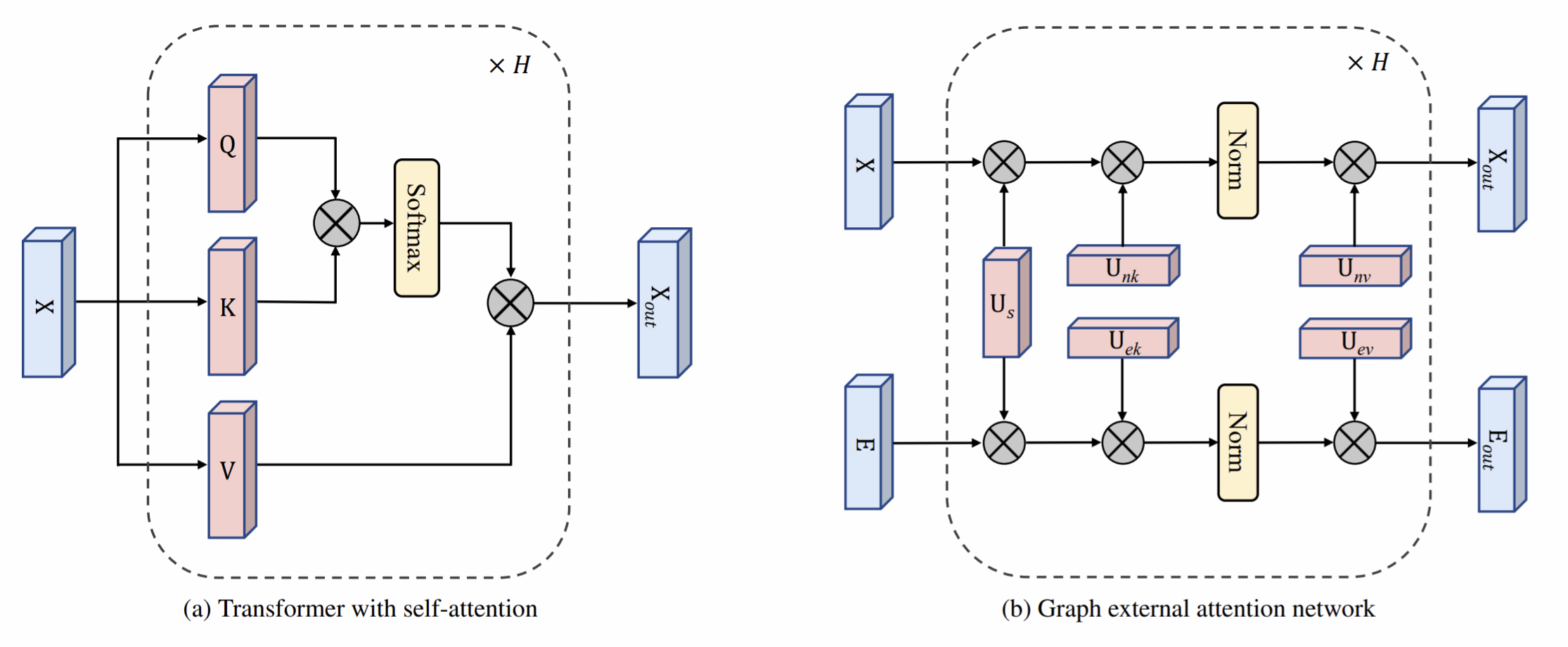
图间共享记忆:用与输入图无关的可学习外部 key-value 单元充当所有图共享的“记忆库”,节点、边各配一套,特征只需与外部单元做注意力,即可隐式建模图间相关性,消融显示去掉任一外部单元都会掉点
论文信息
- 论文:Graph External Attention Enhanced Transformer
- 出处:ICML 2024
核心痛点
消息传递 GNN 有表达力受限、过平滑、过挤压、长程依赖差等老毛病;图 Transformer 缓解了不少,但两者都只盯着单张图内部,忽略了图与图之间的相关性,白白浪费了数据集里图间的共性知识。
模块亮点
- 图间共享记忆:用与输入图无关的可学习外部 key-value 单元充当所有图共享的“记忆库”,节点、边各配一套,特征只需与外部单元做注意力,即可隐式建模图间相关性,消融显示去掉任一外部单元都会掉点
- 轻量省编码:GEA 对节点数、边数均为线性复杂度(自注意力随节点数二次增长);且更不依赖位置编码,注意力更稀疏、更聚焦 N、O 等关键原子
- 涨点明显:GEANet 输出与 GNN 输出直接组合、无需任何额外改动——GCN 在 MNIST 上准确率从 90.705% 提到 96.465%,GatedGCN 在 CIFAR10 上从 67.312% 提到 73.857%,GIN 在 ZINC 上 MAE 从 0.526 降到 0.193
适用场景
领域为图表示学习 / 图神经网络;原文验证了图分类、节点分类与分子 / 肽类回归(MNIST、CIFAR10、ZINC 等);可迁移到社交网络分析、药物发现、蛋白质设计等图数据任务。
插入位置建议
- 与 GCN、GIN、GatedGCN 等消息传递 GNN 并联,GEANet 输出与 GNN 输出直接组合
- 替换图 Transformer 中的全局自注意力分支,用线性复杂度的 GEA 捕捉全局与外部信息
- 照原文 GEAET 搭特征提取层:GEANet 管图间、GNN 管局部结构、自注意力管图内全局交互
适用任务
- 图表示学习
- 图神经网络
完整代码
gea.py
from torch import Tensor
from torch import nn, sum
import torch
from torch.nn import init

"""GEA(Graph External Attention)ICML2024
Transformer架构最近在图表示学习领域获得了相当大的关注,因为它自然地克服了图神经网络(GNN)的几个限制,具有定制的注意力机制或位置和结构编码。
尽管取得了一些进展,但现有的工作往往忽略了图的外部信息,特别是图之间的相关性。
直观地说,具有相似结构的图形应该具有相似的表示。因此,我们提出了图外部注意力(Graph External Attention,GEA)
一种新型的注意力机制,它利用多个外部节点/边缘键值单元来隐式捕获图间相关性。
在此基础上,我们设计了一种有效的架构,称为图外部注意力增强转换器(GEAET),该架构集成了局部结构和全局交互信息,
以实现更全面的图表示。在基准数据集上的广泛实验表明,GEAET实现了最先进的实证性能。
"""


def external_norm(attn):
    softmax = nn.Softmax(dim=0)  # N
    attn = softmax(attn)  # bs,n,S
    attn = attn /sum(attn, dim=2, keepdim=True)  # bs,n,S
    return attn


class DNorm(nn.Module):
    def __init__(
            self,
            dim1=0 ,dim2=2
    ):
        super().__init__()
        self.dim1 =dim1
        self.dim2 =dim2
        self.softmax = nn.Softmax(dim=self.dim1)  # N

    def forward(self, attn: Tensor) -> Tensor:
        # softmax = nn.Softmax(dim=0)  # N
        attn = self.softmax(attn)  # bs,n,S
        attn = attn /sum(attn, dim=self.dim2, keepdim=True)  # bs,n,S
        return attn

class GEANet(nn.Module):

    def __init__(
            self, dim, GEANet_cfg):
        super().__init__()


        self.dim = dim
        self.external_num_heads = GEANet_cfg.n_heads
        self.use_shared_unit = GEANet_cfg.shared_unit
        self.use_edge_unit = GEANet_cfg.edge_unit
        self.unit_size = GEANet_cfg.unit_size

        # self.q_Linear = nn.Linear(in_dim, gconv_dim - dim_pe)
        self.node_U1 = nn.Linear(self.unit_size, self.unit_size)
        self.node_U2 = nn.Linear(self.unit_size, self.unit_size)

        assert self.unit_size * self.external_num_heads == self.dim, "dim must be divisible by external_num_heads"

        # nn.init.xavier_normal_(self.node_m1.weight, gain=1)
        # nn.init.xavier_normal_(self.node_m2.weight, gain=1)
        if  self.use_edge_unit:
            self.edge_U1 = nn.Linear(self.unit_size, self.unit_size)
            self.edge_U2 = nn.Linear(self.unit_size, self.unit_size)
            if self.use_shared_unit:
                self.share_U = nn.Linear(dim, dim)

            # nn.init.xavier_normal_(self.edge_m1.weight, gain=1)
            # nn.init.xavier_normal_(self.edge_m2.weight, gain=1)
            # nn.init.xavier_normal_(self.share_m.weight, gain=1)
        self.norm = DNorm()

        # self.init_weights()


    def init_weights(self):
        for m in self.modules():
            if isinstance(m, nn.Linear):
                init.normal_(m.weight, std=0.001)
                if m.bias is not None:
                    init.constant_(m.bias, 0)


    def forward(self, node_x ,edge_attr = None) -> Tensor:
        if self.use_shared_unit:
            node_x = self.share_U(node_x)
            edge_attr = self.share_U(edge_attr)
        # x : N x 64
        # External attention
        N, d, head = node_x.size()[0], node_x.size()[1], self.external_num_heads
        node_out = node_x.reshape(N, head ,-1)  # Q * 4(head)  :  N x 16 x 4(head)
        # node_out = node_out.transpose(1, 2)  # (N, 16, 4) -> (N, 4, 16)
        node_out = self.node_U1(node_out)
        attn = self.norm(node_out)  # 行列归一化  N x 16 x 4
        node_out = self.node_U2(attn)
        node_out = node_out.reshape(N, -1)

        if self.use_edge_unit:

            N, d, head = edge_attr.size()[0], edge_attr.size()[1], self.external_num_heads
            edge_out = edge_attr.reshape(N, -1, head)  # Q * 4(head)  :  N x 16 x 4(head)
            edge_out = edge_out.transpose(1, 2)  # (N, 16, 4) -> (N, 4, 16)
            edge_out = self.edge_U1(edge_out)
            attn = self.norm(edge_out)  # 行列归一化  N x 16 x 4
            edge_out = self.edge_U2(attn)
            edge_out = edge_out.reshape(N, -1)
        else:
            edge_out = edge_attr

        return node_out ,edge_out


class GEANetConfig:
    def __init__(self, n_heads, shared_unit, edge_unit, unit_size):
        self.n_heads = n_heads
        self.shared_unit = shared_unit
        self.edge_unit = edge_unit
        self.unit_size = unit_size


if __name__ == '__main__':
    config = GEANetConfig(
        n_heads=4,
        shared_unit=True,
        edge_unit=True,
        unit_size=16
    )

    dim = 64

    block = GEANet(dim, config)

    node_input = torch.rand(10, dim)
    edge_input = torch.rand(10, dim)

    node_output, edge_output = block(node_input, edge_input)

    print("Node input size:", node_input.size())
    print("Node output size:", node_output.size())
    print("Edge input size:", edge_input.size())
    print("Edge output size:", edge_output.size())
环境与依赖
Python 3.9+
继续浏览
下一篇GeoConv 几何卷积正交基分解聚合:把边特征提取分解到三个正交基(区分正负共六基)上,用方向关联的权重独立提取,再按与各基夹角的 cos² 系数聚合、按 (r−距离)² 加权邻居,显式建模方向与距离结构相关资源
模块2026-11-20
ContraNorm 对比归一化层
对抗维度崩溃:把对比学习的均匀性损失搬到表示本身,一步梯度展开得到前向公式:x 减去 scale × softmax(相似度)x 再接 LayerNorm,把挤在一起的表示"撑开",能提升表示的方差与有效秩
Transformer图神经网络ContraNorm
图神经网络MIT
模块2026-11-20
EFIGNN 显式特征交互感知图神经网络
显式学任意阶交互:每层做无激活函数的图卷积聚合邻居信息,再哈达玛乘上 1 阶特征之和,交互阶数随层数递增,2 层学 2 阶、4 层学 4 阶
图神经网络EFIGNN特征交互
图神经网络MIT
模块2026-11-20
GCKM 图卷积核机器
卷积套核函数:每层先用归一化邻接矩阵做邻居聚合,再用高斯核把特征隐式映射到高维空间,后续逐层只在核矩阵上递归计算
图神经网络GCKM核方法
图神经网络MIT