模块更新于 2026-11-20· 浏览 1· 下载 0
HDA 超边动态注意力模块
超边动态加权:先用注意力把超边内顶点聚合成超边特征再传回顶点,按顶点相似度为每条超边学出自适应权重,让高置信超边主导标签传播
结构图
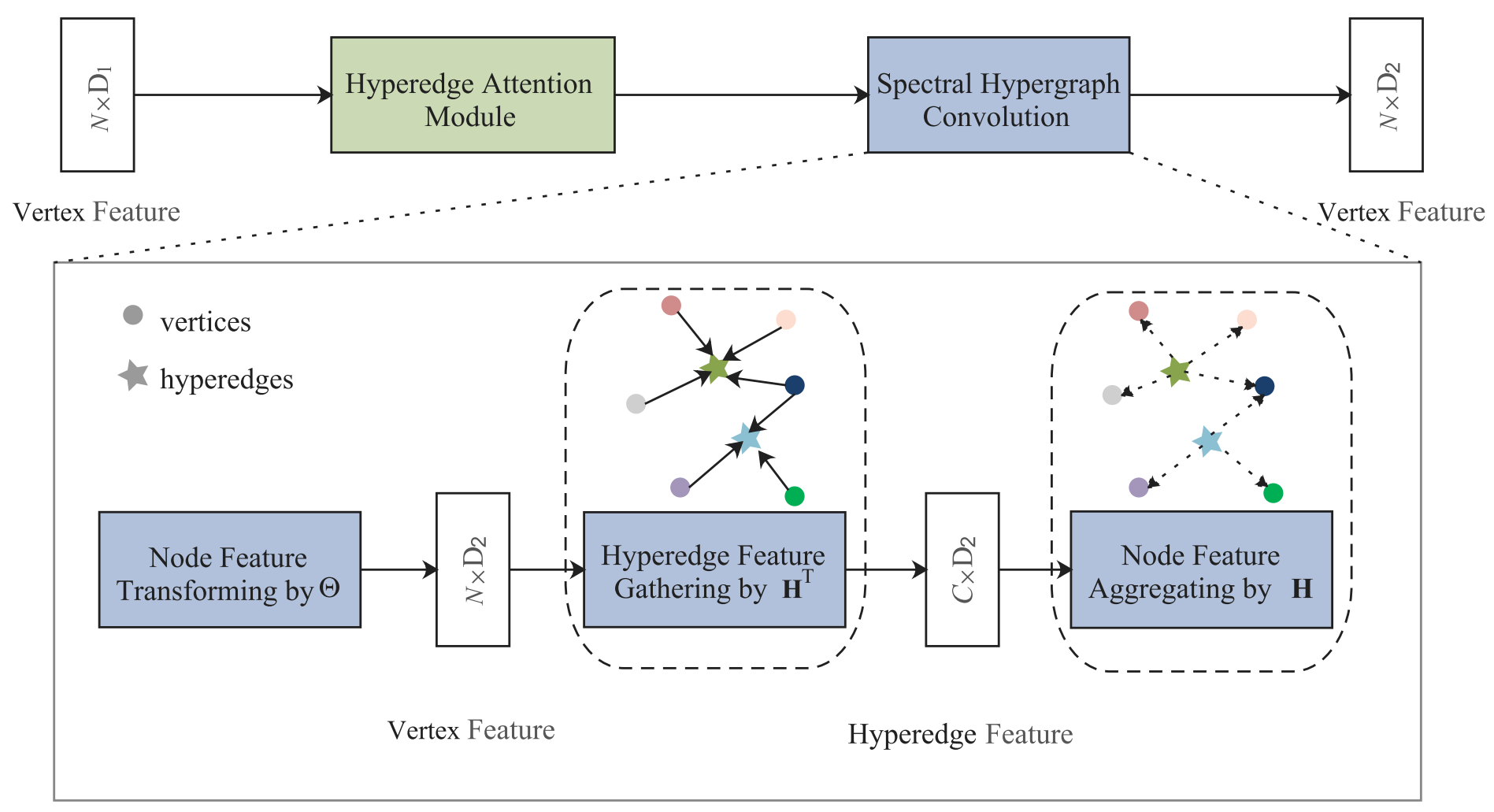
超边动态加权:先用注意力把超边内顶点聚合成超边特征再传回顶点,按顶点相似度为每条超边学出自适应权重,让高置信超边主导标签传播
论文信息
- 论文:Hypergraph convolutional network based weakly supervised point cloud semantic segmentation with scene-level annotations
- 出处:Neurocomputing 2025
核心痛点
点云分割里普通 GNN 一条边只能连两个顶点,抓不住高阶语义关系;超图能一条超边连多个顶点,但 HGNN 等现有超图卷积给所有超边配相同权重,无法为标签传播提供准确信息;弱监督下 CAM 伪标签稀疏不完整,雪上加霜。
模块亮点
- 超边动态加权:先用注意力把超边内顶点聚合成超边特征再传回顶点,按顶点相似度为每条超边学出自适应权重,让高置信超边主导标签传播
- 消融涨点明确:换成 HDA 后,ScanNet、S3DIS、Semantic3D 上 mIoU 分别相对提升约 1.3%、1.7%、7.3%;整体 WHCN 在四个基准上比当前最佳方法高出 3.5% 至 36.1% mIoU
- 接入成本极低:输入只要顶点特征和关联矩阵,几个线性层搞定;在超点层面建图,训练总时长 3.96 小时、平均显存占用 35.7%,均为弱监督方法中最低
适用场景
领域为 3D 点云弱监督语义分割(场景级标注);原文在 ScanNet、S3DIS、Semantic3D 与 ShapeNet Part 上验证;可迁移到多标签图像弱监督分割的伪标签精炼、知识图谱 / 分子交互等高阶关系建模。
插入位置建议
- 替换 HGNN、SPG 等图 / 超图卷积网络中的超图卷积块,传入顶点特征和关联矩阵即可
- 接在 CAM 或弱监督种子标签之后、分割网络训练前,作为标签传播模块精炼伪标签
- 放在超点 / 超像素等过分割特征之后,把过分割块当顶点、同类种子连成超边聚合
适用任务
- 3D 点云弱监督语义分割
完整代码
hda.py
import torch
import torch.nn.functional as F
from torch import nn
from torch.nn import Module, Parameter
import math

from torch.nn import Sequential as Seq, Dropout, Linear as Lin,BatchNorm1d as BN


"""《Hypergraph convolutional network based weakly supervised point cloud semantic segmentation with scene-level annotations》 Neurocomputing 2025 (中科院2区TOP)
利用场景级标注进行点云分割是一项极具前景但又极具挑战性的任务。目前,最流行的方法是利用类激活图 (CAM) 定位判别性区域,然后根据场景级标注生成点级伪标签。然而,这些方法通常存在类别间点不平衡以及 CAM 稀疏且不完全监督的问题。
本文提出了一种基于加权超图卷积网络的新型方法 WHCN,以应对从场景级标注中学习点级标签的挑战。首先,为了同时克服不同类别间的点不平衡并降低模型复杂度,利用几何同质划分生成训练点云的超点。
然后,基于从场景级标注转换而来的高置信度超点级种子点构建超图。其次,WHCN 将超图作为输入,通过标签传播学习预测高精度点级伪标签。除了由谱超图卷积块组成的骨干网络外,还学习了一个超边注意模块来调整 WHCN 中超边的权重。
最后,利用这些伪点云标签训练分割网络。在 scanNet、S3DIS、Semantic3D 和 ShapeNet Part 基准测试上的实验结果表明,所提出的 WHCN 能够有效预测带有场景标注的点标签,其 mIou 性能比当前最佳方法高出 3.5% 至 36.1%。
"""


def MLP(channels, bias=True):
    return Seq(*[
        Seq(Lin(channels[i - 1], channels[i], bias=bias),BN(channels[i]),torch.nn.LeakyReLU(negative_slope=0.2),Lin(channels[i], channels[i], bias=bias))
        for i in range(1, len(channels))
    ])


class HyperedgeAttention(nn.Module):

    def __init__(self, in_features, out_features, dropout, alpha, transfer, concat=True, bias=False):
        super(HyperedgeAttention, self).__init__()
        self.dropout = dropout
        self.in_features = in_features
        self.out_features = out_features
        self.alpha = alpha
        self.concat = concat

        self.transfer = transfer

        if self.transfer:
            self.weight = Parameter(torch.Tensor(self.in_features, self.out_features))
        else:
            self.register_parameter('weight', None)

        self.weight2 = Parameter(torch.Tensor(self.in_features, self.out_features))
        self.weight3 = Parameter(torch.Tensor(self.out_features, self.out_features))

        if bias:
            self.bias = Parameter(torch.Tensor(self.out_features))
        else:
            self.register_parameter('bias', None)

        self.word_context = nn.Embedding(1, self.out_features)

        self.a = nn.Parameter(torch.zeros(size=(2 * out_features, 1)))
        self.a2 = nn.Parameter(torch.zeros(size=(2 * out_features, 1)))
        self.leakyrelu = nn.LeakyReLU(self.alpha)

        self.reset_parameters()

    def reset_parameters(self):
        stdv = 1. / math.sqrt(self.out_features)
        if self.weight is not None:
            self.weight.data.uniform_(-stdv, stdv)
        self.weight2.data.uniform_(-stdv, stdv)
        self.weight3.data.uniform_(-stdv, stdv)
        if self.bias is not None:
            self.bias.data.uniform_(-stdv, stdv)

        nn.init.uniform_(self.a.data, -stdv, stdv)
        nn.init.uniform_(self.a2.data, -stdv, stdv)
        nn.init.uniform_(self.word_context.weight.data, -stdv, stdv)

    def forward(self, x, adj):
        x_4att = x.matmul(self.weight2)

        if self.transfer:
            x = x.matmul(self.weight)
            if self.bias is not None:
                x = x + self.bias

        N1 = adj.shape[1]
        N2 = adj.shape[2]

        pair = adj.nonzero().t()

        get = lambda i: x_4att[i][adj[i].nonzero().t()[1]]
        x1 = torch.cat([get(i) for i in torch.arange(x.shape[0]).long()])

        q1 = self.word_context.weight[0:].view(1, -1).repeat(x1.shape[0], 1).view(x1.shape[0], self.out_features)

        pair_h = torch.cat((q1, x1), dim=-1)
        pair_e = self.leakyrelu(torch.matmul(pair_h, self.a).squeeze()).t()
        assert not torch.isnan(pair_e).any()
        pair_e = F.dropout(pair_e, self.dropout, training=self.training)

        e = torch.sparse_coo_tensor(pair, pair_e, torch.Size([x.shape[0], N1, N2])).to_dense()

        zero_vec = -9e15 * torch.ones_like(e)
        attention = torch.where(adj > 0, e, zero_vec)

        attention_edge = F.softmax(attention, dim=2)

        edge = torch.matmul(attention_edge, x)

        edge = F.dropout(edge, self.dropout, training=self.training)

        edge_4att = edge.matmul(self.weight3)

        get = lambda i: edge_4att[i][adj[i].nonzero().t()[0]]
        y1 = torch.cat([get(i) for i in torch.arange(x.shape[0]).long()])

        get = lambda i: x_4att[i][adj[i].nonzero().t()[1]]
        q1 = torch.cat([get(i) for i in torch.arange(x.shape[0]).long()])

        pair_h = torch.cat((q1, y1), dim=-1)
        pair_e = self.leakyrelu(torch.matmul(pair_h, self.a2).squeeze()).t()
        assert not torch.isnan(pair_e).any()
        pair_e = F.dropout(pair_e, self.dropout, training=self.training)

        e = torch.sparse_coo_tensor(pair, pair_e, torch.Size([x.shape[0], N1, N2])).to_dense()

        zero_vec = -9e15 * torch.ones_like(e)
        attention = torch.where(adj > 0, e, zero_vec)

        attention_node = F.softmax(attention.transpose(1, 2), dim=2)

        node = torch.matmul(attention_node, edge)

        if self.concat:
            node = F.elu(node)

        return node


if __name__ == '__main__':
    batch_size = 4  # 批大小
    num_nodes = 10  # 节点数量
    num_edges = 6  # 超边数量
    in_features = 32  # 输入特征维度
    out_features = 32  # 输出特征维度
    dropout = 0.1  # dropout率
    alpha = 0.2  # LeakyReLU参数

    # 生成随机输入数据 (batch_size, num_nodes, in_features)
    x = torch.randn(batch_size, num_nodes, in_features).to('cuda')

    # 创建随机邻接矩阵 (batch_size, num_edges, num_nodes)
    adj = torch.zeros(batch_size, num_edges, num_nodes).to('cuda')
    for b in range(batch_size):
        for e in range(num_edges):
            # 每个超边随机连接2-4个节点
            connected_nodes = torch.randperm(num_nodes)[:torch.randint(2, 5, (1,))]
            adj[b, e, connected_nodes] = 1

    # 初始化超边注意力模块
    block = HyperedgeAttention(
        in_features=in_features,
        out_features=out_features,
        dropout=dropout,
        alpha=alpha,
        transfer=True,  # 是否使用线性变换
        concat=True,  # 是否使用ELU激活
        bias=False  # 是否使用偏置
    ).to('cuda')

    # 前向传播
    output = block(x, adj)

    # 打印输入输出尺寸
    print("输入特征尺寸:", x.size())
    print("邻接矩阵尺寸:", adj.size())
    print("输出特征尺寸:", output.size())
环境与依赖
Python 3.9+
继续浏览
下一篇HFP 高频感知模块频域高通滤波:对特征图做 DCT,用预定义高通滤波器置零低频成分(超参 α 控制截止频带),再逆变换回空间域;小目标对应高频细节,原图 SCR 仅 0.9939 的目标滤波后最高升至 1.5797相关资源
模块2026-11-20
CAA 通道亲和注意力模块
在通道空间做注意力:不逐点加权,改算通道间的长程依赖,天然不受点云无序性影响;先用共享 MLP 压缩每个通道向量再估计 C×C 相似度矩阵,绕开 N×N 大矩阵
点云三维视觉CAA
三维视觉MIT
模块2026-11-20
GeoConv 几何卷积
正交基分解聚合:把边特征提取分解到三个正交基(区分正负共六基)上,用方向关联的权重独立提取,再按与各基夹角的 cos² 系数聚合、按 (r−距离)² 加权邻居,显式建模方向与距离结构
计算机视觉3D点云GeoConv
三维视觉MIT
模块2026-11-20
ResLFE 残差局部特征提取模块
计算量砍十倍:位置编码改成阶段级,每个 stage 开头预计算一次、全 stage 复用,FLOPs 直接减半(92.2G→44.6G),最终只用 plain 设计 10% 的计算量(92.2G→9.2G),
三维点云点云分割ResLFE
三维视觉MIT