模块更新于 2026-11-20· 浏览 0· 下载 0
HOIST 人-物交互空间Transformer
三元组标记化:把每组〈主体、动作、客体〉连同边界框编成三个 token,主体/客体用 CLIP 文本嵌入加傅里叶框嵌入融合,动作走单独 MLP;再用实例嵌入聚组、角色嵌入分角色,多组交互同框也能分清谁在对谁做什么
结构图
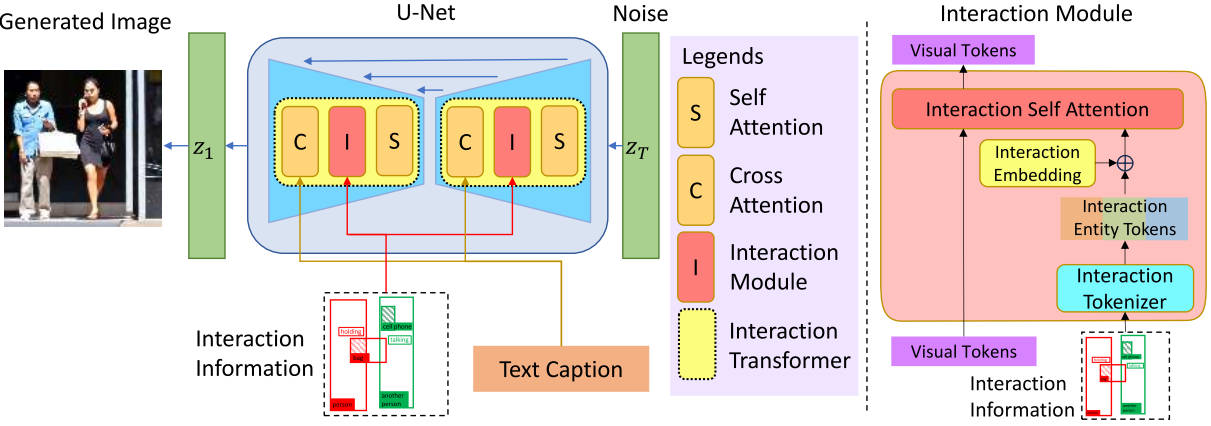
三元组标记化:把每组〈主体、动作、客体〉连同边界框编成三个 token,主体/客体用 CLIP 文本嵌入加傅里叶框嵌入融合,动作走单独 MLP;再用实例嵌入聚组、角色嵌入分角色,多组交互同框也能分清谁在对谁做什么
论文信息
- 论文:InteractDiffusion: Interaction Control in Text-to-Image Diffusion Models
- 出处:CVPR 2024
核心痛点
文生图扩散模型已能控制"物体在哪"——GLIGEN 等布局方法能把物体摆到指定位置,却管不了"物体之间在做什么":想生成"人拿着手机""人喂猫",结果经常动作错配、交互混乱。
模块亮点
- 三元组标记化:把每组〈主体、动作、客体〉连同边界框编成三个 token,主体/客体用 CLIP 文本嵌入加傅里叶框嵌入融合,动作走单独 MLP;再用实例嵌入聚组、角色嵌入分角色,多组交互同框也能分清谁在对谁做什么
- 涨点实打实:HICO-DET 上 HOI 检测分数(FGAHOI Swin-Tiny,Default 设定)从 GLIGEN 微调基线的 25.23 涨到 29.53 mAP;FID 18.69 还略优于基线
- 冻结原模型注入:新的交互自注意力插在原 Transformer 块的自注意力和交叉注意力之间,原有注意力层全部冻结、只训新层,零初始化门控渐进注入
适用场景
领域为文生图 / 扩散模型可控生成,原文基于 Stable Diffusion / GLIGEN 在 HICO-DET 上验证人-物交互图像生成;可迁移到电商、游戏等场景生成。
插入位置建议
- 插在 Stable Diffusion / GLIGEN 的 U-Net 各 Transformer 块里,自注意力之后、交叉注意力之前
- 替换 GLIGEN 的 gated self-attention 位置,把布局 token 换成交互三元组 token
- 接到其他 LDM 系文生图模型中,与 ControlNet 等叠加,补上"交互"控制维度
适用任务
- 文生图
- 扩散模型可控生成
- 原文基于 Stable Diffusion
完整代码
hoist.py
from inspect import isfunction
import math
import torch
import torch.nn.functional as F
from torch import nn, einsum
from einops import rearrange, repeat

# from ldm.modules.diffusionmodules.util import checkpoint, FourierEmbedder
from torch.utils import checkpoint


"""InteractDiffusion  CVPR2024
大规模文本到图像 (T2I) 扩散模型展示了基于文本描述生成连贯图像的令人难以置信的能力,从而在内容生成中实现了广泛的应用。
虽然最近的进步引入了对对象定位、姿势和图像轮廓等因素的控制,但我们在控制生成内容中对象之间交互的能力方面仍然存在一个关键差距。在生成的图像中控制良好的交互可以产生有意义的应用程序,例如创建具有交互角色的逼真场景。
在这项工作中,我们研究了用人-客体交互 (HOI) 信息来调节 T2I 扩散模型的问题,这些信息由三元组标签 (人、动作、物体) 和相应的边界框组成。
我们提出了一种可插拔的交互控制模型,称为 InteractDiffusion,它扩展了现有的预训练 T2I 扩散模型,使它们能够更好地适应交互。
具体来说,我们对 HOI 信息进行标记化,并通过交互嵌入了解它们之间的关系。训练调节自我注意层将 HOI 标记映射到视觉标记,从而在现有的 T2I 扩散模型中更好地调节视觉标记。
我们的模型能够控制现有 T2I 扩散模型的相互作用和位置,它在 HOI 检测分数以及 FID 和 KID 的保真度方面大大优于现有基线。
"""


try:
    import xformers
    import xformers.ops

    XFORMERS_IS_AVAILABLE = True
except:
    XFORMERS_IS_AVAILABLE = False
    print("Xformers is not available. Install via ")


def exists(val):
    return val is not None


def uniq(arr):
    return {el: True for el in arr}.keys()


def default(val, d):
    if exists(val):
        return val
    return d() if isfunction(d) else d


def max_neg_value(t):
    return -torch.finfo(t.dtype).max


def init_(tensor):
    dim = tensor.shape[-1]
    std = 1 / math.sqrt(dim)
    tensor.uniform_(-std, std)
    return tensor


# feedforward
class GEGLU(nn.Module):
    def __init__(self, dim_in, dim_out):
        super().__init__()
        self.proj = nn.Linear(dim_in, dim_out * 2)

    def forward(self, x):
        x, gate = self.proj(x).chunk(2, dim=-1)
        return x * F.gelu(gate)


class FeedForward(nn.Module):
    def __init__(self, dim, dim_out=None, mult=4, glu=False, dropout=0.):
        super().__init__()
        inner_dim = int(dim * mult)
        dim_out = default(dim_out, dim)
        project_in = nn.Sequential(
            nn.Linear(dim, inner_dim),
            nn.GELU()
        ) if not glu else GEGLU(dim, inner_dim)

        self.net = nn.Sequential(
            project_in,
            nn.Dropout(dropout),
            nn.Linear(inner_dim, dim_out)
        )

    def forward(self, x):
        return self.net(x)


def zero_module(module):
    """
    Zero out the parameters of a module and return it.
    """
    for p in module.parameters():
        p.detach().zero_()
    return module


def Normalize(in_channels):
    return torch.nn.GroupNorm(num_groups=32, num_channels=in_channels, eps=1e-6, affine=True)


class LinearAttention(nn.Module):
    def __init__(self, dim, heads=4, dim_head=32):
        super().__init__()
        self.heads = heads
        hidden_dim = dim_head * heads
        self.to_qkv = nn.Conv2d(dim, hidden_dim * 3, 1, bias=False)
        self.to_out = nn.Conv2d(hidden_dim, dim, 1)

    def forward(self, x):
        b, c, h, w = x.shape
        qkv = self.to_qkv(x)
        q, k, v = rearrange(qkv, 'b (qkv heads c) h w -> qkv b heads c (h w)', heads=self.heads, qkv=3)
        k = k.softmax(dim=-1)
        context = torch.einsum('bhdn,bhen->bhde', k, v)
        out = torch.einsum('bhde,bhdn->bhen', context, q)
        out = rearrange(out, 'b heads c (h w) -> b (heads c) h w', heads=self.heads, h=h, w=w)
        return self.to_out(out)


class CrossAttention(nn.Module):
    def __init__(self, query_dim, key_dim, value_dim, heads=8, dim_head=64, dropout=0):
        super().__init__()
        inner_dim = dim_head * heads
        self.scale = dim_head ** -0.5
        self.heads = heads
        self.dim_head = dim_head

        self.to_q = nn.Linear(query_dim, inner_dim, bias=False)
        self.to_k = nn.Linear(key_dim, inner_dim, bias=False)
        self.to_v = nn.Linear(value_dim, inner_dim, bias=False)

        self.to_out = nn.Sequential(nn.Linear(inner_dim, query_dim), nn.Dropout(dropout))

    def fill_inf_from_mask(self, sim, mask):
        if mask is not None:
            B, M = mask.shape
            mask = mask.unsqueeze(1).repeat(1, self.heads, 1).reshape(B * self.heads, 1, -1)
            max_neg_value = -torch.finfo(sim.dtype).max
            sim.masked_fill_(~mask, max_neg_value)
        return sim

    def forward_plain(self, x, key, value, mask=None):
        q = self.to_q(x)  # B*N*(H*C)
        k = self.to_k(key)  # B*M*(H*C)
        v = self.to_v(value)  # B*M*(H*C)

        B, N, HC = q.shape
        _, M, _ = key.shape
        H = self.heads
        C = HC // H

        q = q.view(B, N, H, C).permute(0, 2, 1, 3).reshape(B * H, N, C)  # (B*H)*N*C
        k = k.view(B, M, H, C).permute(0, 2, 1, 3).reshape(B * H, M, C)  # (B*H)*M*C
        v = v.view(B, M, H, C).permute(0, 2, 1, 3).reshape(B * H, M, C)  # (B*H)*M*C

        sim = torch.einsum('b i d, b j d -> b i j', q, k) * self.scale  # (B*H)*N*M
        self.fill_inf_from_mask(sim, mask)
        attn = sim.softmax(dim=-1)  # (B*H)*N*M

        out = torch.einsum('b i j, b j d -> b i d', attn, v)  # (B*H)*N*C
        out = out.view(B, H, N, C).permute(0, 2, 1, 3).reshape(B, N, (H * C))  # B*N*(H*C)

        return self.to_out(out)

    def forward(self, x, key, value, mask=None):
        if not XFORMERS_IS_AVAILABLE:
            return self.forward_plain(x, key, value, mask)

        q = self.to_q(x)  # B*N*(H*C)
        k = self.to_k(key)  # B*M*(H*C)
        v = self.to_v(value)  # B*M*(H*C)

        b, _, _ = q.shape
        q, k, v = map(
            lambda t: t.unsqueeze(3)
            .reshape(b, t.shape[1], self.heads, self.dim_head)
            .permute(0, 2, 1, 3)
            .reshape(b * self.heads, t.shape[1], self.dim_head)
            .contiguous(),
            (q, k, v),
        )

        # actually compute the attention, what we cannot get enough of
        out = xformers.ops.memory_efficient_attention(q, k, v, attn_bias=None, op=None)

        if exists(mask):
            raise NotImplementedError
        out = (
            out.unsqueeze(0)
            .reshape(b, self.heads, out.shape[1], self.dim_head)
            .permute(0, 2, 1, 3)
            .reshape(b, out.shape[1], self.heads * self.dim_head)
        )
        return self.to_out(out)


class SelfAttention(nn.Module):
    def __init__(self, query_dim, heads=8, dim_head=64, dropout=0.):
        super().__init__()
        inner_dim = dim_head * heads
        self.scale = dim_head ** -0.5
        self.heads = heads
        self.dim_head = dim_head

        self.to_q = nn.Linear(query_dim, inner_dim, bias=False)
        self.to_k = nn.Linear(query_dim, inner_dim, bias=False)
        self.to_v = nn.Linear(query_dim, inner_dim, bias=False)

        self.to_out = nn.Sequential(nn.Linear(inner_dim, query_dim), nn.Dropout(dropout))

    def forward_plain(self, x):
        q = self.to_q(x)  # B*N*(H*C)
        k = self.to_k(x)  # B*N*(H*C)
        v = self.to_v(x)  # B*N*(H*C)

        B, N, HC = q.shape
        H = self.heads
        C = HC // H

        q = q.view(B, N, H, C).permute(0, 2, 1, 3).reshape(B * H, N, C)  # (B*H)*N*C
        k = k.view(B, N, H, C).permute(0, 2, 1, 3).reshape(B * H, N, C)  # (B*H)*N*C
        v = v.view(B, N, H, C).permute(0, 2, 1, 3).reshape(B * H, N, C)  # (B*H)*N*C

        sim = torch.einsum('b i c, b j c -> b i j', q, k) * self.scale  # (B*H)*N*N
        attn = sim.softmax(dim=-1)  # (B*H)*N*N

        out = torch.einsum('b i j, b j c -> b i c', attn, v)  # (B*H)*N*C
        out = out.view(B, H, N, C).permute(0, 2, 1, 3).reshape(B, N, (H * C))  # B*N*(H*C)

        return self.to_out(out)

    def forward(self, x, context=None, mask=None):
        if not XFORMERS_IS_AVAILABLE:
            return self.forward_plain(x)

        q = self.to_q(x)
        context = default(context, x)
        k = self.to_k(context)
        v = self.to_v(context)

        b, _, _ = q.shape
        q, k, v = map(
            lambda t: t.unsqueeze(3)
            .reshape(b, t.shape[1], self.heads, self.dim_head)
            .permute(0, 2, 1, 3)
            .reshape(b * self.heads, t.shape[1], self.dim_head)
            .contiguous(),
            (q, k, v),
        )

        # actually compute the attention, what we cannot get enough of
        out = xformers.ops.memory_efficient_attention(q, k, v, attn_bias=None, op=None)

        if exists(mask):
            raise NotImplementedError
        out = (
            out.unsqueeze(0)
            .reshape(b, self.heads, out.shape[1], self.dim_head)
            .permute(0, 2, 1, 3)
            .reshape(b, out.shape[1], self.heads * self.dim_head)
        )
        return self.to_out(out)


class GatedCrossAttentionDense(nn.Module):
    def __init__(self, query_dim, key_dim, value_dim, n_heads, d_head):
        super().__init__()

        self.attn = CrossAttention(query_dim=query_dim, key_dim=key_dim, value_dim=value_dim, heads=n_heads,
                                   dim_head=d_head)
        self.ff = FeedForward(query_dim, glu=True)

        self.norm1 = nn.LayerNorm(query_dim)
        self.norm2 = nn.LayerNorm(query_dim)

        self.register_parameter('alpha_attn', nn.Parameter(torch.tensor(0.)))
        self.register_parameter('alpha_dense', nn.Parameter(torch.tensor(0.)))

        # this can be useful: we can externally change magnitude of tanh(alpha)
        # for example, when it is set to 0, then the entire model is same as original one
        self.scale = 1

    def forward(self, x, objs):
        x = x + self.scale * torch.tanh(self.alpha_attn) * self.attn(self.norm1(x), objs, objs)
        x = x + self.scale * torch.tanh(self.alpha_dense) * self.ff(self.norm2(x))

        return x


class GatedSelfAttentionDense(nn.Module):
    def __init__(self, query_dim, context_dim, n_heads, d_head):
        super().__init__()

        # we need a linear projection since we need cat visual feature and obj feature
        self.linear = nn.Linear(context_dim, query_dim)

        self.attn = SelfAttention(query_dim=query_dim, heads=n_heads, dim_head=d_head)
        self.ff = FeedForward(query_dim, glu=True)

        self.norm1 = nn.LayerNorm(query_dim)
        self.norm2 = nn.LayerNorm(query_dim)

        self.register_parameter('alpha_attn', nn.Parameter(torch.tensor(0.)))
        self.register_parameter('alpha_dense', nn.Parameter(torch.tensor(0.)))

        # this can be useful: we can externally change magnitude of tanh(alpha)
        # for example, when it is set to 0, then the entire model is same as original one
        self.scale = 1

    def forward(self, x, objs):
        N_visual = x.shape[1]
        objs = self.linear(objs)

        x = x + self.scale * torch.tanh(self.alpha_attn) * self.attn(self.norm1(torch.cat([x, objs], dim=1)))[:,
                                                           0:N_visual, :]
        x = x + self.scale * torch.tanh(self.alpha_dense) * self.ff(self.norm2(x))

        return x


class GatedSelfAttentionDense2(nn.Module):
    def __init__(self, query_dim, context_dim, n_heads, d_head):
        super().__init__()

        # we need a linear projection since we need cat visual feature and obj feature
        self.linear = nn.Linear(context_dim, query_dim)

        self.attn = SelfAttention(query_dim=query_dim, heads=n_heads, dim_head=d_head)
        self.ff = FeedForward(query_dim, glu=True)

        self.norm1 = nn.LayerNorm(query_dim)
        self.norm2 = nn.LayerNorm(query_dim)

        self.register_parameter('alpha_attn', nn.Parameter(torch.tensor(0.)))
        self.register_parameter('alpha_dense', nn.Parameter(torch.tensor(0.)))

        # this can be useful: we can externally change magnitude of tanh(alpha)
        # for example, when it is set to 0, then the entire model is same as original one
        self.scale = 1

    def forward(self, x, objs):
        B, N_visual, _ = x.shape
        B, N_ground, _ = objs.shape

        objs = self.linear(objs)

        # sanity check
        size_v = math.sqrt(N_visual)
        size_g = math.sqrt(N_ground)
        assert int(size_v) == size_v, "Visual tokens must be square rootable"
        assert int(size_g) == size_g, "Grounding tokens must be square rootable"
        size_v = int(size_v)
        size_g = int(size_g)

        # select grounding token and resize it to visual token size as residual
        out = self.attn(self.norm1(torch.cat([x, objs], dim=1)))[:, N_visual:, :]
        out = out.permute(0, 2, 1).reshape(B, -1, size_g, size_g)
        out = torch.nn.functional.interpolate(out, (size_v, size_v), mode='bicubic')
        residual = out.reshape(B, -1, N_visual).permute(0, 2, 1)

        # add residual to visual feature
        x = x + self.scale * torch.tanh(self.alpha_attn) * residual
        x = x + self.scale * torch.tanh(self.alpha_dense) * self.ff(self.norm2(x))

        return x


class BasicTransformerBlock(nn.Module):
    def __init__(self, query_dim, key_dim, value_dim, n_heads, d_head, fuser_type, use_checkpoint=True):
        super().__init__()
        self.attn1 = SelfAttention(query_dim=query_dim, heads=n_heads, dim_head=d_head)
        self.ff = FeedForward(query_dim, glu=True)
        self.attn2 = CrossAttention(query_dim=query_dim, key_dim=key_dim, value_dim=value_dim, heads=n_heads,
                                    dim_head=d_head)
        self.norm1 = nn.LayerNorm(query_dim)
        self.norm2 = nn.LayerNorm(query_dim)
        self.norm3 = nn.LayerNorm(query_dim)
        self.use_checkpoint = use_checkpoint

        if fuser_type == "gatedSA":
            # note key_dim here actually is context_dim
            self.fuser = GatedSelfAttentionDense(query_dim, key_dim, n_heads, d_head)
        elif fuser_type == "gatedSA2":
            # note key_dim here actually is context_dim
            self.fuser = GatedSelfAttentionDense2(query_dim, key_dim, n_heads, d_head)
        elif fuser_type == "gatedCA":
            self.fuser = GatedCrossAttentionDense(query_dim, key_dim, value_dim, n_heads, d_head)
        else:
            assert False

    def forward(self, x, context, objs):
        #        return checkpoint(self._forward, (x, context, objs), self.parameters(), self.use_checkpoint)
        if self.use_checkpoint and x.requires_grad:
            return checkpoint.checkpoint(self._forward, x, context, objs)
        else:
            return self._forward(x, context, objs)

    def _forward(self, x, context, objs):
        x = self.attn1(self.norm1(x)) + x
        x = self.fuser(x, objs)  # identity mapping in the beginning
        x = self.attn2(self.norm2(x), context, context) + x
        x = self.ff(self.norm3(x)) + x
        return x


class HOISpatialTransformer(nn.Module):
    def __init__(self, in_channels, key_dim, value_dim, n_heads, d_head, depth=1, fuser_type=None, use_checkpoint=True):
        super().__init__()
        self.in_channels = in_channels
        query_dim = n_heads * d_head
        self.norm = Normalize(in_channels)

        self.proj_in = nn.Conv2d(in_channels,
                                 query_dim,
                                 kernel_size=1,
                                 stride=1,
                                 padding=0)

        self.transformer_blocks = nn.ModuleList(
            [BasicTransformerBlock(query_dim, key_dim, value_dim, n_heads, d_head, fuser_type,
                                   use_checkpoint=use_checkpoint)
             for d in range(depth)]
        )

        self.proj_out = zero_module(nn.Conv2d(query_dim,
                                              in_channels,
                                              kernel_size=1,
                                              stride=1,
                                              padding=0))

    def forward(self, x, context, objs):
        b, c, h, w = x.shape
        x_in = x
        x = self.norm(x)
        x = self.proj_in(x)
        x = rearrange(x, 'b c h w -> b (h w) c')  # .contiguous()
        for block in self.transformer_blocks:
            x = block(x, context, objs)
        x = rearrange(x, 'b (h w) c -> b c h w', h=h, w=w).contiguous()
        x = self.proj_out(x)
        return x + x_in


import torch

if __name__ == '__main__':
    block = HOISpatialTransformer(in_channels=64, key_dim=128, value_dim=128, n_heads=8, d_head=32, depth=2, fuser_type="gatedSA", use_checkpoint=False)

    input = torch.rand(4, 64, 32, 32)

    context = torch.rand(4, 16, 128)  # 假设context是 (batch_size, num_context, key_dim)
    objs = torch.rand(4, 10, 128)     # 假设objs是 (batch_size, num_objs, value_dim)

    output = block(input, context, objs)

    print("Input size:", input.size())
    print("Output size:", output.size())
环境与依赖
Python 3.9+
继续浏览
下一篇HSPA 高相似性传递注意力软阈值高通筛选:用软阈值操作替代 softmax,按相似度向量动态算出阈值,低于阈值的权重截断为 0、其余平移,只有高相似区域能"通过",无需手调相关资源
模块2026-11-20
IQA-Adapter 图像质量适配器
分数条件化:把 IQA/IAA 模型输出的质量分数(可多指标拼成向量)经轻量投影变成与文本 token 同维的质量 token,经交叉注意力注入 U-Net,SDXL 权重全程冻结,开销小
扩散模型文生图IQAAdapter
计算机视觉MIT
模块2026-11-21
FUNM FreeU 免训练增强
零额外成本:完全不需要训练/微调,无新增参数量、无显存占用上涨、无推理耗时增加,仅需在推理阶段修改几行代码即可生效。
计算机视觉AIGC扩散模型
计算机视觉MIT
模块2026-11-20
FRFN 特征精炼前馈网络
先增强、再减负:用 PConv(部分卷积)增强有价值的特征,再用门控机制削减通道冗余,专治 FFN 里的通道冗余问题
计算机视觉图像复原FRFN
计算机视觉MIT