模块更新于 2026-11-20· 浏览 2· 下载 0
LCGA 局部曲率引导注意力
曲率先验进注意力:可学习 3×3 深度卷积提取局部微分样响应,归一化成曲率图,再乘性调制窗口注意力 logits(1+α·曲率),曲率大处注意力自动增强
结构图
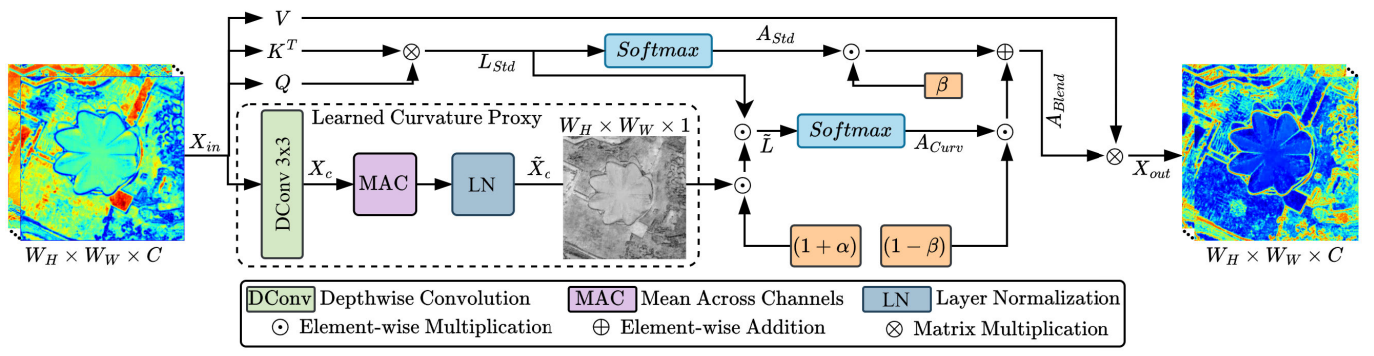
曲率先验进注意力:可学习 3×3 深度卷积提取局部微分样响应,归一化成曲率图,再乘性调制窗口注意力 logits(1+α·曲率),曲率大处注意力自动增强
论文信息
- 论文:CGA: Curvature-Guided Attention for Remote Sensing Image Super-Resolution
- 出处:IEEE TGRS 2026
核心痛点
遥感影像里道路、河流、屋顶边缘等曲线结构下采样后极易混叠;通用注意力不带几何先验,重建常是锯齿边缘和被"洗白"的细节;窗口注意力只按内容相似度聚合,脊线、急弯等几何脆弱处分不到足够注意力。
模块亮点
- 曲率先验进注意力:可学习 3×3 深度卷积提取局部微分样响应,归一化成曲率图,再乘性调制窗口注意力 logits(1+α·曲率),曲率大处注意力自动增强
- 混合门控保稳:曲率注意力与标准注意力按可学习 β 凸组合,脊线邻域强调曲率、平坦区退回标准注意力,比固定 LoG/Laplacian 更适应遥感统计
- 消融掉点最多:UCMerced ×4 消融中,去掉 LCGA 是所有组件里掉分最狠的(29.4141→29.1993,-0.2148 dB),关掉混合机制再掉 0.0304 dB;CGA 用 10.47M 参数达 29.77 dB,超过 TTST 与 HMoE(29.71 dB)
适用场景
领域为遥感图像超分辨率;原文在 AID、UCMerced、WHU-RS19 上验证了 ×2/×4 超分,还做了 DOTA 小目标旋转框检测;也可迁移到自然图像超分、去噪、去模糊等窗口注意力复原网络。
插入位置建议
- 直接替换 Swin、Restormer、CAT 等复原 Transformer 块中的窗口注意力子层
- 放进残差组或 U 型网络深层块,与全局注意力交替堆叠,管局部脊线连续
- 接在 HSENET、TransENet 等遥感超分网络的特征提取块之后作结构增强子层
适用任务
- 遥感图像超分辨率
完整代码
lcga.py
import torch
import torch.nn as nn
from torch.nn import functional as F


def img2windows(img, H_sp, W_sp):
    B, C, H, W = img.shape
    img_reshape = img.view(B, C, H // H_sp, H_sp, W // W_sp, W_sp)
    img_perm = img_reshape.permute(0, 2, 4, 3, 5, 1).contiguous().reshape(-1, H_sp * W_sp, C)
    return img_perm


def windows2img(img_splits_hw, H_sp, W_sp, H, W):
    B = int(img_splits_hw.shape[0] / (H * W / H_sp / W_sp))

    img = img_splits_hw.view(B, H // H_sp, W // W_sp, H_sp, W_sp, -1)
    img = img.permute(0, 1, 3, 2, 4, 5).contiguous().view(B, H, W, -1)
    return img


class DynamicPosBias(nn.Module):
    # The implementation builds on Crossformer code https://github.com/cheerss/CrossFormer/blob/main/models/crossformer.py
    def __init__(self, dim, num_heads, residual):
        super().__init__()
        self.residual = residual
        self.num_heads = num_heads
        self.pos_dim = dim // 4
        self.pos_proj = nn.Linear(2, self.pos_dim)
        self.pos1 = nn.Sequential(
            nn.LayerNorm(self.pos_dim),
            nn.ReLU(inplace=True),
            nn.Linear(self.pos_dim, self.pos_dim),
        )
        self.pos2 = nn.Sequential(
            nn.LayerNorm(self.pos_dim),
            nn.ReLU(inplace=True),
            nn.Linear(self.pos_dim, self.pos_dim)
        )
        self.pos3 = nn.Sequential(
            nn.LayerNorm(self.pos_dim),
            nn.ReLU(inplace=True),
            nn.Linear(self.pos_dim, self.num_heads)
        )

    def forward(self, biases):
        if self.residual:
            pos = self.pos_proj(biases)  # 2Gh-1 * 2Gw-1, heads
            pos = pos + self.pos1(pos)
            pos = pos + self.pos2(pos)
            pos = self.pos3(pos)
        else:
            pos = self.pos3(self.pos2(self.pos1(self.pos_proj(biases))))
        return pos


class WindowAttention(nn.Module):
    def __init__(self, dim, idx, split_size=[8, 8], dim_out=None, num_heads=6, attn_drop=0., proj_drop=0.,
                 qk_scale=None, position_bias=True):
        super().__init__()
        self.dim = dim
        self.dim_out = dim_out or dim
        self.split_size = split_size
        self.num_heads = num_heads
        self.idx = idx
        self.position_bias = position_bias

        head_dim = dim // num_heads
        self.scale = qk_scale or head_dim ** -0.5

        if idx == 0:
            H_sp, W_sp = self.split_size[0], self.split_size[1]
        elif idx == 1:
            W_sp, H_sp = self.split_size[0], self.split_size[1]
        else:
            print("ERROR MODE", idx)
            exit(0)
        self.H_sp = H_sp
        self.W_sp = W_sp

        if self.position_bias:
            self.pos = DynamicPosBias(self.dim // 4, self.num_heads, residual=False)
            # generate mother-set
            position_bias_h = torch.arange(1 - self.H_sp, self.H_sp)
            position_bias_w = torch.arange(1 - self.W_sp, self.W_sp)
            biases = torch.stack(torch.meshgrid([position_bias_h, position_bias_w]))
            biases = biases.flatten(1).transpose(0, 1).contiguous().float()
            self.register_buffer('rpe_biases', biases)

            # get pair-wise relative position index for each token inside the window
            coords_h = torch.arange(self.H_sp)
            coords_w = torch.arange(self.W_sp)
            coords = torch.stack(torch.meshgrid([coords_h, coords_w]))
            coords_flatten = torch.flatten(coords, 1)
            relative_coords = coords_flatten[:, :, None] - coords_flatten[:, None, :]
            relative_coords = relative_coords.permute(1, 2, 0).contiguous()
            relative_coords[:, :, 0] += self.H_sp - 1
            relative_coords[:, :, 1] += self.W_sp - 1
            relative_coords[:, :, 0] *= 2 * self.W_sp - 1
            relative_position_index = relative_coords.sum(-1)
            self.register_buffer('relative_position_index', relative_position_index)

        # Curvature guidance components
        self.curvature_conv = nn.Conv2d(dim, dim, 3, 1, 1, groups=dim, bias=False)  # 用来提取局部曲率代理
        self.alpha = nn.Parameter(torch.zeros(1))  # 控制曲率对 logits 的调制强度
        self.beta = nn.Parameter(torch.tensor(0.5))  # 控制标准注意力和曲率注意力的融合比例

        self.attn_drop = nn.Dropout(attn_drop)

    def im2win(self, x, H, W):
        B, N, C = x.shape
        x = x.transpose(-2, -1).contiguous().view(B, C, H, W)
        x = img2windows(x, self.H_sp, self.W_sp)
        x = x.reshape(-1, self.H_sp * self.W_sp, self.num_heads, C // self.num_heads).permute(0, 2, 1, 3).contiguous()
        return x

    def forward(self, qkv, H, W, mask=None):
        """
        Input: qkv: (B, 3*L, C), H, W, mask: (B, N, N), N is the window size
        Output: x (B, H, W, C)
        """
        q, k, v = qkv[0], qkv[1], qkv[2]

        B, L, C = q.shape
        assert L == H * W, "flatten img_tokens has wrong size"

        # partition the q,k,v, image to window
        q = self.im2win(q, H, W)
        k = self.im2win(k, H, W)
        v = self.im2win(v, H, W)

        # Raw attention logits
        attn_logits = (q @ k.transpose(-2, -1)) * self.scale  # [B*nW, heads, N, N]

        # calculate drpe
        if self.position_bias:
            pos = self.pos(self.rpe_biases)
            # select position bias
            relative_position_bias = pos[self.relative_position_index.view(-1)].view(
                self.H_sp * self.W_sp, self.H_sp * self.W_sp, -1)
            relative_position_bias = relative_position_bias.permute(2, 0, 1).contiguous()
            attn_logits = attn_logits + relative_position_bias.unsqueeze(0)

        N = attn_logits.shape[3]

        # use mask for shift window
        if mask is not None:
            nW = mask.shape[0]
            attn_logits = attn_logits.view(B, nW, self.num_heads, N, N) + mask.unsqueeze(1).unsqueeze(0)
            attn_logits = attn_logits.view(-1, self.num_heads, N, N)

        # Compute curvature
        x2d = qkv[0].transpose(1, 2).view(B, C, H, W)
        curvature = self.curvature_conv(x2d).mean(dim=1, keepdim=True).view(B, -1)  # [B, H*W]
        curvature = F.layer_norm(curvature, curvature.shape[1:])
        curvature_map = curvature.view(B, 1, H, W)
        curvature_patches = img2windows(curvature_map, self.H_sp, self.W_sp)
        curvature_win = curvature_patches.view(-1, self.H_sp * self.W_sp)
        curvature_win = curvature_win.unsqueeze(1).unsqueeze(-1)

        # Modulate attention logits with curvature
        modulated_logits = attn_logits * (1 + self.alpha * curvature_win)

        # Final blended attention scores
        attn_std = F.softmax(attn_logits, dim=-1, dtype=attn_logits.dtype)
        attn_cga = F.softmax(modulated_logits, dim=-1, dtype=attn_logits.dtype)
        attn = self.beta * attn_std + (1 - self.beta) * attn_cga
        attn = self.attn_drop(attn)

        x = (attn @ v)
        x = x.transpose(1, 2).reshape(-1, self.H_sp * self.W_sp, C)  # B head N N @ B head N C

        # merge the window, window to image
        x = windows2img(x, self.H_sp, self.W_sp, H, W)  # B H' W' C

        return x


class LCGA(nn.Module):
    """
    Local Curvature-Guided Attention (LCGA)
    The implementation builds on CAT code https://github.com/zhengchen1999/CAT/blob/main/basicsr/archs/cat_arch.py
    """

    def __init__(self, dim, num_heads,
                 split_size=[2, 4], shift_size=[1, 2], qkv_bias=False, qk_scale=None,
                 drop=0., attn_drop=0., idx=0, reso=64, rs_id=0):
        super().__init__()
        self.dim = dim
        self.num_heads = num_heads
        self.split_size = split_size
        self.shift_size = shift_size
        self.idx = idx
        self.rs_id = rs_id
        self.patches_resolution = reso
        self.qkv = nn.Linear(dim, dim * 3, bias=qkv_bias)

        assert 0 <= self.shift_size[0] < self.split_size[0], "shift_size must in 0-split_size0"
        assert 0 <= self.shift_size[1] < self.split_size[1], "shift_size must in 0-split_size1"

        self.branch_num = 2

        self.proj = nn.Linear(dim, dim)
        self.proj_drop = nn.Dropout(drop)

        self.attns = nn.ModuleList([
            WindowAttention(
                dim // 2, idx=i,
                split_size=split_size, num_heads=num_heads // 2, dim_out=dim // 2,
                qk_scale=qk_scale, attn_drop=attn_drop, proj_drop=drop, position_bias=True)
            for i in range(self.branch_num)])

        if (self.rs_id % 2 == 0 and self.idx > 0 and (self.idx - 2) % 4 == 0) or (
                self.rs_id % 2 != 0 and self.idx % 4 == 0):
            attn_mask = self.calculate_mask(self.patches_resolution, self.patches_resolution)

            self.register_buffer("attn_mask_0", attn_mask[0])
            self.register_buffer("attn_mask_1", attn_mask[1])
        else:
            attn_mask = None

            self.register_buffer("attn_mask_0", None)
            self.register_buffer("attn_mask_1", None)

        self.get_v = nn.Conv2d(dim, dim, kernel_size=3, stride=1, padding=1, groups=dim)  # DW Conv

    def calculate_mask(self, H, W):
        # The implementation builds on Swin Transformer code https://github.com/microsoft/Swin-Transformer/blob/main/models/swin_transformer.py
        # calculate attention mask for Rwin
        img_mask_0 = torch.zeros((1, H, W, 1))  # 1 H W 1 idx=0
        img_mask_1 = torch.zeros((1, H, W, 1))  # 1 H W 1 idx=1
        h_slices_0 = (slice(0, -self.split_size[0]),
                      slice(-self.split_size[0], -self.shift_size[0]),
                      slice(-self.shift_size[0], None))
        w_slices_0 = (slice(0, -self.split_size[1]),
                      slice(-self.split_size[1], -self.shift_size[1]),
                      slice(-self.shift_size[1], None))

        h_slices_1 = (slice(0, -self.split_size[1]),
                      slice(-self.split_size[1], -self.shift_size[1]),
                      slice(-self.shift_size[1], None))
        w_slices_1 = (slice(0, -self.split_size[0]),
                      slice(-self.split_size[0], -self.shift_size[0]),
                      slice(-self.shift_size[0], None))
        cnt = 0
        for h in h_slices_0:
            for w in w_slices_0:
                img_mask_0[:, h, w, :] = cnt
                cnt += 1
        cnt = 0
        for h in h_slices_1:
            for w in w_slices_1:
                img_mask_1[:, h, w, :] = cnt
                cnt += 1

        # calculate mask for H-Shift
        img_mask_0 = img_mask_0.view(1, H // self.split_size[0], self.split_size[0], W // self.split_size[1],
                                     self.split_size[1], 1)
        img_mask_0 = img_mask_0.permute(0, 1, 3, 2, 4, 5).contiguous().view(-1, self.split_size[0], self.split_size[1],
                                                                            1)  # nW, sw[0], sw[1], 1
        mask_windows_0 = img_mask_0.view(-1, self.split_size[0] * self.split_size[1])
        attn_mask_0 = mask_windows_0.unsqueeze(1) - mask_windows_0.unsqueeze(2)
        attn_mask_0 = attn_mask_0.masked_fill(attn_mask_0 != 0, float(-100.0)).masked_fill(attn_mask_0 == 0, float(0.0))

        # calculate mask for V-Shift
        img_mask_1 = img_mask_1.view(1, H // self.split_size[1], self.split_size[1], W // self.split_size[0],
                                     self.split_size[0], 1)
        img_mask_1 = img_mask_1.permute(0, 1, 3, 2, 4, 5).contiguous().view(-1, self.split_size[1], self.split_size[0],
                                                                            1)  # nW, sw[1], sw[0], 1
        mask_windows_1 = img_mask_1.view(-1, self.split_size[1] * self.split_size[0])
        attn_mask_1 = mask_windows_1.unsqueeze(1) - mask_windows_1.unsqueeze(2)
        attn_mask_1 = attn_mask_1.masked_fill(attn_mask_1 != 0, float(-100.0)).masked_fill(attn_mask_1 == 0, float(0.0))

        return attn_mask_0, attn_mask_1

    def forward(self, x, H, W):
        B, L, C = x.shape
        assert L == H * W, "flatten img_tokens has wrong size"

        qkv = self.qkv(x).reshape(B, -1, 3, C).permute(2, 0, 1, 3)  # 3, B, HW, C
        # v without partition
        v = qkv[2].transpose(-2, -1).contiguous().view(B, C, H, W)

        max_split_size = max(self.split_size[0], self.split_size[1])
        pad_l = pad_t = 0
        pad_r = (max_split_size - W % max_split_size) % max_split_size
        pad_b = (max_split_size - H % max_split_size) % max_split_size

        qkv = qkv.reshape(3 * B, H, W, C).permute(0, 3, 1, 2)  # 3B C H W
        qkv = F.pad(qkv, (pad_l, pad_r, pad_t, pad_b)).reshape(3, B, C, -1).transpose(-2, -1)  # l r t b
        _H = pad_b + H
        _W = pad_r + W
        _L = _H * _W

        if (self.rs_id % 2 == 0 and self.idx > 0 and (self.idx - 2) % 4 == 0) or (
                self.rs_id % 2 != 0 and self.idx % 4 == 0):
            qkv = qkv.view(3, B, _H, _W, C)
            # H-Shift
            qkv_0 = torch.roll(qkv[:, :, :, :, :C // 2], shifts=(-self.shift_size[0], -self.shift_size[1]), dims=(2, 3))
            qkv_0 = qkv_0.view(3, B, _L, C // 2)
            # V-Shift
            qkv_1 = torch.roll(qkv[:, :, :, :, C // 2:], shifts=(-self.shift_size[1], -self.shift_size[0]), dims=(2, 3))
            qkv_1 = qkv_1.view(3, B, _L, C // 2)

            if self.patches_resolution != _H or self.patches_resolution != _W:
                mask_tmp = self.calculate_mask(_H, _W)
                # H-Rwin
                x1_shift = self.attns[0](qkv_0, _H, _W, mask=mask_tmp[0].to(x.device))
                # V-Rwin
                x2_shift = self.attns[1](qkv_1, _H, _W, mask=mask_tmp[1].to(x.device))

            else:
                # H-Rwin
                x1_shift = self.attns[0](qkv_0, _H, _W, mask=self.attn_mask_0)
                # V-Rwin
                x2_shift = self.attns[1](qkv_1, _H, _W, mask=self.attn_mask_1)

            x1 = torch.roll(x1_shift, shifts=(self.shift_size[0], self.shift_size[1]), dims=(1, 2))
            x2 = torch.roll(x2_shift, shifts=(self.shift_size[1], self.shift_size[0]), dims=(1, 2))
            x1 = x1[:, :H, :W, :].reshape(B, L, C // 2)
            x2 = x2[:, :H, :W, :].reshape(B, L, C // 2)
            # Concat
            attened_x = torch.cat([x1, x2], dim=2)
        else:
            # V-Rwin
            x1 = self.attns[0](qkv[:, :, :, :C // 2], _H, _W)[:, :H, :W, :].reshape(B, L, C // 2)
            # H-Rwin
            x2 = self.attns[1](qkv[:, :, :, C // 2:], _H, _W)[:, :H, :W, :].reshape(B, L, C // 2)
            # Concat
            attened_x = torch.cat([x1, x2], dim=2)

        # mix
        lcm = self.get_v(v)
        lcm = lcm.permute(0, 2, 3, 1).contiguous().view(B, L, C)

        x = attened_x + lcm

        x = self.proj(x)
        x = self.proj_drop(x)

        return x


if __name__ == '__main__':
    B = 2
    H = 8
    W = 8
    C = 64
    num_heads = 2

    block = LCGA(
        dim=C,
        num_heads=num_heads
    ).to('cuda')

    x = torch.randn(B, H * W, C).to('cuda')


    out = block(x, H, W)

    print('input shape :', x.shape)
    print('output shape:', out.shape)
环境与依赖
Python 3.9+
继续浏览
下一篇LEGM 局部特征嵌入全局特征提取模块局部全局双路并行:卷积分支(3×3 卷积或 5×5 深度卷积)管局部细节,窗口自注意力管长程依赖,两路相加后投影输出相关资源
模块2026-11-20
FSSA 频域稀疏自注意力
到频域里做注意力:对特征图做傅里叶变换,高频信息在频域被显著突出,再在频域做自注意力,直接建模不同频率成分的关联,最后逆变换回空间域,输入输出都是普通特征图
遥感图像超分辨率FSSA
计算机视觉MIT
模块2026-11-20
MSC 多尺度稀疏交叉注意力
多尺度线索抓全:对低层特征并行做 3、5、7 三种窗口的平均池化后相加,小窗口保纹理细节、大窗口抓整体结构
遥感图像场景分类MSC
计算机视觉MIT
模块2026-11-20
TIAM 时空交互注意力模块
时空双重交互:对双时相特征构建 Gram 矩阵,同时查询空间透视依赖与时间风格相关性,沿时间、空间两维加权重建特征后残差输出,一次前向对抗视角旋转与风格差异
遥感图像变化检测TIAM
计算机视觉MIT