模块更新于 2026-11-21· 浏览 0· 下载 0
MambaIR RSSB 残差状态空间块
状态空间建模:利用视觉状态空间模块捕获较长距离的像素依赖。
结构图
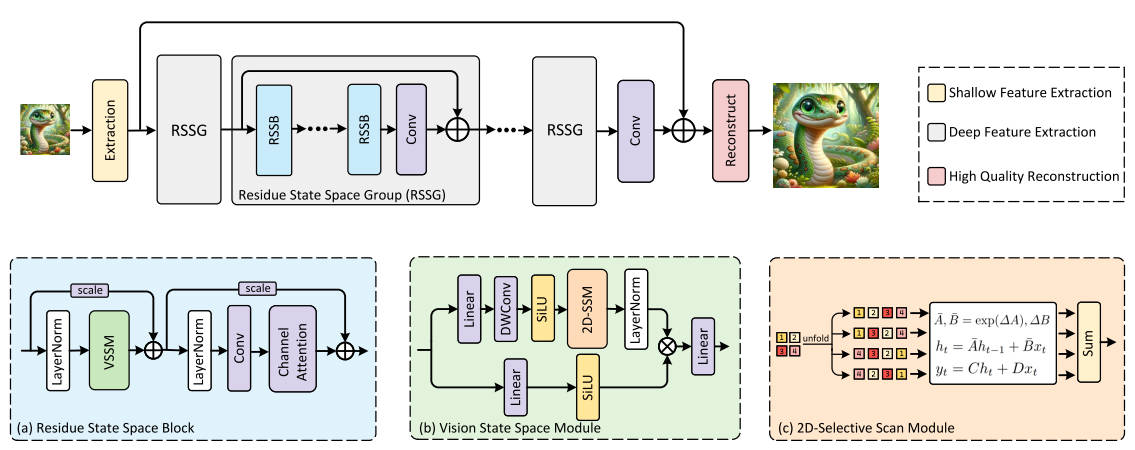
状态空间建模:利用视觉状态空间模块捕获较长距离的像素依赖。
论文信息
- 论文:MambaIR: A Simple Baseline for Image Restoration with State-Space Model,arXiv 2024
核心痛点
图像恢复需要兼顾长距离依赖与局部细节。CNN感受野有限,全局自注意力计算成本较高,而原生Mamba用于二维图像时还存在局部像素遗忘与通道冗余问题。
模块亮点
- 状态空间建模:利用视觉状态空间模块捕获较长距离的像素依赖。
- 局部增强:引入卷积利用邻近像素的相似性,补充局部纹理信息。
- 通道注意力:对不同通道进行重加权,结合残差连接组织特征更新。
- 论文在图像超分辨率和去噪等设置中进行了实验;具体收益需结合数据集、模型规模和训练配置验证。
适用场景
图像超分辨率、图像去噪等低层视觉研究,可作为图像恢复网络深层特征提取模块的参考。
插入位置建议
- 放在浅层特征提取之后、图像重建之前。替换现有残差块或Transformer块时,需要核对通道数、张量布局和重建分支接口;代码依赖mamba_ssm等组件,需先准备相应运行环境。
适用任务
- 视觉特征建模
完整代码
mambair.py
# Code Implementation of the MambaIR Model
import warnings
warnings.filterwarnings("ignore")
import math
import torch
import torch.nn as nn
import torch.nn.functional as F
from functools import partial
from typing import Optional, Callable
from timm.models.layers import DropPath, to_2tuple, trunc_normal_
from mamba_ssm.ops.selective_scan_interface import selective_scan_fn, selective_scan_ref
from einops import rearrange, repeat


"""
最近,选择性结构化状态空间模型,特别是改进版本的Mamba,在线性复杂度的远程依赖建模方面表现出了巨大的潜力。
然而,标准Mamba在低级视觉方面仍然面临一定的挑战,例如局部像素遗忘和通道冗余。在这项工作中,我们引入了局部增强和通道注意力来改进普通 Mamba。
通过这种方式,我们利用了局部像素相似性并减少了通道冗余。大量的实验证明了我们方法的优越性。
"""


NEG_INF = -1000000


class ChannelAttention(nn.Module):
    """Channel attention used in RCAN.
    Args:
        num_feat (int): Channel number of intermediate features.
        squeeze_factor (int): Channel squeeze factor. Default: 16.
    """

    def __init__(self, num_feat, squeeze_factor=16):
        super(ChannelAttention, self).__init__()
        self.attention = nn.Sequential(
            nn.AdaptiveAvgPool2d(1),
            nn.Conv2d(num_feat, num_feat // squeeze_factor, 1, padding=0),
            nn.ReLU(inplace=True),
            nn.Conv2d(num_feat // squeeze_factor, num_feat, 1, padding=0),
            nn.Sigmoid())

    def forward(self, x):
        y = self.attention(x)
        return x * y


class CAB(nn.Module):
    def __init__(self, num_feat, is_light_sr= False, compress_ratio=3,squeeze_factor=30):
        super(CAB, self).__init__()
        if is_light_sr: # we use depth-wise conv for light-SR to achieve more efficient
            self.cab = nn.Sequential(
                nn.Conv2d(num_feat, num_feat, 3, 1, 1, groups=num_feat),
                ChannelAttention(num_feat, squeeze_factor)
            )
        else: # for classic SR
            self.cab = nn.Sequential(
                nn.Conv2d(num_feat, num_feat // compress_ratio, 3, 1, 1),
                nn.GELU(),
                nn.Conv2d(num_feat // compress_ratio, num_feat, 3, 1, 1),
                ChannelAttention(num_feat, squeeze_factor)
            )

    def forward(self, x):
        return self.cab(x)


class Mlp(nn.Module):
    def __init__(self, in_features, hidden_features=None, out_features=None, act_layer=nn.GELU, drop=0.):
        super().__init__()
        out_features = out_features or in_features
        hidden_features = hidden_features or in_features
        self.fc1 = nn.Linear(in_features, hidden_features)
        self.act = act_layer()
        self.fc2 = nn.Linear(hidden_features, out_features)
        self.drop = nn.Dropout(drop)

    def forward(self, x):
        x = self.fc1(x)
        x = self.act(x)
        x = self.drop(x)
        x = self.fc2(x)
        x = self.drop(x)
        return x


class DynamicPosBias(nn.Module):
    def __init__(self, dim, num_heads):
        super().__init__()
        self.num_heads = num_heads
        self.pos_dim = dim // 4
        self.pos_proj = nn.Linear(2, self.pos_dim)
        self.pos1 = nn.Sequential(
            nn.LayerNorm(self.pos_dim),
            nn.ReLU(inplace=True),
            nn.Linear(self.pos_dim, self.pos_dim),
        )
        self.pos2 = nn.Sequential(
            nn.LayerNorm(self.pos_dim),
            nn.ReLU(inplace=True),
            nn.Linear(self.pos_dim, self.pos_dim)
        )
        self.pos3 = nn.Sequential(
            nn.LayerNorm(self.pos_dim),
            nn.ReLU(inplace=True),
            nn.Linear(self.pos_dim, self.num_heads)
        )

    def forward(self, biases):
        pos = self.pos3(self.pos2(self.pos1(self.pos_proj(biases))))
        return pos

    def flops(self, N):
        flops = N * 2 * self.pos_dim
        flops += N * self.pos_dim * self.pos_dim
        flops += N * self.pos_dim * self.pos_dim
        flops += N * self.pos_dim * self.num_heads
        return flops


class Attention(nn.Module):
    r""" Multi-head self attention module with dynamic position bias.

    Args:
        dim (int): Number of input channels.
        num_heads (int): Number of attention heads.
        qkv_bias (bool, optional):  If True, add a learnable bias to query, key, value. Default: True
        qk_scale (float | None, optional): Override default qk scale of head_dim ** -0.5 if set
        attn_drop (float, optional): Dropout ratio of attention weight. Default: 0.0
        proj_drop (float, optional): Dropout ratio of output. Default: 0.0
    """

    def __init__(self, dim, num_heads, qkv_bias=True, qk_scale=None, attn_drop=0., proj_drop=0.,
                 position_bias=True):

        super().__init__()
        self.dim = dim
        self.num_heads = num_heads
        head_dim = dim // num_heads
        self.scale = qk_scale or head_dim ** -0.5
        self.position_bias = position_bias
        if self.position_bias:
            self.pos = DynamicPosBias(self.dim // 4, self.num_heads)

        self.qkv = nn.Linear(dim, dim * 3, bias=qkv_bias)
        self.attn_drop = nn.Dropout(attn_drop)
        self.proj = nn.Linear(dim, dim)
        self.proj_drop = nn.Dropout(proj_drop)

        self.softmax = nn.Softmax(dim=-1)

    def forward(self, x, H, W, mask=None):
        """
        Args:
            x: input features with shape of (num_groups*B, N, C)
            mask: (0/-inf) mask with shape of (num_groups, Gh*Gw, Gh*Gw) or None
            H: height of each group
            W: width of each group
        """
        group_size = (H, W)
        B_, N, C = x.shape
        assert H * W == N
        qkv = self.qkv(x).reshape(B_, N, 3, self.num_heads, C // self.num_heads).permute(2, 0, 3, 1, 4).contiguous()
        q, k, v = qkv[0], qkv[1], qkv[2]

        q = q * self.scale
        attn = (q @ k.transpose(-2, -1))  # (B_, self.num_heads, N, N), N = H*W

        if self.position_bias:
            # generate mother-set
            position_bias_h = torch.arange(1 - group_size[0], group_size[0], device=attn.device)
            position_bias_w = torch.arange(1 - group_size[1], group_size[1], device=attn.device)
            biases = torch.stack(torch.meshgrid([position_bias_h, position_bias_w]))  # 2, 2Gh-1, 2W2-1
            biases = biases.flatten(1).transpose(0, 1).contiguous().float()  # (2h-1)*(2w-1) 2

            # get pair-wise relative position index for each token inside the window
            coords_h = torch.arange(group_size[0], device=attn.device)
            coords_w = torch.arange(group_size[1], device=attn.device)
            coords = torch.stack(torch.meshgrid([coords_h, coords_w]))  # 2, Gh, Gw
            coords_flatten = torch.flatten(coords, 1)  # 2, Gh*Gw
            relative_coords = coords_flatten[:, :, None] - coords_flatten[:, None, :]  # 2, Gh*Gw, Gh*Gw
            relative_coords = relative_coords.permute(1, 2, 0).contiguous()  # Gh*Gw, Gh*Gw, 2
            relative_coords[:, :, 0] += group_size[0] - 1  # shift to start from 0
            relative_coords[:, :, 1] += group_size[1] - 1
            relative_coords[:, :, 0] *= 2 * group_size[1] - 1
            relative_position_index = relative_coords.sum(-1)  # Gh*Gw, Gh*Gw

            pos = self.pos(biases)  # 2Gh-1 * 2Gw-1, heads
            # select position bias
            relative_position_bias = pos[relative_position_index.view(-1)].view(
                group_size[0] * group_size[1], group_size[0] * group_size[1], -1)  # Gh*Gw,Gh*Gw,nH
            relative_position_bias = relative_position_bias.permute(2, 0, 1).contiguous()  # nH, Gh*Gw, Gh*Gw
            attn = attn + relative_position_bias.unsqueeze(0)

        if mask is not None:
            nP = mask.shape[0]
            attn = attn.view(B_ // nP, nP, self.num_heads, N, N) + mask.unsqueeze(1).unsqueeze(
                0)  # (B, nP, nHead, N, N)
            attn = attn.view(-1, self.num_heads, N, N)
            attn = self.softmax(attn)
        else:
            attn = self.softmax(attn)

        attn = self.attn_drop(attn)

        x = (attn @ v).transpose(1, 2).reshape(B_, N, C)
        x = self.proj(x)
        x = self.proj_drop(x)
        return x


class SS2D(nn.Module):
    def __init__(
            self,
            d_model,
            d_state=16,
            d_conv=3,
            expand=2.,
            dt_rank="auto",
            dt_min=0.001,
            dt_max=0.1,
            dt_init="random",
            dt_scale=1.0,
            dt_init_floor=1e-4,
            dropout=0.,
            conv_bias=True,
            bias=False,
            device=None,
            dtype=None,
            **kwargs,
    ):
        factory_kwargs = {"device": device, "dtype": dtype}
        super().__init__()
        self.d_model = d_model
        self.d_state = d_state
        self.d_conv = d_conv
        self.expand = expand
        self.d_inner = int(self.expand * self.d_model)
        self.dt_rank = math.ceil(self.d_model / 16) if dt_rank == "auto" else dt_rank

        self.in_proj = nn.Linear(self.d_model, self.d_inner * 2, bias=bias, **factory_kwargs)
        self.conv2d = nn.Conv2d(
            in_channels=self.d_inner,
            out_channels=self.d_inner,
            groups=self.d_inner,
            bias=conv_bias,
            kernel_size=d_conv,
            padding=(d_conv - 1) // 2,
            **factory_kwargs,
        )
        self.act = nn.SiLU()

        self.x_proj = (
            nn.Linear(self.d_inner, (self.dt_rank + self.d_state * 2), bias=False, **factory_kwargs),
            nn.Linear(self.d_inner, (self.dt_rank + self.d_state * 2), bias=False, **factory_kwargs),
            nn.Linear(self.d_inner, (self.dt_rank + self.d_state * 2), bias=False, **factory_kwargs),
            nn.Linear(self.d_inner, (self.dt_rank + self.d_state * 2), bias=False, **factory_kwargs),
        )
        self.x_proj_weight = nn.Parameter(torch.stack([t.weight for t in self.x_proj], dim=0))  # (K=4, N, inner)
        del self.x_proj

        self.dt_projs = (
            self.dt_init(self.dt_rank, self.d_inner, dt_scale, dt_init, dt_min, dt_max, dt_init_floor,
                         **factory_kwargs),
            self.dt_init(self.dt_rank, self.d_inner, dt_scale, dt_init, dt_min, dt_max, dt_init_floor,
                         **factory_kwargs),
            self.dt_init(self.dt_rank, self.d_inner, dt_scale, dt_init, dt_min, dt_max, dt_init_floor,
                         **factory_kwargs),
            self.dt_init(self.dt_rank, self.d_inner, dt_scale, dt_init, dt_min, dt_max, dt_init_floor,
                         **factory_kwargs),
        )
        self.dt_projs_weight = nn.Parameter(torch.stack([t.weight for t in self.dt_projs], dim=0))  # (K=4, inner, rank)
        self.dt_projs_bias = nn.Parameter(torch.stack([t.bias for t in self.dt_projs], dim=0))  # (K=4, inner)
        del self.dt_projs

        self.A_logs = self.A_log_init(self.d_state, self.d_inner, copies=4, merge=True)  # (K=4, D, N)
        self.Ds = self.D_init(self.d_inner, copies=4, merge=True)  # (K=4, D, N)

        self.selective_scan = selective_scan_fn

        self.out_norm = nn.LayerNorm(self.d_inner)
        self.out_proj = nn.Linear(self.d_inner, self.d_model, bias=bias, **factory_kwargs)
        self.dropout = nn.Dropout(dropout) if dropout > 0. else None

    @staticmethod
    def dt_init(dt_rank, d_inner, dt_scale=1.0, dt_init="random", dt_min=0.001, dt_max=0.1, dt_init_floor=1e-4,
                **factory_kwargs):
        dt_proj = nn.Linear(dt_rank, d_inner, bias=True, **factory_kwargs)

        # Initialize special dt projection to preserve variance at initialization
        dt_init_std = dt_rank ** -0.5 * dt_scale
        if dt_init == "constant":
            nn.init.constant_(dt_proj.weight, dt_init_std)
        elif dt_init == "random":
            nn.init.uniform_(dt_proj.weight, -dt_init_std, dt_init_std)
        else:
            raise NotImplementedError

        # Initialize dt bias so that F.softplus(dt_bias) is between dt_min and dt_max
        dt = torch.exp(
            torch.rand(d_inner, **factory_kwargs) * (math.log(dt_max) - math.log(dt_min))
            + math.log(dt_min)
        ).clamp(min=dt_init_floor)
        # Inverse of softplus: https://github.com/pytorch/pytorch/issues/72759
        inv_dt = dt + torch.log(-torch.expm1(-dt))
        with torch.no_grad():
            dt_proj.bias.copy_(inv_dt)
        # Our initialization would set all Linear.bias to zero, need to mark this one as _no_reinit
        dt_proj.bias._no_reinit = True

        return dt_proj

    @staticmethod
    def A_log_init(d_state, d_inner, copies=1, device=None, merge=True):
        # S4D real initialization
        A = repeat(
            torch.arange(1, d_state + 1, dtype=torch.float32, device=device),
            "n -> d n",
            d=d_inner,
        ).contiguous()
        A_log = torch.log(A)  # Keep A_log in fp32
        if copies > 1:
            A_log = repeat(A_log, "d n -> r d n", r=copies)
            if merge:
                A_log = A_log.flatten(0, 1)
        A_log = nn.Parameter(A_log)
        A_log._no_weight_decay = True
        return A_log

    @staticmethod
    def D_init(d_inner, copies=1, device=None, merge=True):
        # D "skip" parameter
        D = torch.ones(d_inner, device=device)
        if copies > 1:
            D = repeat(D, "n1 -> r n1", r=copies)
            if merge:
                D = D.flatten(0, 1)
        D = nn.Parameter(D)  # Keep in fp32
        D._no_weight_decay = True
        return D

    def forward_core(self, x: torch.Tensor):
        B, C, H, W = x.shape
        L = H * W
        K = 4
        x_hwwh = torch.stack([x.view(B, -1, L), torch.transpose(x, dim0=2, dim1=3).contiguous().view(B, -1, L)], dim=1).view(B, 2, -1, L)
        xs = torch.cat([x_hwwh, torch.flip(x_hwwh, dims=[-1])], dim=1) # (1, 4, 192, 3136)

        x_dbl = torch.einsum("b k d l, k c d -> b k c l", xs.view(B, K, -1, L), self.x_proj_weight)
        dts, Bs, Cs = torch.split(x_dbl, [self.dt_rank, self.d_state, self.d_state], dim=2)
        dts = torch.einsum("b k r l, k d r -> b k d l", dts.view(B, K, -1, L), self.dt_projs_weight)
        xs = xs.float().view(B, -1, L)
        dts = dts.contiguous().float().view(B, -1, L) # (b, k * d, l)
        Bs = Bs.float().view(B, K, -1, L)
        Cs = Cs.float().view(B, K, -1, L) # (b, k, d_state, l)
        Ds = self.Ds.float().view(-1)
        As = -torch.exp(self.A_logs.float()).view(-1, self.d_state)
        dt_projs_bias = self.dt_projs_bias.float().view(-1) # (k * d)
        out_y = self.selective_scan(
            xs, dts,
            As, Bs, Cs, Ds, z=None,
            delta_bias=dt_projs_bias,
            delta_softplus=True,
            return_last_state=False,
        ).view(B, K, -1, L)
        assert out_y.dtype == torch.float

        inv_y = torch.flip(out_y[:, 2:4], dims=[-1]).view(B, 2, -1, L)
        wh_y = torch.transpose(out_y[:, 1].view(B, -1, W, H), dim0=2, dim1=3).contiguous().view(B, -1, L)
        invwh_y = torch.transpose(inv_y[:, 1].view(B, -1, W, H), dim0=2, dim1=3).contiguous().view(B, -1, L)

        return out_y[:, 0], inv_y[:, 0], wh_y, invwh_y

    def forward(self, x: torch.Tensor, **kwargs):
        B, H, W, C = x.shape

        xz = self.in_proj(x)
        x, z = xz.chunk(2, dim=-1)

        x = x.permute(0, 3, 1, 2).contiguous()
        x = self.act(self.conv2d(x))
        y1, y2, y3, y4 = self.forward_core(x)
        assert y1.dtype == torch.float32
        y = y1 + y2 + y3 + y4
        y = torch.transpose(y, dim0=1, dim1=2).contiguous().view(B, H, W, -1)
        y = self.out_norm(y)
        y = y * F.silu(z)
        out = self.out_proj(y)
        if self.dropout is not None:
            out = self.dropout(out)
        return out


class VSSBlock(nn.Module):
    def __init__(
            self,
            hidden_dim: int = 0,
            drop_path: float = 0,
            norm_layer: Callable[..., torch.nn.Module] = partial(nn.LayerNorm, eps=1e-6),
            attn_drop_rate: float = 0,
            d_state: int = 16,
            expand: float = 2.,
            is_light_sr: bool = False,
            **kwargs,
    ):
        super().__init__()
        self.ln_1 = norm_layer(hidden_dim)
        self.self_attention = SS2D(d_model=hidden_dim, d_state=d_state,expand=expand,dropout=attn_drop_rate, **kwargs)
        self.drop_path = DropPath(drop_path)
        self.skip_scale= nn.Parameter(torch.ones(hidden_dim))
        self.conv_blk = CAB(hidden_dim,is_light_sr)
        self.ln_2 = nn.LayerNorm(hidden_dim)
        self.skip_scale2 = nn.Parameter(torch.ones(hidden_dim))


    def forward(self, input, x_size):
        # x [B,HW,C]
        B, L, C = input.shape
        input = input.view(B, *x_size, C).contiguous()  # [B,H,W,C]
        x = self.ln_1(input)
        x = input*self.skip_scale + self.drop_path(self.self_attention(x))
        x = x*self.skip_scale2 + self.conv_blk(self.ln_2(x).permute(0, 3, 1, 2).contiguous()).permute(0, 2, 3, 1).contiguous()
        x = x.view(B, -1, C).contiguous()
        return x


if __name__ == '__main__':
    # 初始化VSSBlock模块,hidden_dim为128
    block = VSSBlock(hidden_dim=128, drop_path=0.1, attn_drop_rate=0.1, d_state=16, expand=2.0, is_light_sr=False)

    # 将模块转移到合适的设备上
    device = torch.device("cuda" if torch.cuda.is_available() else "cpu")
    block = block.to(device)

    # 生成随机输入张量,尺寸为[B, H*W, C],这里模拟的是批次大小为4,每个图像的尺寸是32x32,通道数为128
    B, H, W, C = 4, 32, 32, 128
    input_tensor = torch.rand(B, H * W, C).to(device)

    # 计算输出
    output_tensor = block(input_tensor, (H, W))

    # 打印输入和输出张量的尺寸
    print("Input tensor size:", input_tensor.size())
    print("Output tensor size:", output_tensor.size())
环境与依赖
Python 3.9+
继续浏览
下一篇MAOM 平台测量感知层在回归输出之后加入固定平台尺度、面积项和平台内中心化的低秩切片截距,用负二项分布区分基因与平台的计数噪声。无需改图像骨干,论文对新切片将截距积分读出。相关资源
模块2026-11-20
ASSM 注意力状态空间模块
非因果状态空间:发现状态空间方程的输出矩阵 C 相当于注意力里的 Query,把代表全图相似像素的可学习提示(prompt)残差注入 C,每个像素都能查询扫描序列外的像素,单次扫描即可全图感知
图像复原超分辨率Mamba
计算机视觉MIT
模块2026-11-20
EVM 高效视觉Mamba模块
重活搬进隐藏状态:HSM-SSD 先把 L 个 token 压成 N 个共享隐藏状态(N≪L),通道混合直接在 N×D 隐藏状态上完成,全局交互复杂度降到 O(ND²+LND)
计算机视觉MambaEVM
计算机视觉MIT
模块2026-11-20
EVSS 高效视觉状态空间模块
先变形、再单向扫描:每个 EVS 块只做一次单向 S6 选择性扫描,扫描前先翻转或转置特征、奇偶交替,近零代价从不同方向捕获非局部信息,每 4 个模块自动还原空间结构
计算机视觉图像复原EVSS
计算机视觉MIT