模块更新于 2026-11-21· 浏览 2· 下载 2
nnMamba 医学分割
原理创新:融合CNN局部特征提取的归纳偏置和Mamba长序列高效建模能力,提出MICCSS基础块,同时实现通道、空间双维度的长距离依赖建模,适配小样本医影数据特性。
结构图
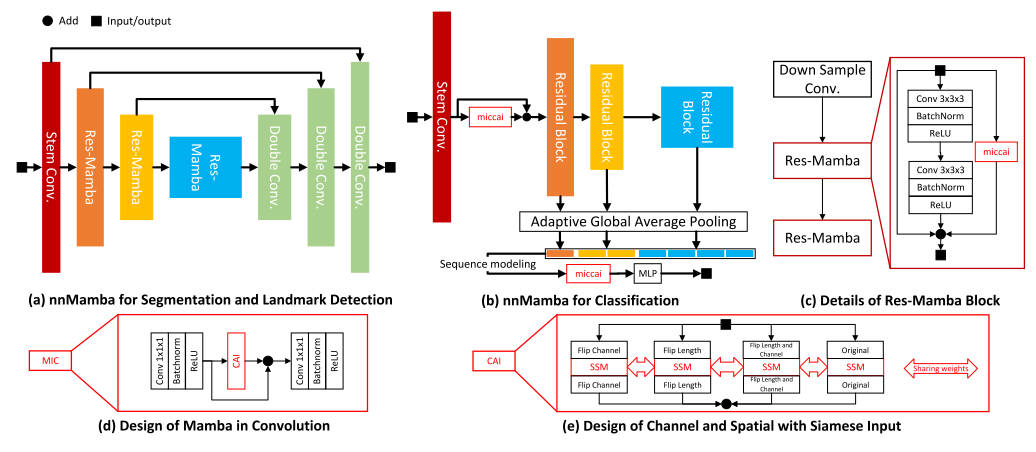
原理创新:融合CNN局部特征提取的归纳偏置和Mamba长序列高效建模能力,提出MICCSS基础块,同时实现通道、空间双维度的长距离依赖建模,适配小样本医影数据特性。
核心痛点
3D医学影像任务中,传统CNN感受野有限,无法有效捕捉长距离体素依赖;Transformer的自注意力机制随输入尺寸平方增长,处理高维3D数据计算量爆炸;现有Mamba类架构缺乏适配3D医影多任务的通用解决方案。
模块亮点
- 原理创新:融合CNN局部特征提取的归纳偏置和Mamba长序列高效建模能力,提出MICCSS基础块,同时实现通道、空间双维度的长距离依赖建模,适配小样本医影数据特性。
- 性能全面SOTA:覆盖3类核心任务,BraTS脑肿瘤分割平均Dice达89.97,AMOS MRI分割mDice领先nnUNet 6.35%;AD疾病分类AUC达95.81%;胎儿关键点检测平均误差低至2.11,均超越现有最优方案。
- 轻量高效:参数量仅15.55M,FLOPs为141G,相比nnUNet减少50%参数量、79%计算量,单卡V100即可训练。
适用场景
CV领域3D医学影像方向,适配UNet、ResNet等主流3D医影架构,可解决3D影像语义分割、疾病分类、关键点检测三类核心任务,尤其适配小样本、大尺寸3D医影数据的长距离建模需求。
插入位置建议
- 分割/关键点检测任务可直接替换UNet编码器中的普通残差卷积块;分类任务插入主干网络浅层特征提取层之后、全局池化层之前的位置即可。
适用任务
- CV领域3D医学影像方向
- 适配UNet
- ResNet
完整代码
nnm.py
import torch
import torch.nn as nn
import torch.nn.functional as F
from mamba_ssm import Mamba


# nnMamba:使用状态空间模型进行 3D 生物医学图像分割、分类和地标检测


def conv3x3(in_planes, out_planes, stride=1, groups=1, dilation=1):
    """3x3 convolution with padding."""
    return nn.Conv3d(
        in_planes,
        out_planes,
        kernel_size=3,
        stride=stride,
        padding=dilation,
        groups=groups,
        bias=False,
        dilation=dilation,
    )


def conv1x1(in_planes, out_planes, stride=1):
    """1x1 convolution."""
    return nn.Conv3d(in_planes, out_planes, kernel_size=1, stride=stride, bias=False)


class BasicBlock(nn.Module):
    expansion = 1

    def __init__(self, inplanes, planes, stride=1, downsample=None, mamba_layer=None):
        super(BasicBlock, self).__init__()

        # Both self.conv1 and self.downsample layers downsample the input when stride != 1
        self.conv1 = conv3x3(inplanes, planes, stride)
        self.bn1 = nn.BatchNorm3d(planes)
        self.relu = nn.ReLU(inplace=True)
        self.conv2 = conv3x3(planes, planes)
        self.bn2 = nn.BatchNorm3d(planes)
        self.mamba_layer = mamba_layer
        self.downsample = downsample
        self.stride = stride

    def forward(self, x):
        identity = x

        out = self.conv1(x)
        out = self.bn1(out)
        out = self.relu(out)

        out = self.conv2(out)
        out = self.bn2(out)
        if self.mamba_layer is not None:
            global_att = self.mamba_layer(x)
            out += global_att
        if self.downsample is not None:
            # if self.mamba_layer is not None:
            #     global_att = self.mamba_layer(x)
            #     identity = self.downsample(x+global_att)
            # else:
            identity = self.downsample(x)

        out += identity
        out = self.relu(out)

        return out


def make_res_layer(inplanes, planes, blocks, stride=1, mamba_layer=None):
    downsample = nn.Sequential(
        conv1x1(inplanes, planes, stride),
        nn.BatchNorm3d(planes),
    )

    layers = []
    layers.append(BasicBlock(inplanes, planes, stride, downsample))
    for _ in range(1, blocks):
        layers.append(BasicBlock(planes, planes, mamba_layer=mamba_layer))

    return nn.Sequential(*layers)


class MambaLayer(nn.Module):
    def __init__(self, dim, d_state=16, d_conv=4, expand=2):
        super().__init__()
        self.dim = dim
        self.nin = conv1x1(dim, dim)
        self.nin2 = conv1x1(dim, dim)
        self.norm2 = nn.BatchNorm3d(dim) # LayerNorm
        self.relu2 = nn.ReLU(inplace=True)
        self.relu3 = nn.ReLU(inplace=True)

        self.norm = nn.BatchNorm3d(dim) # LayerNorm
        self.relu = nn.ReLU(inplace=True)
        self.mamba = Mamba(
            d_model=dim,  # Model dimension d_model
            d_state=d_state,  # SSM state expansion factor
            d_conv=d_conv,  # Local convolution width
            expand=expand  # Block expansion factor
        )

    def forward(self, x):
        B, C = x.shape[:2]
        x = self.nin(x)
        x = self.norm(x)
        x = self.relu(x)
        act_x = x
        assert C == self.dim
        n_tokens = x.shape[2:].numel()
        img_dims = x.shape[2:]
        x_flat = x.reshape(B, C, n_tokens).transpose(-1, -2)

        # x_mamba = self.mamba(x_flat)

        x_flip_l = torch.flip(x_flat, dims=[2])
        x_flip_c = torch.flip(x_flat, dims=[1])
        x_flip_lc = torch.flip(x_flat, dims=[1,2])
        x_ori = self.mamba(x_flat)
        x_mamba_l = self.mamba(x_flip_l)
        x_mamba_c = self.mamba(x_flip_c)
        x_mamba_lc = self.mamba(x_flip_lc)
        x_ori_l = torch.flip(x_mamba_l, dims=[2])
        x_ori_c = torch.flip(x_mamba_c, dims=[1])
        x_ori_lc = torch.flip(x_mamba_lc, dims=[1,2])
        x_mamba = (x_ori+x_ori_l+x_ori_c+x_ori_lc)/4

        out = x_mamba.transpose(-1, -2).reshape(B, C, *img_dims)
        # act_x = self.relu3(x)
        out += act_x
        out = self.nin2(out)
        out = self.norm2(out)
        out = self.relu2(out)
        return out


class DoubleConv(nn.Module):

    def __init__(self, in_ch, out_ch, stride=1, kernel_size=3):
        super(DoubleConv, self).__init__()
        self.conv = nn.Sequential(
            nn.Conv3d(in_ch, out_ch, kernel_size=kernel_size, stride=stride, padding=int(kernel_size / 2)),
            nn.BatchNorm3d(out_ch),
            nn.ReLU(inplace=True),
            nn.Conv3d(out_ch, out_ch, 3, padding=1, dilation=1),
            nn.BatchNorm3d(out_ch),
            nn.ReLU(inplace=True),
        )

    def forward(self, input):
        return self.conv(input)


class SingleConv(nn.Module):

    def __init__(self, in_ch, out_ch):
        super(SingleConv, self).__init__()
        self.conv = nn.Sequential(nn.Conv3d(in_ch, out_ch, 3, padding=1), nn.BatchNorm3d(out_ch), nn.ReLU(inplace=True))

    def forward(self, input):
        return self.conv(input)

class Attentionlayer(nn.Module):
    def __init__(self,dim,r=16,act='relu'):
        super(Attentionlayer, self).__init__()
        self.layer1 = nn.Linear(dim, int(dim//r))
        self.layer2 = nn.Linear(int(dim//r), dim)
        self.relu = nn.ReLU()
        self.sigmoid = nn.Sigmoid()
    def forward(self, inp):
        att = self.sigmoid(self.layer2(self.relu(self.layer1(inp))))
        return att.unsqueeze(-1)


class nnMamba(nn.Module):
    def __init__(self, in_ch=3, channels=32, blocks=3, number_classes=3):
        super(nnMamba, self).__init__()
        self.in_conv = DoubleConv(in_ch, channels, stride=2, kernel_size=3)
        # self.mamba_layer_stem = MambaLayer(channels)
        self.pooling = nn.AdaptiveAvgPool3d((1, 1, 1))

        self.att1 = Attentionlayer(channels)
        self.layer1 = make_res_layer(channels, channels * 2, blocks, stride=2, mamba_layer=MambaLayer(channels*2))

        self.att2 = Attentionlayer(channels*2)
        self.layer2 = make_res_layer(channels * 2, channels * 4, blocks, stride=2, mamba_layer=MambaLayer(channels*4))
        # self.mamba_layer_2 = MambaLayer(channels*4)

        self.att3 = Attentionlayer(channels*4)
        self.layer3 = make_res_layer(channels * 4, channels * 8, blocks, stride=2, mamba_layer=MambaLayer(channels*8))
        # self.mamba_layer_3 = MambaLayer(channels*8)

        self.up5 = nn.Upsample(scale_factor=2, mode='trilinear', align_corners=False)
        self.conv5 = DoubleConv(channels * 12, channels * 4)
        self.up6 = nn.Upsample(scale_factor=2, mode='trilinear', align_corners=False)
        self.conv6 = DoubleConv(channels * 6, channels * 2)
        self.up7 = nn.Upsample(scale_factor=2, mode='trilinear', align_corners=False)
        self.conv7 = DoubleConv(channels * 3, channels)
        self.up8 = nn.Upsample(scale_factor=2, mode='trilinear', align_corners=False)
        self.conv8 = DoubleConv(channels, number_classes)

    def forward(self, x):
        c1 = self.in_conv(x)
        scale_f1 = self.att1(self.pooling(c1).reshape(c1.shape[0], c1.shape[1])).reshape(c1.shape[0], c1.shape[1], 1, 1, 1)
        # c1_s = self.mamba_layer_stem(c1) + c1
        c2 = self.layer1(c1)
        # c2_s = self.mamba_layer_1(c2) + c2
        scale_f2 = self.att2(self.pooling(c2).reshape(c2.shape[0], c2.shape[1])).reshape(c2.shape[0], c2.shape[1], 1, 1, 1)

        c3 = self.layer2(c2)
        # c3_s = self.mamba_layer_2(c3) + c3
        scale_f3 = self.att3(self.pooling(c3).reshape(c3.shape[0], c3.shape[1])).reshape(c3.shape[0], c3.shape[1], 1, 1, 1)
        c4 = self.layer3(c3)
        # c4_s = self.mamba_layer_3(c4) + c4

        up_5 = self.up5(c4)
        merge5 = torch.cat([up_5, c3*scale_f3], dim=1)
        c5 = self.conv5(merge5)
        up_6 = self.up6(c5)
        merge6 = torch.cat([up_6, c2*scale_f2], dim=1)
        c6 = self.conv6(merge6)
        up_7 = self.up7(c6)
        merge7 = torch.cat([up_7, c1*scale_f1], dim=1)
        c7 = self.conv7(merge7)
        up_8 = self.up8(c7)
        c8 = self.conv8(up_8)
        return c8


if __name__ == '__main__':
    block = nnMamba().cuda()
    input = torch.rand(8, 3, 128, 128, 128).cuda()
    output = block(input)
    print(input.size())
    print(output.size())
环境与依赖
Python 3.9+
继续浏览
下一篇ODCNOV ODConv 全维度动态卷积原理创新:提出并行多维注意力机制,同时对卷积核的空间、输入通道、输出通道、核数量四个维度生成互补注意力,逐维度加权卷积核,大幅提升特征提取能力。相关资源
模块2026-11-20
ConvSSM 卷积状态空间模块
卷积SSM双分支:输入按通道一分为二,一半卷积分支抠局部细节,另一半经深度卷积送入 SS2D 四方向选择性扫描建模长程依赖,拼接后 1×1 卷积融合、残差输出
医学图像图像分类ConvSSM
医学影像MIT
模块2026-11-20
CTR-GC 通道拓扑细化图卷积
细化代替独立学习:先学所有通道共享的拓扑作为通用先验,再用逐样本动态推断的通道特定相关性去细化,额外参数极少
计算机视觉骨架动作识别CTRGC
医学影像MIT
模块2026-11-20
FreqSelect 频率选择模块
分频段动态加权:按倍频程把特征分解成 4 个频段,对每个频段预测空间选择图分别重加权,压低背景与物体中心的高频、保留物体边界的高频
语义分割计算机视觉FreqSelect
医学影像MIT