模块更新于 2026-11-20· 浏览 0· 下载 0
PeakConv 峰值卷积
把 CFAR 装进卷积:把感受野重定义为峰值感受野 PRF,端到端学习"中心响应减干扰响应"的峰值检测逻辑,固定阈值变成可学习权重
结构图
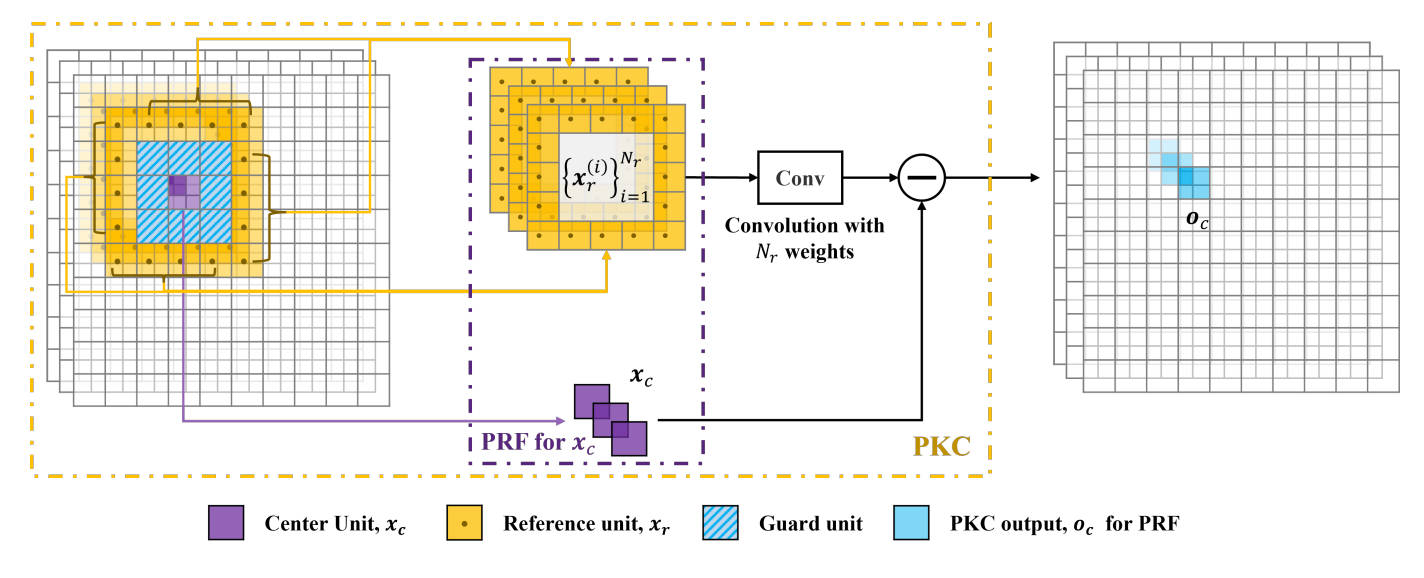
把 CFAR 装进卷积:把感受野重定义为峰值感受野 PRF,端到端学习"中心响应减干扰响应"的峰值检测逻辑,固定阈值变成可学习权重
论文信息
- 论文:PeakConv: Learning Peak Receptive Field for Radar Semantic Segmentation
- 出处:CVPR 2023
核心痛点
常规卷积和空洞、可变形等变体的感受野都按光学图像的物体表征定义,而雷达目标签名本质是局部的峰值频率响应,硬套既冗余又低效;传统 CFAR 峰值检测贴合雷达机理,却要手工精调超参,还给不出目标类别。
模块亮点
- 把 CFAR 装进卷积:把感受野重定义为峰值感受野 PRF,端到端学习"中心响应减干扰响应"的峰值检测逻辑,固定阈值变成可学习权重
- 两个版本任选:vanilla-PKC 估计干扰时排除中心单元;ReDA-PKC 直接对"中心−参考"响应差做卷积,还解除了输入输出通道数相等的约束
- 涨点实打实:同框架消融中 ReDA-PKC 多帧版 RD 视图 mIoU 60.7%,比普通 3×3 卷积高 4.6 个点,也压过最强的空洞卷积(59.9%);整体模型 PKCIn* 以 6.3M 参数在 CARRADA 双视角刷新 SoTA
适用场景
领域为雷达感知 / 雷达语义分割;原文在 CARRADA 上验证了 RD、RA 双视角的行人、骑行者、车辆、背景四类分割;可迁移到雷达目标检测、自动驾驶与无人机预警等任务。
插入位置建议
- 替换编码器里的常规 / 空洞 / 可变形卷积块,原文 PKCIn-Net 把两层 PKC 插在单视角编码分支的 3D 卷积之后
- 参照 PKCOn-Net,用 PeakConv 层堆出纯峰值卷积的编码分支,单帧输入即可预测
- 移植到 RSS-Net、ROD-Net、MVRSS 等网络时,注意 Doppler 维的保护带宽要与非 Doppler 维分开设置
适用任务
- 雷达感知
- 雷达语义分割
完整代码
peakconv.py
import torch
import torch.nn as nn
import warnings
warnings.filterwarnings("ignore")

"""CVPR2023
基于机器学习的现代技术在自动雷达场景理解方面显示出相当大的潜力。在这些努力中,雷达语义分割 (RSS) 可以提供更精细和详细的信息,包括雷达有效感受野内的移动物体和背景杂波。
受卷积网络在各种视觉计算任务中的成功的推动,这些网络也被引入来解决 RSS 任务。但是,常规卷积运算和修改后的卷积运算都不是专门用于解释雷达信号的。现有卷积的感受野由光信号中的对象表示定义,但这两个信号具有不同的感知机制。
在经典的雷达信号处理中,根据局部峰值响应(即 CFAR 检测)来检测目标特征。受这个想法的启发,我们将卷积运算的感受野重新定义为峰值感受野(PRF),并提出了峰值卷积运算(PeakConv)来学习端到端网络中的对象特征。
通过将提出的 PeakConv 层合并到编码器中,与其他 SoTA 方法相比,我们的 RSS 网络可以在从 FMCW 雷达收集的多视图实测数据集上获得更好的分割结果。
"""


class DoubleConvBlock(nn.Module):
    """ (2D conv => BN => LeakyReLU) * 2 """

    def __init__(self, in_ch, out_ch, k_size, pad, dil):
        super().__init__()
        self.block = nn.Sequential(
            nn.Conv2d(in_ch, out_ch, kernel_size=k_size, padding=pad, dilation=dil),
            nn.BatchNorm2d(out_ch),
            nn.LeakyReLU(inplace=True),
            nn.Conv2d(out_ch, out_ch, kernel_size=k_size, padding=pad, dilation=dil),
            nn.BatchNorm2d(out_ch),
            nn.LeakyReLU(inplace=True)
        )

    def forward(self, x):
        x = self.block(x)
        return x

class DoubleTPKCBlock(nn.Module):
    """ (Temporal PKC block => BN => LeakyReLU) * 2 """
    """ Input: x (B, in_ch, n_frames, h, w) """
    """ Output x (B, out_ch, h, w) """

    def __init__(self, n_frames, in_ch, out_ch, bias, rb, gb_dop, gb, sig):
        super(DoubleTPKCBlock, self).__init__()
        self.n_frames = n_frames
        self.bias = bias
        self.refer_band = rb
        self.guard_band_dop = gb_dop
        self.guard_band = gb
        self.signal_type = sig

        self.tpkc1 = PeakConv2D(in_ch, out_ch, bias=self.bias,
                                refer_band=self.refer_band,
                                guard_band_dop=self.guard_band_dop,
                                guard_band=self.guard_band,
                                signal_type=self.signal_type)
        self.bn1 = nn.BatchNorm2d(out_ch)
        self.act1 = nn.LeakyReLU(inplace=True)

        self.tpkc2 = PeakConv2D(out_ch, out_ch, bias=self.bias,
                                refer_band=self.refer_band,
                                guard_band_dop=self.guard_band_dop,
                                guard_band=self.guard_band,
                                signal_type=self.signal_type)
        self.bn2 = nn.BatchNorm2d(out_ch)
        self.act2 = nn.LeakyReLU(inplace=True)
        self.temp_avg_pool = nn.AvgPool3d((self.n_frames, 1, 1))

    def forward(self, x):
        # (B,in_ch,n_frames,h,w) ==> (B,n_frames,in_ch,h,w)
        x1 = x.contiguous().permute(0, 2, 1, 3, 4)
        # (B,n_frames,in_ch,h,w) ==> (B*n_frames,in_ch,h,w)
        x1 = x1.contiguous().flatten(start_dim=0, end_dim=1)
        # PKC block output: (B*n_frames,out_ch,h,w)
        x1 = self.tpkc1(x1)
        x1 = self.bn1(x1)
        x1 = self.act1(x1)
        x1 = self.tpkc2(x1)
        x1 = self.bn2(x1)
        x1 = self.act2(x1)
        # (B*n_frames,out_ch,h,w) ==> (B,out_ch,n_frames,h,w)
        x1 = x1.contiguous().view(x.size(0), x1.size(1), self.n_frames, x1.size(2), x1.size(3))
        x1 = self.temp_avg_pool(x1)
        return x1


class ConvBlock(nn.Module):
    """ (2D conv => BN => LeakyReLU) """

    def __init__(self, in_ch, out_ch, k_size, pad, dil):
        super().__init__()
        self.block = nn.Sequential(
            nn.Conv2d(in_ch, out_ch, kernel_size=k_size, padding=pad, dilation=dil),
            nn.BatchNorm2d(out_ch),
            nn.LeakyReLU(inplace=True)
        )

    def forward(self, x):
        x = self.block(x)
        return x


# reda peak_conv zlw @20220624
# Peak Conv with fixed guard banwidth (gb) and dense reference receptive field (RRF)
class PeakConv2D(nn.Module):
    def __init__(self, in_ch, out_ch, bias, refer_band, guard_band_dop, guard_band, signal_type):
        """
        Args:
            refer_band: a single integer value or integer vector of two values.
            guard_band_dop: guard bandwidth for doppler input
            guard_band: guard banwidth for non-doppler input
            signal_type in ('range_doppler', 'angle_doppler', 'range_angle').
            k_size, padding and stride are computed using the input fixed guard bandwidth
            input: x in the shape of BxCxHxW
        """
        super(PeakConv2D, self).__init__()
        self.signal_type = signal_type
        if self.signal_type in ('range_doppler', 'angle_doppler'):
            # guard_band should be bi-lateral
            self.guard_band = (guard_band_dop, guard_band_dop)
            # padding order: l-r-t-b
            self.padding = (self.guard_band[1] + refer_band,
                            self.guard_band[1] + refer_band,
                            self.guard_band[0] + refer_band,
                            self.guard_band[0] + refer_band)
        else:
            self.guard_band = (guard_band, guard_band)
            # padding order: l-r-t-b
            self.padding = (self.guard_band[1] + refer_band,
                            self.guard_band[1] + refer_band,
                            self.guard_band[0] + refer_band,
                            self.guard_band[0] + refer_band)
        self.refer_band = refer_band
        self.kernel_size = (self.guard_band[0] + self.guard_band[1] + self.refer_band * 2), 4
        self.stride = self.kernel_size
        # padding order: l-r-t-b
        self.zero_padding = nn.ZeroPad2d(self.padding)
        self.bias = bias
        self.pc_strd = 1
        # conv block for peak receptive field (PRF) in x
        # take PRF as input and output the center point output of PRF;
        # kernel channel = in_ch*2: depth_concat(p_c, p_r) for relation
        # kernel channel = in_ch depth-diff: p_c - p_r for reda
        # since each p_c is expanded as a tensor of kernel scale RF, the stride = kernel_size
        '''
        self.relation_conv = ConvBlock(in_ch*2, out_ch,
                                       k_size=1,
                                       pad=0,
                                       dil=1)
                                       '''
        self.peak_conv = nn.Conv2d(in_ch, out_ch,
                                   kernel_size=self.kernel_size,
                                   padding=0,
                                   stride=self.stride,
                                   bias=self.bias)
        self.peak_conv.register_backward_hook(self._set_lr)

    @staticmethod
    # set learning rate for peak_conv
    def _set_lr(module, grad_input, grad_output):
        grad_input = (grad_input[i] * 0.1 for i in range(len(grad_input)))
        grad_output = (grad_output[i] * 0.1 for i in range(len(grad_output)))

    def forward(self, x):
        h, w = x.shape[2], x.shape[3]
        rb = self.refer_band
        gb = self.guard_band
        k_pk = self.kernel_size
        N = k_pk[0] * k_pk[1]
        dtype = x.data.type()
        b = x.size(0)

        # let p_r denote the reference point positions
        # p_r shape: Bx2NxHxW
        p_r = self._get_p_r(b, h, w, N, dtype)
        # sample x_r (b, c, h, w, N) using p_r
        x_r = self._sample_x(self.zero_padding(x), p_r, N)

        # vanilla-pkc
        # x_r = self._reshape_x_prf(k_pk[0], k_pk[1], x_r)
        # x_r = self.peak_conv(x_r)
        # x = x - x_r

        # reda-pkc (b, c, h, w, N) ==> (b, 2c, h, w, N)
        # sample x_c (b, c, h, w, N) using p_c
        p_c = self._get_p_c(b, h, w, N, dtype)
        x_c = self._sample_x(self.zero_padding(x), p_c, N)
        # (b, 2c, h*k_pk[0], w*k_pk[1])
        x = self._reshape_x_prf(k_pk[0], k_pk[1], x_c - x_r)
        # out: (b, c, h, w)
        x = self.peak_conv(x)

        return x

    # getting p_c (the center point coords) from the padded grid of input x
    def _get_p_c(self, b, h, w, N, dtype):
        # generating pc_grid
        p_c_x, p_c_y = torch.meshgrid(
            torch.arange(self.padding[2], h * self.pc_strd + self.padding[2], self.pc_strd),
            torch.arange(self.padding[0], w * self.pc_strd + self.padding[0], self.pc_strd))
        p_c_x = torch.flatten(p_c_x).view(1, 1, h, w).repeat(1, N, 1, 1)
        p_c_y = torch.flatten(p_c_y).view(1, 1, h, w).repeat(1, N, 1, 1)
        # p_c: 1x2NxHxW
        p_c = torch.cat([p_c_x, p_c_y], 1).type(dtype)
        # (B, 2N, h, w)
        p_c = p_c.repeat(b, 1, 1, 1)
        return p_c

    # generating peak receptive field grid
    def _gen_prf_grid(self, rb, gb, N, dtype):
        h_t = -(rb + gb[0])
        h_d = rb + gb[0]
        w_l = -(rb + gb[1])
        w_r = rb + gb[1]
        w_prf = (rb + gb[1]) * 2 + 1
        h_prf = (rb + gb[0]) * 2 + 1

        prf_x_idx, prf_y_idx = torch.meshgrid(
            torch.arange(h_t, h_d + 1),
            torch.arange(w_l, w_r + 1))

        # grid_size*2, 1 grid_size = (h_d*2+1) * (w_r*2+1)
        # taking positions clockwise
        prf_xt = prf_x_idx[0:rb]
        prf_xr = prf_x_idx[rb:(h_prf - 2 * rb + 1), (w_prf - rb):w_prf]
        prf_xd = prf_x_idx[(h_prf - rb):h_prf]
        prf_xl = prf_x_idx[rb:(h_prf - 2 * rb + 1), 0:rb]
        prf_x = torch.cat([torch.flatten(prf_xt),
                           torch.flatten(prf_xr),
                           torch.flatten(prf_xd),
                           torch.flatten(prf_xl)], 0)
        prf_yt = prf_y_idx[0:rb]
        prf_yr = prf_y_idx[rb:(h_prf - 2 * rb + 1), (w_prf - rb):w_prf]
        prf_yd = prf_y_idx[(h_prf - rb):h_prf]
        prf_yl = prf_y_idx[rb:(h_prf - 2 * rb + 1), 0:rb]
        prf_y = torch.cat([torch.flatten(prf_yt),
                           torch.flatten(prf_yr),
                           torch.flatten(prf_yd),
                           torch.flatten(prf_yl)], 0)

        prf = torch.cat([prf_x, prf_y], 0)
        prf = prf.view(1, 2 * N, 1, 1).type(dtype)
        return prf

    # getting p_r positions from each p_c
    def _get_p_r(self, b, h, w, N, dtype):
        rb = self.refer_band
        gb = self.guard_band
        # (1, 2N, 1, 1)
        prf = self._gen_prf_grid(rb, gb, N, dtype)
        # (B, 2N, h, w)
        p_c = self._get_p_c(b, h, w, N, dtype)
        # (B, 2N, h, w)
        p_r = p_c + prf
        return p_r

    # sampling x using p_r or p_c
    def _sample_x(self, x_pad, p, N):
        p = p.contiguous().permute(0, 2, 3, 1).floor()
        b, h, w, _ = p.size()
        h_pad = x_pad.size(2)
        w_pad = x_pad.size(3)
        c = x_pad.size(1)
        # (b, c, h_pad*w_pad)
        # strech each spatial channel of x_pad as 1-D vector
        x_pad = x_pad.contiguous().view(b, c, -1)
        # (b, h_pad, w_pad, N)
        # transform spatial coord of p into the 1-D index
        index = p[..., :N] * w_pad + p[..., N:]
        # (b, c, h*w*N)
        index = index.contiguous().unsqueeze(dim=1).expand(-1, c, -1, -1, -1).contiguous().view(b, c, -1)
        index = index.long()
        x_r = x_pad.gather(dim=-1, index=index).contiguous().view(b, c, h, w, N)
        return x_r

    @staticmethod
    # reshape the x_prf
    def _reshape_x_prf(k_h, k_w, x_prf):
        b, c, h, w, N = x_prf.size()
        x_prf = torch.cat([x_prf[..., s:s + k_w].contiguous().view(b, c, h, w * k_w) for s in range(0, N, k_w)], dim=-1)
        x_prf = x_prf.contiguous().view(b, c, h * k_h, w * k_w)
        return x_prf


if __name__ == '__main__':
    in_ch = 3  # 输入通道数
    out_ch = 3  # 输出通道数
    bias = True  # 是否使用偏置
    refer_band = 1  # 参考带宽
    guard_band_dop = 1  # Doppler 输入的保护带宽
    guard_band = 1  # 非 Doppler 输入的保护带宽
    signal_type = 'range_doppler'  # 可以为 'range_doppler', 'angle_doppler', 'range_angle'


    input_tensor = torch.rand(32, in_ch, 64, 64)

    peak_conv = PeakConv2D(in_ch=in_ch, out_ch=out_ch, bias=bias, refer_band=refer_band, guard_band_dop=guard_band_dop, guard_band=guard_band, signal_type=signal_type)

    output_tensor = peak_conv(input_tensor)

    print("输入张量大小:", input_tensor.size())
    print("输出张量大小:", output_tensor.size())
环境与依赖
Python 3.9+
继续浏览
下一篇PF-Net 点分形网络只补缺不动原点:只预测缺失区域的点,已知点分毫不动,完整保留原始空间排列,让网络专注感知缺失部分的位置与结构相关资源
模块2026-11-20
Pag 像素注意力引导融合模块
像素级选择性融合:两支对应像素的向量各过 1×1 卷积后点积、再过 Sigmoid,得到“属于同一物体”的概率 σ;σ 高就信任上下文分支,σ 低就保留细节分支,让细节分支有选择地吸收语义
计算机视觉语义分割Pag
计算机视觉MIT
模块2026-11-20
CRA 通道缩减注意力
QK 压成一维标量:把每个注意力头中 query 和 key 的通道维嵌到一维,token 变成标量,Query-Key 计算量直接缩小 C 倍,注意力运算量约减半
计算机视觉语义分割CRA
计算机视觉MIT
模块2026-11-20
FFM 特征融合模块
先对齐再减冗:1×1 卷积把 CNN 特征图与 Transformer token 序列对齐到同一维度,再用通道注意力(CA)压低冗余通道、放大互补信息
计算机视觉语义分割FFM
计算机视觉MIT