模块更新于 2026-11-20· 浏览 0· 下载 0
RDSBN 校正域特定批归一化
一域一分支:每个域配独立 BN 支路,各自统计均值方差并归一化,避免跨域共享参数,先隔离域特定风格
结构图
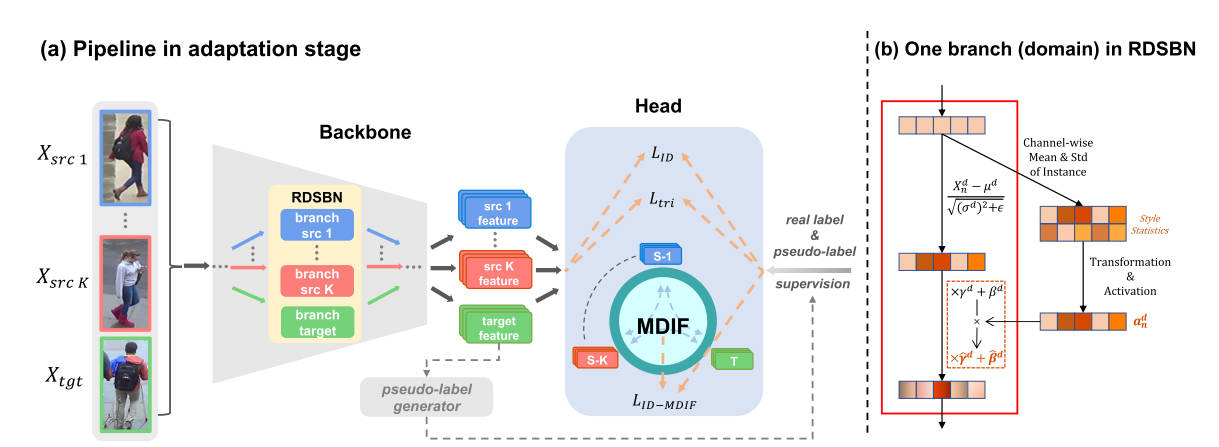
一域一分支:每个域配独立 BN 支路,各自统计均值方差并归一化,避免跨域共享参数,先隔离域特定风格
论文信息
- 论文:Unsupervised Multi-Source Domain Adaptation for Person Re-Identification
- 出处:CVPR 2021
核心痛点
无监督域自适应行人重识别大多只用单一有标签源域预训练,标注数据被浪费;多源混训又因颜色、光照、相机视角差异大(域差距)提升有限甚至负效果。DSBN 这类域特定方法本为闭集分类设计,而 re-ID 是细粒度开集问题、各域身份不相交,直接套用容易错误聚合身份。
模块亮点
- 一域一分支:每个域配独立 BN 支路,各自统计均值方差并归一化,避免跨域共享参数,先隔离域特定风格
- 实例级校正:用实例的通道均值、标准差等风格统计量,经可学习变换加 Sigmoid 生成通道权重,逐实例校正 BN 的 γ、β,增强身份相关风格
- 消融涨点扎实:Duke+CUHK→Market1501 上 ResNet50-RDSBN 达 78.2 mAP、91.0 Rank-1,比 DSBN 高 4.1 mAP;配 MDIF 的整体模型在 Duke→Market1501 达 81.5 mAP(比 MMT 高 6.9),三源融合后 86.0 mAP
适用场景
领域为行人重识别 / 无监督域自适应,原文在 Market1501、DukeMTMC-reID、CUHK03、MSMT 上验证;也可迁移到人脸、车辆重识别、跨域检索等任务。
插入位置建议
- 把 ResNet50 等骨干中的 BN 层整体替换成 RDSBN,每域一条分支,测试时只走目标域分支
- 用在多源域自适应训练的骨干各 stage,源域真标签与目标域伪标签共同监督
- 与域融合模块(如原文 MDIF)串联:RDSBN 先压域特定信息,MDIF 再拉近域间分布
适用任务
- 行人重识别
- 无监督域自适应
- 原文在 Market1501
完整代码
rdsbn.py
from torch.nn.modules.batchnorm import _BatchNorm
from torch.nn.parameter import Parameter
from torch.nn import functional as F
from torch import nn
import torch

"""Unsupervised Multi-Source Domain Adaptation for Person Re-Identification(CVPR2021)
适用于有领域差异的场景,特别是在领域自适应、多域学习和跨域任务中.

无监督领域自适应(UDA)方法用于行人再识别(re-ID),其目标是将来自有标签的源数据的 re-ID 知识转移到无标签的目标数据上。
尽管取得了显著进展,但大多数方法仅使用来自单一源域的有限数据进行模型预训练,从而未能充分利用丰富的有标签数据。为充分利用这些宝贵的有标签数据,我们将多源概念引入到 UDA 行人再识别领域,在训练中使用多个源数据集。
然而,由于不同域之间存在域间差距,简单地结合不同数据集仅能带来有限的提升。在本文中,我们从两个角度出发来解决该问题,即领域特定视角和领域融合视角。为此,我们提出了两个结构性模块,且它们彼此兼容。
首先,提出了一个校正域特定批归一化(RDSBN)模块(rectification domain-specific batch normalization),以同时减少域特定特征并增强行人特征的区分性。其次,提出了基于图卷积网络(GCN)的多域信息融合(MDIF)模块,通过融合不同域的特征来最小化域间距离。
所提出的方法显著超越了当前最先进的 UDA 行人再识别方法,甚至在不使用任何后处理技术的情况下达到了与监督方法相当的性能。
"""


class RcBatchNorm2d(_BatchNorm):
    def __init__(self, num_features, eps=1e-5, momentum=0.1, affine=True, track_running_stats=True):
        super(RcBatchNorm2d, self).__init__(num_features, eps, momentum, affine, track_running_stats)

        self.cfc = Parameter(torch.Tensor(num_features, 2))
        self.cfc.data.fill_(0)
        self.activation = nn.Sigmoid()

    def _check_input_dim(self, input):
        if input.dim() != 4:
            raise ValueError('expected 4D input (got {}D input)'.format(input.dim()))

    def recalibration(self, x, eps=1e-5):
        N, C, _, _ = x.size()

        channel_mean = x.view(N, C, -1).mean(dim=2, keepdim=True)
        channel_var = x.view(N, C, -1).var(dim=2, keepdim=True) + eps
        channel_std = channel_var.sqrt()

        t = torch.cat((channel_mean, channel_std), dim=2)

        z = t * self.cfc[None, :, :]  # B x C x 2
        z = torch.sum(z, dim=2)[:, :, None, None]  # B x C x 1 x 1
        g = self.activation(z)

        return g

    def forward(self, input, epochs=-1):
        self._check_input_dim(input)

        out_bn = F.batch_norm(
            input, self.running_mean, self.running_var, self.weight, self.bias,
            self.training, self.momentum, self.eps)

        if not self.training and epochs == 0:
            # print('epoch 0 for stable clustering.')
            out = out_bn
        else:
            g = self.recalibration(input)
            out = out_bn * g

        return out


class DomainSpecificRcBatchNorm2d(nn.Module):

    def __init__(self, num_channel, num_domains, eps=1e-9, momentum=0.1, affine=True,
                 track_running_stats=True, within_single_batch=False):
        super(DomainSpecificRcBatchNorm2d, self).__init__()
        self.bns = nn.ModuleList(
            [RcBatchNorm2d(num_channel, eps, momentum, affine, track_running_stats) for _ in range(num_domains)])
        self.single_batch = within_single_batch

    def reset_running_stats(self):
        for bn in self.bns:
            bn.reset_running_stats()

    def reset_parameters(self):
        for bn in self.bns:
            bn.reset_parameters()

    def _check_input_dim(self, input):
        if input.dim() != 4:
            raise ValueError('expected 4D input (got {}D input)'.format(input.dim()))

    def bias_requires_grad(self, flag):
        for bn in self.bns:
            bn.bias.requires_grad_(flag)

    def forward(self, x, domain_label):
        self._check_input_dim(x)
        N, C, _, _ = x.size()

        epochs = -1
        if x.size(0) != domain_label.size(0):
            epochs = domain_label[-1]

        if self.training and self.single_batch:
            stride = 16
            assert stride * 4 == N

            assert domain_label[0] == 0
            bn0 = self.bns[0]

            assert domain_label[stride] == 1
            bn1 = self.bns[1]

            assert domain_label[2 * stride] == 2
            bn2 = self.bns[2]

            assert domain_label[3 * stride] == 3
            bn3 = self.bns[3]

            out = [bn0(x[:stride], epochs), bn1(x[stride:2*stride], epochs),
                   bn2(x[2 * stride: 3 * stride], epochs),
                   bn3(x[3 * stride:], epochs)]
            out = torch.cat(out)
        else:
            bn = self.bns[domain_label[0]]
            out = bn(x, epochs)

        return out, domain_label

if __name__ == '__main__':
    num_channels = 3
    num_domains = 4
    batch_size = 16  # 每个域 4 个样本,总共 16 个样本
    height, width = 32, 32


    block = DomainSpecificRcBatchNorm2d(num_channel=num_channels, num_domains=num_domains, within_single_batch=True)

    # 创建一个随机输入张量和域标签
    input_tensor = torch.rand(batch_size * num_domains, num_channels, height, width)  # (64, 3, 32, 32)
    domain_labels = torch.cat([torch.full((batch_size,), i) for i in range(num_domains)])  # (64,)

    output_tensor, output_labels = block(input_tensor, domain_labels)

    print("输入张量大小:", input_tensor.size())
    print("输出张量大小:", output_tensor.size())
    print("域标签大小:", output_labels.size())
环境与依赖
Python 3.9+
继续浏览
下一篇ReMoE 区域感知混合专家模块三粒度专家互补:全局专家聚合整图上下文,中心专家专注中央区域,区域专家各管一块空间分区,直接替换 ViT 块里的标准 FFN,补上区域级归纳偏置相关资源
模块2026-11-20
RGA 关系感知全局注意力
关系显式入网:把每个位置与所有位置的双向亲和度堆叠成关系向量,与自身特征拼接,用两层 1×1 卷积 + Sigmoid 学出注意力
计算机视觉行人重识别RGA
计算机视觉MIT
模块2026-11-20
AFW 自适应帧加权模块
按质量给帧打分:对每一帧特征估计"帧质量",经 Softmax 得到权重,动态突出信息量大的帧、压低模糊 / 遮挡帧
计算机视觉姿态估计AFW
计算机视觉MIT
模块2026-11-20
Agent Attention 代理注意力
代理聚合广播:在 (Q,K,V) 之外引入少量 Agent token,先代理 Query 从 K、V 聚合全局信息,再广播回每个 Query,兼得 Softmax 表达力与线性复杂度
计算机视觉注意力机制AgentAttention
计算机视觉MIT