模块更新于 2026-11-20· 浏览 0· 下载 0
SSPCAB 自监督预测卷积注意力模块
重建写进卷积核:感受野中心被遮挡、只保留四角子核,逼网络用上下文"脑补"中心信息;膨胀率 d 控制上下文从局部到全局
结构图
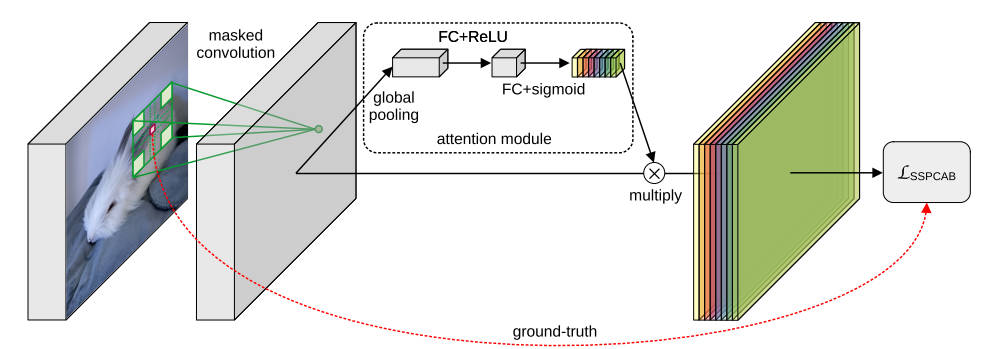
重建写进卷积核:感受野中心被遮挡、只保留四角子核,逼网络用上下文"脑补"中心信息;膨胀率 d 控制上下文从局部到全局
论文信息
- 论文:Self-Supervised Predictive Convolutional Attentive Block for Anomaly Detection
- 出处:CVPR 2024
核心痛点
异常检测只有正常样本可学;主流重建类方法靠自编码器 / GAN"遮住一块再补全"打异常分,掩码只能加在输入层;且神经网络泛化能力太强,有时连异常样本都能被低误差重建,正常 / 异常反而分不开。
模块亮点
- 重建写进卷积核:感受野中心被遮挡、只保留四角子核,逼网络用上下文"脑补"中心信息;膨胀率 d 控制上下文从局部到全局
- 自带损失防偷懒:重建图先过 SE 通道注意力重校准,防止网络靠线性插值糊弄补全,消融中带通道注意力的版本增益最高(micro AUC 5.9%);块内自带 MSE 重建损失,按 λ=0.1 并入主损失
- 六大框架全线涨点:插进 CutPaste、DRAEM 等六个 SOTA 框架后几乎所有指标都涨——MVTec AD 上 DRAEM 定位 AP 从 68.4% 提到 69.9%;Avenue 上 RBDC 从 41% 飙到 62%(+21.22%),并刷新 Avenue 与 ShanghaiTech 的 SOTA
适用场景
领域为图像 / 视频异常检测,原文验证了 MVTec AD 工业缺陷检测与定位、Avenue / ShanghaiTech 监控异常事件检测;可迁移到"只学正常"的一类分类任务,如工业质检、安防监控
插入位置建议
- 替换骨干网络倒数第二个卷积层,这是原文所有实验的默认插法
- 放进自编码器等重建类异常检测网络,重建误差可直接当异常信号
- 加到帧预测、光流重建等视频模型的卷积层之后,与主任务损失加权联合训练
适用任务
- 图像
- 视频异常检测
- 原文验证了 MVTec AD 工业缺陷检测与定位
完整代码
sspcab.py
import torch
import torch.nn as nn
import torch.nn.functional as F


"""
异常检测通常被视为一类分类问题,其中模型只能从正常训练样本中学习,同时在正常和异常测试样本上进行评估。
在成功的异常检测方法中,一类独特的方法依赖于预测屏蔽信息(例如补丁、未来帧等)并利用相对于屏蔽信息的重建误差作为异常分数。与相关方法不同,我们建议将基于重建的功能集成到一种新颖的自监督预测架构构建块中。
所提出的自监督块是通用的,可以很容易地合并到各种最先进的异常检测方法中。我们的块从带有扩张滤波器的卷积层开始,其中感受野的中心区域被屏蔽。生成的激活图通过通道注意模块传递。
我们的块配备了一个损失,可以最小化相对于感受野中的掩模区域的重建误差。我们通过将我们的模块集成到几个最先进的图像和视频异常检测框架中来展示该模块的通用性。
"""


class SELayer(nn.Module):
    def __init__(self, num_channels, reduction_ratio=8):
        '''
            num_channels: The number of input channels
            reduction_ratio: The reduction ratio 'r' from the paper
        '''
        super(SELayer, self).__init__()
        num_channels_reduced = num_channels // reduction_ratio
        self.reduction_ratio = reduction_ratio
        self.fc1 = nn.Linear(num_channels, num_channels_reduced, bias=True)
        self.fc2 = nn.Linear(num_channels_reduced, num_channels, bias=True)
        self.relu = nn.ReLU()
        self.sigmoid = nn.Sigmoid()

    def forward(self, input_tensor):
        batch_size, num_channels, H, W = input_tensor.size()

        squeeze_tensor = input_tensor.view(batch_size, num_channels, -1).mean(dim=2)

        # channel excitation
        fc_out_1 = self.relu(self.fc1(squeeze_tensor))
        fc_out_2 = self.sigmoid(self.fc2(fc_out_1))

        a, b = squeeze_tensor.size()
        output_tensor = torch.mul(input_tensor, fc_out_2.view(a, b, 1, 1))
        return output_tensor


# SSPCAB implementation
class SSPCAB(nn.Module):
    def __init__(self, channels, kernel_dim=1, dilation=1, reduction_ratio=8):
        '''
            channels: The number of filter at the output (usually the same with the number of filter from the input)
            kernel_dim: The dimension of the sub-kernels ' k' ' from the paper
            dilation: The dilation dimension 'd' from the paper
            reduction_ratio: The reduction ratio for the SE block ('r' from the paper)
        '''
        super(SSPCAB, self).__init__()
        self.pad = kernel_dim + dilation
        self.border_input = kernel_dim + 2*dilation + 1

        self.relu = nn.ReLU()
        self.se = SELayer(channels, reduction_ratio=reduction_ratio)

        self.conv1 = nn.Conv2d(in_channels=channels,
                               out_channels=channels,
                               kernel_size=kernel_dim)
        self.conv2 = nn.Conv2d(in_channels=channels,
                               out_channels=channels,
                               kernel_size=kernel_dim)
        self.conv3 = nn.Conv2d(in_channels=channels,
                               out_channels=channels,
                               kernel_size=kernel_dim)
        self.conv4 = nn.Conv2d(in_channels=channels,
                               out_channels=channels,
                               kernel_size=kernel_dim)

    def forward(self, x):
        x = F.pad(x, (self.pad, self.pad, self.pad, self.pad), "constant", 0)

        x1 = self.conv1(x[:, :, :-self.border_input, :-self.border_input])
        x2 = self.conv2(x[:, :, self.border_input:, :-self.border_input])
        x3 = self.conv3(x[:, :, :-self.border_input, self.border_input:])
        x4 = self.conv4(x[:, :, self.border_input:, self.border_input:])
        x = self.relu(x1 + x2 + x3 + x4)

        x = self.se(x)
        return x

if __name__ == '__main__':
    block = SSPCAB(channels=3)
    input = torch.rand(16,3,32,32)
    output = block(input)
    print(input.size())
    print(output.size())


# Example of how our block should be updated
# mse_loss = nn.MSELoss()
# cost_sspcab = mse_loss(input_sspcab, output_sspcab)
环境与依赖
Python 3.9+
继续浏览
下一篇STP 条带池化模块长窄核重定义池化:把常规 N×N 方形池化换成 1×N 或 N×1 的条带池化,一维拉长捕捉长程依赖、另一维窄核聚焦细节,天然适配各向异性场景相关资源
模块2026-11-20
BCN 批通道归一化
统一 BN 与 LN:对同一份特征分别沿 batch 维(BN 式)和样本内通道维(LN 式)归一化,再用可学习的逐通道权重加权融合,初始等价 BN,训练中自动学出每个通道更信 BN 还是 LN
归一化BCN计算机视觉
计算机视觉MIT
模块2026-11-20
FRFN 特征精炼前馈网络
先增强、再减负:用 PConv(部分卷积)增强有价值的特征,再用门控机制削减通道冗余,专治 FFN 里的通道冗余问题
计算机视觉图像复原FRFN
计算机视觉MIT
模块2026-11-20
KPA 运动学先验注意力
拓扑注入先验:按人体骨架构建空间局部拓扑,叠加可学习全局拓扑,对称融合成运动学拓扑,把关节间的运动相关性写进 token
计算机视觉3D人体姿态估计KPA
计算机视觉MIT