模块更新于 2026-11-20· 浏览 0· 下载 0
U-KAN 柯尔莫哥洛夫-阿诺德U型网络
非线性可学习激活:基于柯尔莫哥洛夫-阿诺德表示定理,KAN 层用可学习激活函数同时充当“边”和“权重”,去掉线性权重矩阵,在 token 化的高层特征上建模通道间非线性
结构图
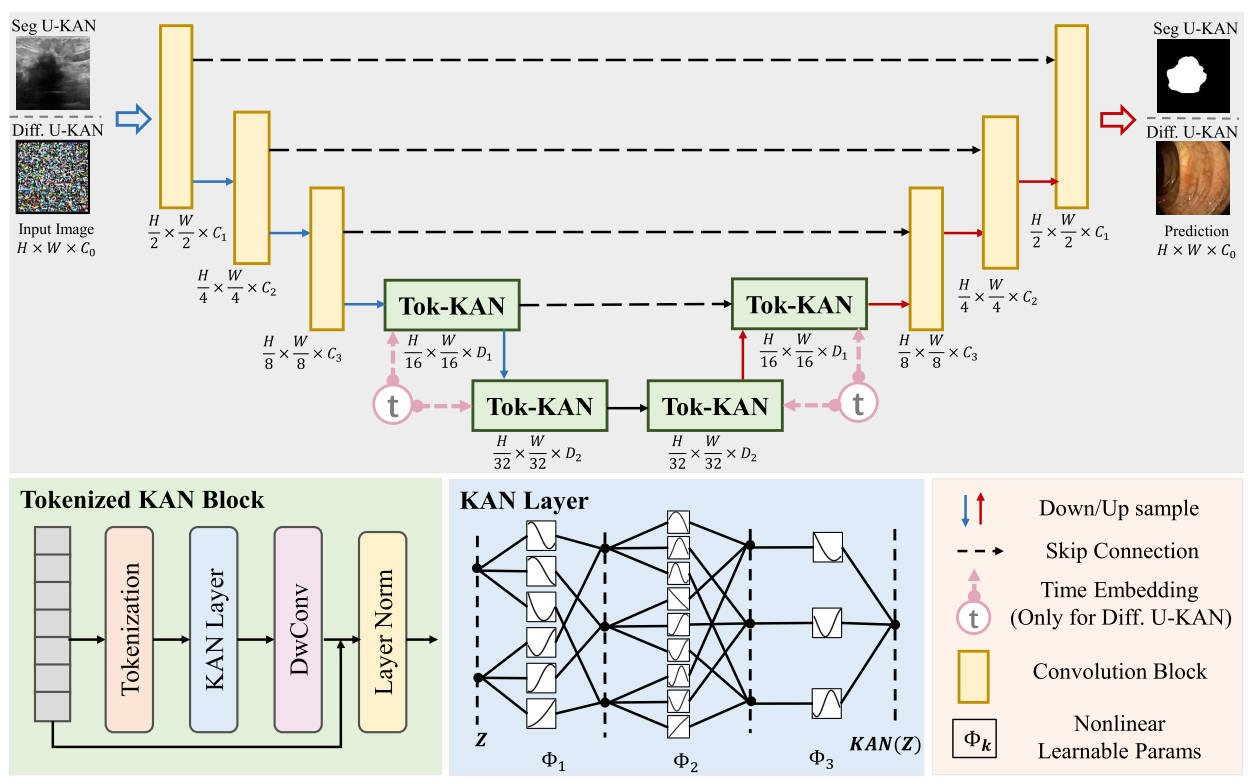
非线性可学习激活:基于柯尔莫哥洛夫-阿诺德表示定理,KAN 层用可学习激活函数同时充当“边”和“权重”,去掉线性权重矩阵,在 token 化的高层特征上建模通道间非线性
论文信息
- 论文:U-KAN Makes Strong Backbone for Medical Image Segmentation and Generation
- 出处:AAAI 2025
核心痛点
医学分割的 U 型网络里,卷积、Transformer、MLP 等常规核都只对通道做线性建模,而医学图像的通道承载不同临床、解剖、病理语义,复杂非线性关系抓不住,且黑盒缺可解释性。
模块亮点
- 非线性可学习激活:基于柯尔莫哥洛夫-阿诺德表示定理,KAN 层用可学习激活函数同时充当“边”和“权重”,去掉线性权重矩阵,在 token 化的高层特征上建模通道间非线性
- 精度效率双杀:在 BUSI、GlaS、CVC 三个基准 IoU、F1 全面领先,BUSI 上 IoU 63.38 / F1 76.40;参数仅 6.35M、14.02 GFLOPs,远低于 U-Net
- 一网两用:消融中 3 层 KAN(IoU 65.26)优于 3 层 MLP 版本(63.49);搬进 DDPM 当噪声预测器,FID 全优于 Diffusion U-Net 各变体(BUSI 101.93 vs 116.52)
适用场景
领域为医学图像分割,原文验证了 BUSI、GlaS、CVC-ClinicDB,并作为扩散模型噪声预测器做了无条件图像生成;可迁移到遥感、工业检测等 2D 分割。
插入位置建议
- 放在 U 型网络瓶颈附近:卷积输出先 tokenize,再过堆叠的 Tok-KAN 块
- 替换 DDPM / 扩散 U-Net 中间的 ResBlock+Attn 为 KAN 块并注入时间步嵌入,即 Diffusion U-KAN
- 用 KANLinear 直接替换 MLP / FFN,维度对齐即可用,层数选 3 层
适用任务
- 医学图像分割
- 原文验证了 BUSI
- GlaS
完整代码
u-kan.py
import math
import torch
from torch import nn
from torch.nn import init
from torch.nn import functional as F


"""《U-KAN Makes Strong Backbone for Medical Image Segmentation and Generation》 AAAI 2025
U-Net 已成为图像分割和扩散概率模型等各种视觉应用的基石。尽管通过引入 Transformer 或 MLP,已引入了许多创新设计和改进,但这些网络仍然局限于线性建模模式,且可解释性不足。
为了应对这些挑战,我们的灵感源于柯尔莫哥洛夫-阿诺德网络 (KAN) 在准确性和可解释性方面取得的卓越成果。KAN 通过源自柯尔莫哥洛夫-阿诺德表示定理的一系列非线性可学习激活函数重塑了神经网络学习。
具体而言,本文探索了 KAN 在改进视觉任务主干网络方面的潜力。我们通过在标记化的中间表示(称为 U-KAN)上集成专用的 KAN 层来研究、修改和重新设计现有的 U-Net 流程。
严格的医学图像分割基准测试验证了 UKAN 的优越性,它以更低的计算成本实现了更高的准确率。我们进一步深入研究了 U-KAN 作为扩散模型中替代 U-Net 噪声预测器的潜力,证明了其在生成面向任务的模型架构中的适用性。
"""

class Swish(nn.Module):
    def forward(self, x):
        return x * torch.sigmoid(x)


class TimeEmbedding(nn.Module):
    def __init__(self, T, d_model, dim):
        assert d_model % 2 == 0
        super().__init__()
        emb = torch.arange(0, d_model, step=2) / d_model * math.log(10000)
        emb = torch.exp(-emb)
        pos = torch.arange(T).float()
        emb = pos[:, None] * emb[None, :]
        assert list(emb.shape) == [T, d_model // 2]
        emb = torch.stack([torch.sin(emb), torch.cos(emb)], dim=-1)
        assert list(emb.shape) == [T, d_model // 2, 2]
        emb = emb.view(T, d_model)

        self.timembedding = nn.Sequential(
            nn.Embedding.from_pretrained(emb),
            nn.Linear(d_model, dim),
            Swish(),
            nn.Linear(dim, dim),
        )
        self.initialize()

    def initialize(self):
        for module in self.modules():
            if isinstance(module, nn.Linear):
                init.xavier_uniform_(module.weight)
                init.zeros_(module.bias)

    def forward(self, t):
        emb = self.timembedding(t)
        return emb


class DownSample(nn.Module):
    def __init__(self, in_ch):
        super().__init__()
        self.main = nn.Conv2d(in_ch, in_ch, 3, stride=2, padding=1)
        self.initialize()

    def initialize(self):
        init.xavier_uniform_(self.main.weight)
        init.zeros_(self.main.bias)

    def forward(self, x, temb):
        x = self.main(x)
        return x


class UpSample(nn.Module):
    def __init__(self, in_ch):
        super().__init__()
        self.main = nn.Conv2d(in_ch, in_ch, 3, stride=1, padding=1)
        self.initialize()

    def initialize(self):
        init.xavier_uniform_(self.main.weight)
        init.zeros_(self.main.bias)

    def forward(self, x, temb):
        _, _, H, W = x.shape
        x = F.interpolate(
            x, scale_factor=2, mode='nearest')
        x = self.main(x)
        return x


class AttnBlock(nn.Module):
    def __init__(self, in_ch):
        super().__init__()
        self.group_norm = nn.GroupNorm(32, in_ch)
        self.proj_q = nn.Conv2d(in_ch, in_ch, 1, stride=1, padding=0)
        self.proj_k = nn.Conv2d(in_ch, in_ch, 1, stride=1, padding=0)
        self.proj_v = nn.Conv2d(in_ch, in_ch, 1, stride=1, padding=0)
        self.proj = nn.Conv2d(in_ch, in_ch, 1, stride=1, padding=0)
        self.initialize()

    def initialize(self):
        for module in [self.proj_q, self.proj_k, self.proj_v, self.proj]:
            init.xavier_uniform_(module.weight)
            init.zeros_(module.bias)
        init.xavier_uniform_(self.proj.weight, gain=1e-5)

    def forward(self, x):
        B, C, H, W = x.shape
        h = self.group_norm(x)
        q = self.proj_q(h)
        k = self.proj_k(h)
        v = self.proj_v(h)

        q = q.permute(0, 2, 3, 1).view(B, H * W, C)
        k = k.view(B, C, H * W)
        w = torch.bmm(q, k) * (int(C) ** (-0.5))
        assert list(w.shape) == [B, H * W, H * W]
        w = F.softmax(w, dim=-1)

        v = v.permute(0, 2, 3, 1).view(B, H * W, C)
        h = torch.bmm(w, v)
        assert list(h.shape) == [B, H * W, C]
        h = h.view(B, H, W, C).permute(0, 3, 1, 2)
        h = self.proj(h)

        return x + h


class ResBlock(nn.Module):
    def __init__(self, in_ch, out_ch, tdim, dropout, attn=False):
        super().__init__()
        self.block1 = nn.Sequential(
            nn.GroupNorm(32, in_ch),
            Swish(),
            nn.Conv2d(in_ch, out_ch, 3, stride=1, padding=1),
        )
        self.temb_proj = nn.Sequential(
            Swish(),
            nn.Linear(tdim, out_ch),
        )
        self.block2 = nn.Sequential(
            nn.GroupNorm(32, out_ch),
            Swish(),
            nn.Dropout(dropout),
            nn.Conv2d(out_ch, out_ch, 3, stride=1, padding=1),
        )
        if in_ch != out_ch:
            self.shortcut = nn.Conv2d(in_ch, out_ch, 1, stride=1, padding=0)
        else:
            self.shortcut = nn.Identity()
        if attn:
            self.attn = AttnBlock(out_ch)
        else:
            self.attn = nn.Identity()
        self.initialize()

    def initialize(self):
        for module in self.modules():
            if isinstance(module, (nn.Conv2d, nn.Linear)):
                init.xavier_uniform_(module.weight)
                init.zeros_(module.bias)
        init.xavier_uniform_(self.block2[-1].weight, gain=1e-5)

    def forward(self, x, temb):
        h = self.block1(x)
        h += self.temb_proj(temb)[:, :, None, None]
        h = self.block2(h)

        h = h + self.shortcut(x)
        h = self.attn(h)
        return h
        # return x


class KANLinear(torch.nn.Module):
    def __init__(
            self,
            in_features,
            out_features,
            grid_size=5,
            spline_order=3,
            scale_noise=0.1,
            scale_base=1.0,
            scale_spline=1.0,
            enable_standalone_scale_spline=True,
            base_activation=torch.nn.SiLU,
            grid_eps=0.02,
            grid_range=[-1, 1],
    ):
        super(KANLinear, self).__init__()
        self.in_features = in_features
        self.out_features = out_features
        self.grid_size = grid_size
        self.spline_order = spline_order

        h = (grid_range[1] - grid_range[0]) / grid_size
        grid = (
            (
                    torch.arange(-spline_order, grid_size + spline_order + 1) * h
                    + grid_range[0]
            )
                .expand(in_features, -1)
                .contiguous()
        )
        self.register_buffer("grid", grid)

        self.base_weight = torch.nn.Parameter(torch.Tensor(out_features, in_features))
        self.spline_weight = torch.nn.Parameter(
            torch.Tensor(out_features, in_features, grid_size + spline_order)
        )
        if enable_standalone_scale_spline:
            self.spline_scaler = torch.nn.Parameter(
                torch.Tensor(out_features, in_features)
            )

        self.scale_noise = scale_noise
        self.scale_base = scale_base
        self.scale_spline = scale_spline
        self.enable_standalone_scale_spline = enable_standalone_scale_spline
        self.base_activation = base_activation()
        self.grid_eps = grid_eps

        self.reset_parameters()

    def reset_parameters(self):
        torch.nn.init.kaiming_uniform_(self.base_weight, a=math.sqrt(5) * self.scale_base)
        with torch.no_grad():
            noise = (
                    (
                            torch.rand(self.grid_size + 1, self.in_features, self.out_features)
                            - 1 / 2
                    )
                    * self.scale_noise
                    / self.grid_size
            )
            self.spline_weight.data.copy_(
                (self.scale_spline if not self.enable_standalone_scale_spline else 1.0)
                * self.curve2coeff(
                    self.grid.T[self.spline_order: -self.spline_order],
                    noise,
                )
            )
            if self.enable_standalone_scale_spline:
                # torch.nn.init.constant_(self.spline_scaler, self.scale_spline)
                torch.nn.init.kaiming_uniform_(self.spline_scaler, a=math.sqrt(5) * self.scale_spline)

    def b_splines(self, x: torch.Tensor):
        """
        Compute the B-spline bases for the given input tensor.

        Args:
            x (torch.Tensor): Input tensor of shape (batch_size, in_features).

        Returns:
            torch.Tensor: B-spline bases tensor of shape (batch_size, in_features, grid_size + spline_order).
        """
        assert x.dim() == 2 and x.size(1) == self.in_features

        grid: torch.Tensor = (
            self.grid
        )  # (in_features, grid_size + 2 * spline_order + 1)
        x = x.unsqueeze(-1)
        bases = ((x >= grid[:, :-1]) & (x < grid[:, 1:])).to(x.dtype)
        for k in range(1, self.spline_order + 1):
            bases = (
                            (x - grid[:, : -(k + 1)])
                            / (grid[:, k:-1] - grid[:, : -(k + 1)])
                            * bases[:, :, :-1]
                    ) + (
                            (grid[:, k + 1:] - x)
                            / (grid[:, k + 1:] - grid[:, 1:(-k)])
                            * bases[:, :, 1:]
                    )

        assert bases.size() == (
            x.size(0),
            self.in_features,
            self.grid_size + self.spline_order,
        )
        return bases.contiguous()

    def curve2coeff(self, x: torch.Tensor, y: torch.Tensor):
        """
        Compute the coefficients of the curve that interpolates the given points.

        Args:
            x (torch.Tensor): Input tensor of shape (batch_size, in_features).
            y (torch.Tensor): Output tensor of shape (batch_size, in_features, out_features).

        Returns:
            torch.Tensor: Coefficients tensor of shape (out_features, in_features, grid_size + spline_order).
        """
        assert x.dim() == 2 and x.size(1) == self.in_features
        assert y.size() == (x.size(0), self.in_features, self.out_features)

        A = self.b_splines(x).transpose(
            0, 1
        )  # (in_features, batch_size, grid_size + spline_order)
        B = y.transpose(0, 1)  # (in_features, batch_size, out_features)
        solution = torch.linalg.lstsq(
            A, B
        ).solution  # (in_features, grid_size + spline_order, out_features)
        result = solution.permute(
            2, 0, 1
        )  # (out_features, in_features, grid_size + spline_order)

        assert result.size() == (
            self.out_features,
            self.in_features,
            self.grid_size + self.spline_order,
        )
        return result.contiguous()

    @property
    def scaled_spline_weight(self):
        return self.spline_weight * (
            self.spline_scaler.unsqueeze(-1)
            if self.enable_standalone_scale_spline
            else 1.0
        )

    def forward(self, x: torch.Tensor):
        assert x.dim() == 2 and x.size(1) == self.in_features

        base_output = F.linear(self.base_activation(x), self.base_weight)
        spline_output = F.linear(
            self.b_splines(x).view(x.size(0), -1),
            self.scaled_spline_weight.view(self.out_features, -1),
        )
        return base_output + spline_output

    @torch.no_grad()
    def update_grid(self, x: torch.Tensor, margin=0.01):
        assert x.dim() == 2 and x.size(1) == self.in_features
        batch = x.size(0)

        splines = self.b_splines(x)  # (batch, in, coeff)
        splines = splines.permute(1, 0, 2)  # (in, batch, coeff)
        orig_coeff = self.scaled_spline_weight  # (out, in, coeff)
        orig_coeff = orig_coeff.permute(1, 2, 0)  # (in, coeff, out)
        unreduced_spline_output = torch.bmm(splines, orig_coeff)  # (in, batch, out)
        unreduced_spline_output = unreduced_spline_output.permute(
            1, 0, 2
        )  # (batch, in, out)

        # sort each channel individually to collect data distribution
        x_sorted = torch.sort(x, dim=0)[0]
        grid_adaptive = x_sorted[
            torch.linspace(
                0, batch - 1, self.grid_size + 1, dtype=torch.int64, device=x.device
            )
        ]

        uniform_step = (x_sorted[-1] - x_sorted[0] + 2 * margin) / self.grid_size
        grid_uniform = (
                torch.arange(
                    self.grid_size + 1, dtype=torch.float32, device=x.device
                ).unsqueeze(1)
                * uniform_step
                + x_sorted[0]
                - margin
        )

        grid = self.grid_eps * grid_uniform + (1 - self.grid_eps) * grid_adaptive
        grid = torch.concatenate(
            [
                grid[:1]
                - uniform_step
                * torch.arange(self.spline_order, 0, -1, device=x.device).unsqueeze(1),
                grid,
                grid[-1:]
                + uniform_step
                * torch.arange(1, self.spline_order + 1, device=x.device).unsqueeze(1),
            ],
            dim=0,
        )

        self.grid.copy_(grid.T)
        self.spline_weight.data.copy_(self.curve2coeff(x, unreduced_spline_output))

    def regularization_loss(self, regularize_activation=1.0, regularize_entropy=1.0):
        """
        Compute the regularization loss.

        This is a dumb simulation of the original L1 regularization as stated in the
        paper, since the original one requires computing absolutes and entropy from the
        expanded (batch, in_features, out_features) intermediate tensor, which is hidden
        behind the F.linear function if we want an memory efficient implementation.

        The L1 regularization is now computed as mean absolute value of the spline
        weights. The authors implementation also includes this term in addition to the
        sample-based regularization.
        """
        l1_fake = self.spline_weight.abs().mean(-1)
        regularization_loss_activation = l1_fake.sum()
        p = l1_fake / regularization_loss_activation
        regularization_loss_entropy = -torch.sum(p * p.log())
        return (
                regularize_activation * regularization_loss_activation
                + regularize_entropy * regularization_loss_entropy
        )


class UKAN(nn.Module):
    def __init__(self, T, ch, ch_mult, attn, num_res_blocks, dropout):
        super().__init__()
        assert all([i < len(ch_mult) for i in attn]), 'attn index out of bound'
        tdim = ch * 4
        self.time_embedding = TimeEmbedding(T, ch, tdim)

        self.head = nn.Conv2d(3, ch, kernel_size=3, stride=1, padding=1)
        self.downblocks = nn.ModuleList()
        chs = [ch]  # record output channel when dowmsample for upsample
        now_ch = ch
        for i, mult in enumerate(ch_mult):
            out_ch = ch * mult
            for _ in range(num_res_blocks):
                self.downblocks.append(ResBlock(
                    in_ch=now_ch, out_ch=out_ch, tdim=tdim,
                    dropout=dropout, attn=(i in attn)))
                now_ch = out_ch
                chs.append(now_ch)
            if i != len(ch_mult) - 1:
                self.downblocks.append(DownSample(now_ch))
                chs.append(now_ch)

        self.middleblocks1 = nn.ModuleList([
            ResBlock(now_ch, now_ch, tdim, dropout, attn=True),
            # ResBlock(now_ch, now_ch, tdim, dropout, attn=False),
        ])

        self.middleblocks2 = nn.ModuleList([
            # ResBlock(now_ch, now_ch, tdim, dropout, attn=True),
            ResBlock(now_ch, now_ch, tdim, dropout, attn=False),
        ])

        self.upblocks = nn.ModuleList()
        for i, mult in reversed(list(enumerate(ch_mult))):
            out_ch = ch * mult
            for _ in range(num_res_blocks + 1):
                self.upblocks.append(ResBlock(
                    in_ch=chs.pop() + now_ch, out_ch=out_ch, tdim=tdim,
                    dropout=dropout, attn=(i in attn)))
                now_ch = out_ch
            if i != 0:
                self.upblocks.append(UpSample(now_ch))
        assert len(chs) == 0

        self.tail = nn.Sequential(
            nn.GroupNorm(32, now_ch),
            Swish(),
            nn.Conv2d(now_ch, 3, 3, stride=1, padding=1)
        )

        grid_size = 5
        spline_order = 3
        scale_noise = 0.1
        scale_base = 1.0
        scale_spline = 1.0
        base_activation = torch.nn.SiLU
        grid_eps = 0.02
        grid_range = [-1, 1]

        kan_c = 512
        self.fc1 = KANLinear(
            kan_c,
            kan_c * 2,
            grid_size=grid_size,
            spline_order=spline_order,
            scale_noise=scale_noise,
            scale_base=scale_base,
            scale_spline=scale_spline,
            base_activation=base_activation,
            grid_eps=grid_eps,
            grid_range=grid_range,
        )
        # print(now_ch)
        # self.dwconv = DWConv(kan_c *2)
        self.act = nn.GELU()
        self.fc2 = KANLinear(
            kan_c * 2,
            kan_c,
            grid_size=grid_size,
            spline_order=spline_order,
            scale_noise=scale_noise,
            scale_base=scale_base,
            scale_spline=scale_spline,
            base_activation=base_activation,
            grid_eps=grid_eps,
            grid_range=grid_range,
        )

        self.initialize()

    def initialize(self):
        init.xavier_uniform_(self.head.weight)
        init.zeros_(self.head.bias)
        init.xavier_uniform_(self.tail[-1].weight, gain=1e-5)
        init.zeros_(self.tail[-1].bias)

    def forward(self, x, t):
        # Timestep embedding
        temb = self.time_embedding(t)
        # Downsampling
        h = self.head(x)
        hs = [h]
        for layer in self.downblocks:
            h = layer(h, temb)
            hs.append(h)
        # Middle
        # for layer in self.middleblocks1:
        # h = layer(h, temb)
        B, C, H, W = h.shape
        # transform  B, C, H, W into B*H*W, C
        h = h.permute(0, 2, 3, 1).reshape(B * H * W, C)
        h = self.fc2(self.fc1(h))
        # transform B*H*W, C  into  B, C, H, W
        h = h.reshape(B, H, W, C).permute(0, 3, 1, 2)

        # for layer in self.middleblocks2:
        #     h = layer(h, temb)
        ### Stage 3
        # Upsampling
        for layer in self.upblocks:
            if isinstance(layer, ResBlock):
                h = torch.cat([h, hs.pop()], dim=1)
            h = layer(h, temb)
        h = self.tail(h)

        assert len(hs) == 0
        return h


if __name__ == '__main__':
    T = 1000  # 时间步数
    ch = 64  # 基础通道数
    ch_mult = [1, 2, 4, 8]  # 通道数乘数
    attn = [2]  # 在第3个分辨率层使用注意力
    num_res_blocks = 2  # 每个分辨率的残差块数
    dropout = 0.1  # dropout率

    model = UKAN(
        T=T,
        ch=ch,
        ch_mult=ch_mult,
        attn=attn,
        num_res_blocks=num_res_blocks,
        dropout=dropout
    ).to('cuda')


    batch_size = 4
    height = width = 32
    x = torch.randn(batch_size, 3, height, width).to('cuda')
    t = torch.randint(0, T, (batch_size,)).to('cuda')  # 随机时间步

    with torch.no_grad():
        output = model(x, t)

    print("\nInput shape:", x.shape)
    print("Output shape:", output.shape)
环境与依赖
Python 3.9+
继续浏览
下一篇UFFC 无偏快速傅里叶卷积矫正频域操作:用可学习的 3×3 范围变换/逆变换包住激活函数,缓解频谱偏移;拼接绝对位置嵌入区分频段、扩大频率感受野;动态跳跃连接以 λ∈(0,1) 保底相关资源
模块2026-11-20
CDFA 对比驱动特征聚合模块
对比引导窗口注意力:把 SID 解耦出的前景、背景特征各经一个线性层,在 K×K 局部窗口内生成注意力权重,两步加权后密集聚合,显式引导多级特征融合
医学图像分割CDFAConDSeg
医学影像MIT
模块2026-11-20
FAM 频率感知匹配模块
频域解耦匹配:用 FFT 把支持图、查询图前景特征转到频域,按 3:4:3 分成低、中、高三个频带,逐频带独立做支持-查询匹配,同时化解域内支持-查询偏差和域间差异
医学图像分割小样本学习FAM
医学影像MIT
模块2026-11-20
MSF 多频谱融合模块
中频引导提纯:拿域稳定的中频特征当 Query、高/低频特征当 Key/Value 做交叉注意力,从域特定频段里捞回域不变信息,保留全部频段而不是直接丢弃
医学图像分割小样本学习MSF
医学影像MIT