模块更新于 2026-11-20· 浏览 2· 下载 2
AKConv 可变核卷积
参数量任意:坐标生成算法让卷积核能取 1、2、3、4、5、6、7… 任意数量的参数,标准卷积和 Deformable Conv 都做不到;参数量随核大小线性增长
结构图
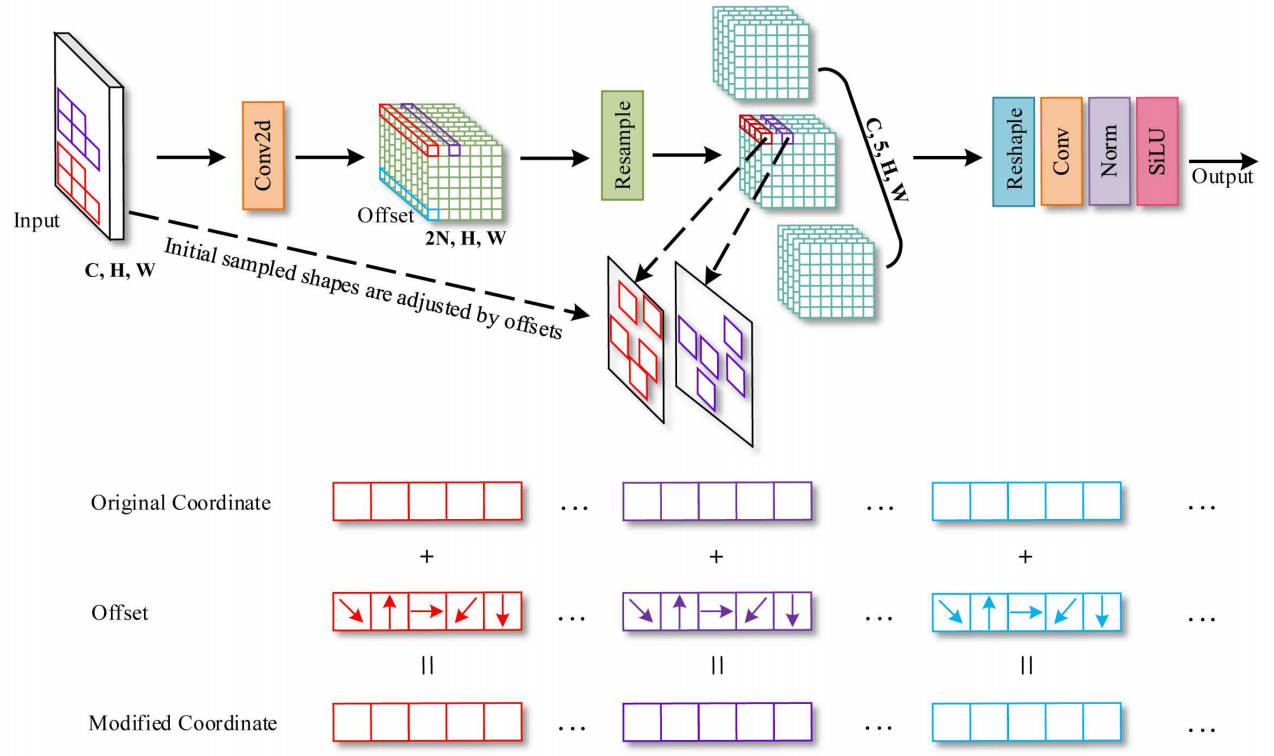
参数量任意:坐标生成算法让卷积核能取 1、2、3、4、5、6、7… 任意数量的参数,标准卷积和 Deformable Conv 都做不到;参数量随核大小线性增长
论文信息
- 论文:AKConv: Convolutional Kernel with Arbitrary Sampled Shapes and Arbitrary Number of Parameters
- 出处:arXiv 2023
核心痛点
标准卷积锁死在 1×1、3×3、5×5 这类正方形核里,采样形状和位置固定,难以贴合形态各异的目标,参数量还随核大小平方增长;Deformable Conv 虽能调整采样形状,但核尺寸仍限于规则方形。
模块亮点
- 参数量任意:坐标生成算法让卷积核能取 1、2、3、4、5、6、7… 任意数量的参数,标准卷积和 Deformable Conv 都做不到;参数量随核大小线性增长
- 采样形状任意:为任意尺寸的核生成初始采样坐标,再用可学习偏移逐位置调整采样形状、适应目标形变,还能按领域先验定制初始形状
- 涨点还降参:COCO2017 上 YOLOv5n 换上 AKConv,AP50 从 45.6 提到 48.8、AP 从 27.5 提到 31,参数量反而从 1.87M 降到 1.65M;VOC 7+12 上同尺寸对比,AKConv mAP50 70.8、DSConv 只有 54.2
适用场景
领域为目标检测;原文在 COCO2017、VOC 7+12、VisDrone-DET2021 上基于 YOLOv5、YOLOv7-tiny、YOLOv8n 验证;可迁移到图像分类、语义分割等 CNN 任务,目标形状多变或需要控制参数量时尤其合适。
插入位置建议
- 直接替换 YOLOv5、YOLOv7、YOLOv8 等检测网络中的标准卷积
- 放进 C3 / C2f 模块替换其中的 3×3 卷积
- 顶替已有的 Deformable Conv:参数个数取 K²(如 9)时两者等价,换成 5、11 等不规则个数还有涨点空间
适用任务
- 目标检测
完整代码
akconv.py
import torch
from torch import nn
import math


from einops.einops import rearrange

def to_3d(x):
    return rearrange(x, 'b c h w -> b (h w) c')

def to_4d(x, h, w):
    return rearrange(x, 'b (h w) c -> b c h w', h=h, w=w)


class AKConv(nn.Module):
    def __init__(self, inc, outc, num_param, stride=1, bias=None):
        super(AKConv, self).__init__()
        self.num_param = num_param
        self.stride = stride
        self.conv = nn.Sequential(nn.Conv2d(inc, outc, kernel_size=(num_param, 1), stride=(num_param, 1), bias=bias)
                                  ,nn.BatchNorm2d(outc)
                                  ,nn.SiLU())  # the conv adds the BN and SiLU to compare original Conv in YOLOv5.
        self.p_conv = nn.Conv2d(inc, 2 * num_param, kernel_size=3, padding=1, stride=stride)
        nn.init.constant_(self.p_conv.weight, 0)
        self.p_conv.register_full_backward_hook(self._set_lr)

    @staticmethod
    def _set_lr(module, grad_input, grad_output):
        grad_input = (grad_input[i] * 0.1 for i in range(len(grad_input)))
        grad_output = (grad_output[i] * 0.1 for i in range(len(grad_output)))

    def forward(self, x):
        # N is num_param.
        offset = self.p_conv(x)
        dtype = offset.data.type()
        N = offset.size(1) // 2
        # (b, 2N, h, w)
        p = self._get_p(offset, dtype)

        # (b, h, w, 2N)
        p = p.contiguous().permute(0, 2, 3, 1)
        q_lt = p.detach().floor()
        q_rb = q_lt + 1

        q_lt = torch.cat([torch.clamp(q_lt[..., :N], 0, x.size(2) - 1), torch.clamp(q_lt[..., N:], 0, x.size(3) - 1)],
                         dim=-1).long()
        q_rb = torch.cat([torch.clamp(q_rb[..., :N], 0, x.size(2) - 1), torch.clamp(q_rb[..., N:], 0, x.size(3) - 1)],
                         dim=-1).long()
        q_lb = torch.cat([q_lt[..., :N], q_rb[..., N:]], dim=-1)
        q_rt = torch.cat([q_rb[..., :N], q_lt[..., N:]], dim=-1)

        # clip p
        p = torch.cat([torch.clamp(p[..., :N], 0, x.size(2) - 1), torch.clamp(p[..., N:], 0, x.size(3) - 1)], dim=-1)

        # bilinear kernel (b, h, w, N)
        g_lt = (1 + (q_lt[..., :N].type_as(p) - p[..., :N])) * (1 + (q_lt[..., N:].type_as(p) - p[..., N:]))
        g_rb = (1 - (q_rb[..., :N].type_as(p) - p[..., :N])) * (1 - (q_rb[..., N:].type_as(p) - p[..., N:]))
        g_lb = (1 + (q_lb[..., :N].type_as(p) - p[..., :N])) * (1 - (q_lb[..., N:].type_as(p) - p[..., N:]))
        g_rt = (1 - (q_rt[..., :N].type_as(p) - p[..., :N])) * (1 + (q_rt[..., N:].type_as(p) - p[..., N:]))

        # resampling the features based on the modified coordinates.
        x_q_lt = self._get_x_q(x, q_lt, N)
        x_q_rb = self._get_x_q(x, q_rb, N)
        x_q_lb = self._get_x_q(x, q_lb, N)
        x_q_rt = self._get_x_q(x, q_rt, N)

        # bilinear
        x_offset = g_lt.unsqueeze(dim=1) * x_q_lt + \
                   g_rb.unsqueeze(dim=1) * x_q_rb + \
                   g_lb.unsqueeze(dim=1) * x_q_lb + \
                   g_rt.unsqueeze(dim=1) * x_q_rt

        x_offset = self._reshape_x_offset(x_offset, self.num_param)
        out = self.conv(x_offset)

        return out

    # generating the inital sampled shapes for the AKConv with different sizes.
    def _get_p_n(self, N, dtype):
        base_int = round(math.sqrt(self.num_param))
        row_number = self.num_param // base_int
        mod_number = self.num_param % base_int
        p_n_x ,p_n_y = torch.meshgrid(
            torch.arange(0, row_number),
            torch.arange(0 ,base_int))
        p_n_x = torch.flatten(p_n_x)
        p_n_y = torch.flatten(p_n_y)
        if mod_number >  0:
            mod_p_n_x ,mod_p_n_y = torch.meshgrid(
                torch.arange(row_number ,row_number +1),
                torch.arange(0 ,mod_number))

            mod_p_n_x = torch.flatten(mod_p_n_x)
            mod_p_n_y = torch.flatten(mod_p_n_y)
            p_n_x ,p_n_y  = torch.cat((p_n_x ,mod_p_n_x)) ,torch.cat((p_n_y ,mod_p_n_y))
        p_n = torch.cat([p_n_x ,p_n_y], 0)
        p_n = p_n.view(1, 2 * N, 1, 1).type(dtype)
        return p_n

    # no zero-padding
    def _get_p_0(self, h, w, N, dtype):
        p_0_x, p_0_y = torch.meshgrid(
            torch.arange(0, h * self.stride, self.stride),
            torch.arange(0, w * self.stride, self.stride))

        p_0_x = torch.flatten(p_0_x).view(1, 1, h, w).repeat(1, N, 1, 1)
        p_0_y = torch.flatten(p_0_y).view(1, 1, h, w).repeat(1, N, 1, 1)
        p_0 = torch.cat([p_0_x, p_0_y], 1).type(dtype)

        return p_0

    def _get_p(self, offset, dtype):
        N, h, w = offset.size(1) // 2, offset.size(2), offset.size(3)

        # (1, 2N, 1, 1)
        p_n = self._get_p_n(N, dtype)
        # (1, 2N, h, w)
        p_0 = self._get_p_0(h, w, N, dtype)
        p = p_0 + p_n + offset
        return p

    def _get_x_q(self, x, q, N):
        b, h, w, _ = q.size()
        padded_w = x.size(3)
        c = x.size(1)
        # (b, c, h*w)
        x = x.contiguous().view(b, c, -1)

        # (b, h, w, N)
        index = q[..., :N] * padded_w + q[..., N:]  # offset_x*w + offset_y
        # (b, c, h*w*N)
        index = index.contiguous().unsqueeze(dim=1).expand(-1, c, -1, -1, -1).contiguous().view(b, c, -1)

        x_offset = x.gather(dim=-1, index=index).contiguous().view(b, c, h, w, N)

        return x_offset


    #  Stacking resampled features in the row direction.
    @staticmethod
    def _reshape_x_offset(x_offset, num_param):
        b, c, h, w, n = x_offset.size()
        # using Conv3d
        # x_offset = x_offset.permute(0,1,4,2,3), then Conv3d(c,c_out, kernel_size =(num_param,1,1),stride=(num_param,1,1),bias= False)
        # using 1 × 1 Conv
        # x_offset = x_offset.permute(0,1,4,2,3), then, x_offset.view(b,c×num_param,h,w)  finally, Conv2d(c×num_param,c_out, kernel_size =1,stride=1,bias= False)
        # using the column conv as follow, then, Conv2d(inc, outc, kernel_size=(num_param, 1), stride=(num_param, 1), bias=bias)

        x_offset = rearrange(x_offset, 'b c h w n -> b c (h n) w')
        return x_offset

if __name__ == '__main__':
    block = AKConv(inc=32,outc=32,num_param=3)
    input = torch.rand(64,32,15,15)
    output = block(input)
    print(input.size())
    print(output.size())
环境与依赖
Python 3.9+
继续浏览
下一篇AKS 自适应关键帧采样相关性覆盖双原则:用轻量视觉-语言模型(默认 BLIP,可换 CLIP 等)计算每帧与问题的匹配分数保证"相关性";再借鉴 Ripley's K 函数,递归分宽度量所选帧在时间轴上的"覆盖",防扎堆、防遗漏相关资源
模块2026-11-20
RFAConv 感受野注意力卷积
感受野级注意力:把特征图重排成互不重叠的滑动窗口,用 AvgPool + 1×1 分组卷积 + Softmax 为每个感受野单独生成注意力权重,卷积参数不再共享
计算机视觉RFAConv注意力机制
计算机视觉MIT
模块2026-11-21
ODCNOV ODConv 全维度动态卷积
原理创新:提出并行多维注意力机制,同时对卷积核的空间、输入通道、输出通道、核数量四个维度生成互补注意力,逐维度加权卷积核,大幅提升特征提取能力。
计算机视觉动态卷积注意力机制
计算机视觉MIT
模块2026-11-20
CBAM 卷积块注意力模块
双池化通道注意力:通道分支同时用平均池化和最大池化聚合空间信息,过共享 MLP 后逐元素相加,最大池化补平均池化的不足;
计算机视觉注意力机制CBAM
计算机视觉MIT