模块更新于 2026-11-20· 浏览 2· 下载 0
D-LKA 可变形大核注意力
大核媲美自注意力:用深度卷积 + 深度空洞卷积 + 1×1 卷积拼出大核注意力,感受野比肩自注意力,FLOPs 只随输入尺寸线性增长,还省掉 sigmoid / Softmax 归一化
结构图
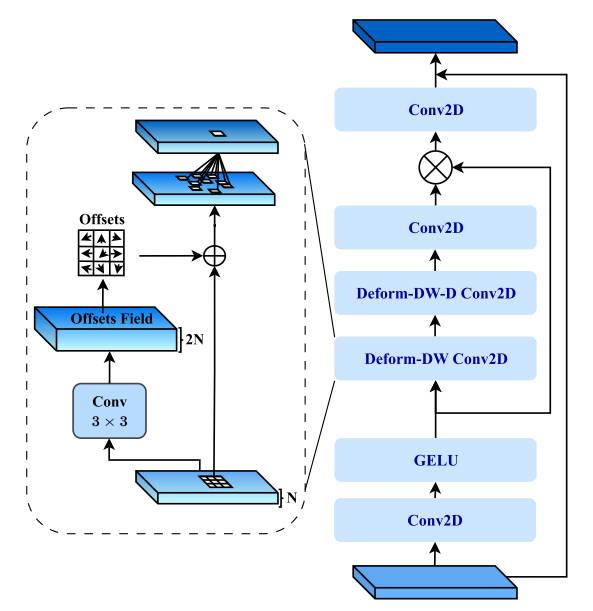
大核媲美自注意力:用深度卷积 + 深度空洞卷积 + 1×1 卷积拼出大核注意力,感受野比肩自注意力,FLOPs 只随输入尺寸线性增长,还省掉 sigmoid / Softmax 归一化
论文信息
- 论文:Beyond Self-Attention: Deformable Large Kernel Attention for Medical Image Segmentation
- 出处:WACV 2024
核心痛点
Transformer 分割模型的自注意力计算量随 token 数平方增长,深度和分辨率被卡住;3D 影像逐切片(伪 3D)处理丢掉切片间信息;病灶、器官形变不规则,固定网格卷积核难贴合,边界越分越糊。
模块亮点
- 大核媲美自注意力:用深度卷积 + 深度空洞卷积 + 1×1 卷积拼出大核注意力,感受野比肩自注意力,FLOPs 只随输入尺寸线性增长,还省掉 sigmoid / Softmax 归一化
- 采样网格可形变:卷积层从特征学出偏移场,可变形卷积扭曲采样网格,核形状随数据自适应,专治形状不规则的病灶与器官
- 消融涨点实打实:Synapse 3D 消融中,3D LKA 基线 85.87 DSC,加普通 3D 卷积升到 86.86,换成可变形卷积再涨到 87.49;整体 3D 模型拿下 SOTA,参数仅 42.35M,计算量约为 Swin-UNETR 的 17%
适用场景
领域为医学图像分割,原文覆盖 Synapse 多器官 CT 分割(2D 与 3D)、NIH 胰腺分割、ISIC 2017 / 2018 皮肤病变分割;也适合息肉、肿瘤等 2D / 3D 分割任务。
插入位置建议
- 替换 U 形分割网络(Swin-UNet、UNETR、HiFormer 等)里的自注意力块
- 在 3D 分割网络各阶段用 3D 版 D-LKA 替掉逐切片的 2D 注意力,吃进跨切片上下文
- 给 VAN 等网络里的 LKA 升级:深度卷积后插一层可变形卷积即可变身 D-LKA
适用任务
- 医学图像分割
- 原文覆盖 Synapse 多器官 CT 分割
完整代码
d-lka.py
import torchvision
import torch
import torch.nn as nn
import numpy as np
from torch.autograd import Variable

"""
医学图像分割已通过 Transformer 模型取得了显著的进步,该模型擅长掌握深远的上下文和全局上下文信息。然而,这些模型的计算需求与 token 数量的平方成正比,限制了它们的深度和分辨率能力。
大多数当前方法都是逐片(称为伪 3D)处理 3D 体积图像数据,缺少关键的切片间信息,从而降低了模型的整体性能。
为了应对这些挑战,我们引入了可变形大核注意力 (D-LKA Attention) 的概念,这是一种精简的注意力机制,采用大型卷积核来充分理解体积上下文。该机制在类似于自注意力的接受场内运行,同时避开了计算开销。
此外,我们提出的注意力机制受益于可变形卷积,可以灵活地扭曲采样网格,使模型能够适当地适应不同的数据模式。我们设计了 D-LKA Attention 的 2D 和 3D 改编版,后者在跨深度数据理解方面表现出色。
"""


def flatten(a):
    return a.contiguous().view(a.nelement())


def repeat(a, repeats, axis=0):
    assert len(a.size()) == 1
    return flatten(torch.transpose(a.repeat(repeats, 1), 0, 1))


def batch_map_coordinates(input, coords, order=1):
    """Interpolate (trilinear) input values given coordinates
    Notations:
        l - left
        r - right
        t - top
        b - bottom
        a - anterior (front)
        p - posterior (back)

    ltp------rtp
    |\        |\
    | lta------rta
    | |       | |
    lbp------rbp|
     \|        \|
      lba------rba

    """

    batch_size = input.size(0)
    input_depth = input.size(1)
    input_height = input.size(2)
    input_width = input.size(3)

    n_coords = coords.size(1)

    coords = torch.cat((
        torch.clamp(coords.narrow(2, 0, 1), 0, input_depth - 1),
        torch.clamp(coords.narrow(2, 1, 1), 0, input_height - 1),
        torch.clamp(coords.narrow(2, 2, 1), 0, input_width - 1)), 2)

    assert (coords.size(1) == n_coords)

    coords_lta = coords.floor().long()
    coords_rbp = coords.ceil().long()

    coords_ltp = torch.stack([coords_lta[..., 0], coords_lta[..., 1], coords_rbp[..., 2]], 2)
    coords_rtp = torch.stack([coords_rbp[..., 0], coords_lta[..., 1], coords_rbp[..., 2]], 2)
    coords_rta = torch.stack([coords_rbp[..., 0], coords_lta[..., 1], coords_lta[..., 2]], 2)
    coords_lba = torch.stack([coords_lta[..., 0], coords_rbp[..., 1], coords_lta[..., 2]], 2)
    coords_lbp = torch.stack([coords_lta[..., 0], coords_rbp[..., 1], coords_rbp[..., 2]], 2)
    coords_rba = torch.stack([coords_rbp[..., 0], coords_rbp[..., 1], coords_lta[..., 2]], 2)

    idx = repeat(torch.arange(0, batch_size), n_coords).long()
    idx = Variable(idx, requires_grad=False)
    if input.is_cuda:
        idx = idx.cuda()

    def _get_vals_by_coords(input, coords):
        indices = torch.stack([
            idx, flatten(coords[..., 0]), flatten(coords[..., 1]), flatten(coords[..., 2])
        ], 1)
        inds = indices[:, 0] * input.size(1) * input.size(2) * input.size(3) \
               + indices[:, 1] * input.size(2) * input.size(3) + indices[:, 2] * input.size(3) + indices[:, 3]

        vals = flatten(input).index_select(0, inds)
        vals = vals.view(batch_size, n_coords)
        return vals

    vals_lta = _get_vals_by_coords(input, coords_lta.detach())
    vals_rbp = _get_vals_by_coords(input, coords_rbp.detach())
    vals_ltp = _get_vals_by_coords(input, coords_ltp.detach())
    vals_rtp = _get_vals_by_coords(input, coords_rtp.detach())
    vals_rta = _get_vals_by_coords(input, coords_rta.detach())
    vals_lba = _get_vals_by_coords(input, coords_lba.detach())
    vals_lbp = _get_vals_by_coords(input, coords_lbp.detach())
    vals_rba = _get_vals_by_coords(input, coords_rba.detach())

    # trilinear interpolation
    # https://en.wikipedia.org/wiki/Trilinear_interpolation
    coords_offset_lta = coords - coords_lta.type(coords.data.type())
    coords_offset_rbp = coords - coords_rbp.type(coords.data.type())

    vals_ta = coords_offset_lta[..., 0] * (vals_rta - vals_lta) + vals_lta
    vals_ba = coords_offset_lta[..., 0] * (vals_rba - vals_lba) + vals_lba

    vals_tp = coords_offset_rbp[..., 0] * (vals_rtp - vals_ltp) + vals_ltp
    vals_bp = coords_offset_rbp[..., 0] * (vals_rbp - vals_lbp) + vals_lbp

    # interpolate top
    vals_t = coords_offset_lta[..., 2] * (vals_tp - vals_ta) + vals_ta

    # interpolate bottom
    vals_b = coords_offset_rbp[..., 2] * (vals_bp - vals_ba) + vals_ba

    mapped_vals = coords_offset_lta[..., 1] * (vals_b - vals_t) + vals_t
    return mapped_vals


def generate_grid(batch_size, input_depth, input_height, input_width, dtype, cuda):
    """Generate grid for coordinates of the input
    Parameters
    ---------
    batch_size : int
    input_depth : int
    input_height : int
    input_width : int
    dtype : torch.dtype
    cuda : boolean

    Returns
    -------
    torch.Tensor. shape = (b, d*h*w, 3)
    """
    grid = np.meshgrid(
        range(input_depth), range(input_height), range(input_width), indexing='ij'
    )
    grid = np.stack(grid, axis=-1)
    grid = grid.reshape(-1, 3)

    grid = np.expand_dims(grid, 0)
    grid = np.tile(grid, [batch_size, 1, 1])

    grid = torch.from_numpy(grid).type(dtype)
    if cuda:
        grid = grid.cuda()
    return Variable(grid, requires_grad=False)


def batch_map_offsets(input, offsets, grid=None, order=1):
    """(Batch) map offsets into input
    Parameters
    ---------
    input : torch.Tensor. shape = (b, s, s, s)
    offsets: torch.Tensor. shape = (b, s, s, s, 3)

    Returns
    -------
    torch.Tensor. shape = (b, s, s, s)
    """
    batch_size = input.size(0)
    input_depth = input.size(1)
    input_height = input.size(2)
    input_width = input.size(3)

    offsets = offsets.view(batch_size, -1, 3)

    if grid is None:
        grid = generate_grid(batch_size,
                             input_depth,
                             input_height,
                             input_width,
                             offsets.data.type(),
                             offsets.data.is_cuda)

    coords = offsets + grid

    mapped_vals = batch_map_coordinates(input, coords)
    return mapped_vals


class ConvOffset3D(nn.Conv3d):
    """Convolutional layer responsible for learning the 3D offsets and output the
    deformed feature map using trilinear interpolation. This layer does not perform
    convolution on the deformed map.
    """

    def __init__(self, in_channels, init_normal_stddev=0.01, **kwargs):
        """Init
        Parameters
        ----------
        filters : int
            Number of channel of the input feature map
        init_normal_stddev : float
            Normal kernel initialization
        **kwargs:
            Pass to superclass. See Con2d layer in pytorch
        """
        self.filters = in_channels
        self._grid_param = None
        super(ConvOffset3D, self).__init__(self.filters, self.filters * 3, 3, padding=1, bias=False, **kwargs)
        self.weight.data.copy_(self._init_weights(self.weight, init_normal_stddev))

    def forward(self, x):
        x_shape = x.size()
        offsets = super(ConvOffset3D, self).forward(x)

        # offsets: (b*c, d, h, w, 3)
        offsets = self._to_bc_d_h_w_3(offsets, x_shape)

        # x: (b*c, d, h, w)
        x = self._to_bc_d_h_w(x, x_shape)

        # X_offset: (b*c, d, h, w)
        x_offset = batch_map_offsets(x, offsets, grid=self._get_grid(self, x))

        # x_offset: (b, d, h, w, c)
        x_offset = self._to_b_c_d_h_w(x_offset, x_shape)

        return x_offset

    @staticmethod
    def _get_grid(self, x):
        batch_size, input_depth, input_height, input_width = x.size(0), x.size(1), x.size(2), x.size(3)
        dtype, cuda = x.data.type(), x.data.is_cuda
        if self._grid_param == (batch_size, input_depth, input_height, input_width, dtype, cuda):
            return self._grid
        self._grid_param = (batch_size, input_depth, input_height, input_width, dtype, cuda)
        self._grid = generate_grid(batch_size, input_depth, input_height, input_width, dtype, cuda)
        return self._grid

    @staticmethod
    def _init_weights(weights, std):
        fan_out = weights.size(0)
        fan_in = weights.size(1) * weights.size(2) * weights.size(3) * weights.size(4)
        w = np.random.normal(0.0, std, (fan_out, fan_in))
        return torch.from_numpy(w.reshape(weights.size()))

    @staticmethod
    def _to_bc_d_h_w_3(x, x_shape):
        """(b, c, d, h, w) -> (b*c, d, h, w, 3)"""
        x = x.contiguous().view(-1, int(x_shape[2]), int(x_shape[3]), int(x_shape[4]), 3)
        return x

    @staticmethod
    def _to_bc_d_h_w(x, x_shape):
        """(b, c, d, h, w) -> (b*c, d, h, w)"""
        x = x.contiguous().view(-1, int(x_shape[2]), int(x_shape[3]), int(x_shape[4]))
        return x

    @staticmethod
    def _to_b_c_d_h_w(x, x_shape):
        """(b*c, d, h, w) -> (b, c, d, h, w)"""
        x = x.contiguous().view(-1, int(x_shape[1]), int(x_shape[2]), int(x_shape[3]), int(x_shape[4]))
        return x


def deform_conv3d(in_c, out_c, kernel_size, **kwargs):
    """Deformable convolution layer: convolution + offset"""
    return nn.Sequential(
        ConvOffset3D(out_c),
        nn.Conv3d(in_c, out_c, kernel_size, **kwargs)

    )

class DeformConv3d(nn.Module):  # TODO: 3d version of this

    def __init__(self, in_channels, groups, kernel_size=(3, 3), padding=1, stride=1, dilation=1, bias=True):
        super(DeformConv3d, self).__init__()

        self.offset_net = nn.Conv2d(in_channels=in_channels,
                                    out_channels=2 * kernel_size[0] * kernel_size[1],
                                    kernel_size=3,
                                    padding=1,
                                    stride=1,
                                    bias=True)

        self.deform_conv = torchvision.ops.DeformConv2d(in_channels=in_channels,  # 3d version of this?
                                                        out_channels=in_channels,
                                                        kernel_size=kernel_size,
                                                        padding=padding,
                                                        groups=groups,
                                                        stride=stride,
                                                        dilation=dilation,
                                                        bias=False)

    def forward(self, x):
        offsets = self.offset_net(x)
        out = self.deform_conv(x, offsets)
        return out


class LKA3d(nn.Module):
    def __init__(self, dim):
        super().__init__()
        self.conv0 = nn.Conv3d(dim, dim, 5, padding=2, groups=dim)
        self.conv_spatial = nn.Conv3d(dim, dim, 7, stride=1, padding=9, groups=dim, dilation=3)
        self.conv1 = nn.Conv3d(dim, dim, 1)

    def forward(self, x):
        u = x.clone()
        attn = self.conv0(x)
        attn = self.conv_spatial(attn)
        attn = self.conv1(attn)

        return u * attn


class LKA_Attention3d(nn.Module):
    def __init__(self, d_model):
        super().__init__()

        self.proj_1 = nn.Conv3d(d_model, d_model, 1)
        self.activation = nn.GELU()
        self.spatial_gating_unit = LKA3d(d_model)
        self.proj_2 = nn.Conv3d(d_model, d_model, 1)

    def forward(self, x):
        shortcut = x.clone()
        x = self.proj_1(x)
        x = self.activation(x)
        x = self.spatial_gating_unit(x)
        x = self.proj_2(x)
        x = x + shortcut
        return x


if __name__ == '__main__':
    block = LKA_Attention3d(d_model=32).cuda(0)
    input = torch.rand(1, 32, 56, 56, 56).cuda(0)
    output = block(input)
    print(input.size())
    print(output.size())
环境与依赖
Python 3.9+
继续浏览
下一篇D2ST-Adapter 解耦可变形时空适配器双路径解耦编码:瓶颈结构下采样后分空间、时序两条路径并行适配,空间抓外观语义、时序学动态变化,融合后上采样,保持单流结构相关资源
模块2026-11-20
DFB 膨胀Transformer模块
局部-全局交替:LS-MSA 把特征图划成不重叠单元、单元内做局部自注意力抓细节,GS-MSA 每隔 g 个 patch 采样拼成"膨胀单元"做全局自注意力,二者交替堆叠,细节和长程依赖全都要
医学图像分割TransformerDFB
医学影像MIT
模块2026-11-20
VSmW-MSA 可变形状混合窗口多头自注意力
四窗并行扩视野:通道均分四组,分别走三个条带窗口加一个立方体局部窗口,一次计算兼顾全局与局部,不加额外成本就扩大感受野
医学图像分割医学影像VSmW-MSA
医学影像MIT
模块2026-11-20
AFDA 自适应频域对齐模块
频域拆解再对齐:用 3×3 均值池化把特征分成低频 / 高频两路,低频管域间风格差异,高频管结构细节;低频生成门控决定对齐多少,高频走适配分支决定对齐什么
医学图像分割域适应AFDA
医学影像MIT