模块更新于 2026-11-20· 浏览 0· 下载 0
OFU 球面偏移场上采样模块
球面几何引导采样:构造 (sin u, cos u, sin v, cos v, cos u·cos v) 五维球面几何图并与特征图拼接,仅用两个卷积层预测偏移场 (Δu, Δv),
结构图
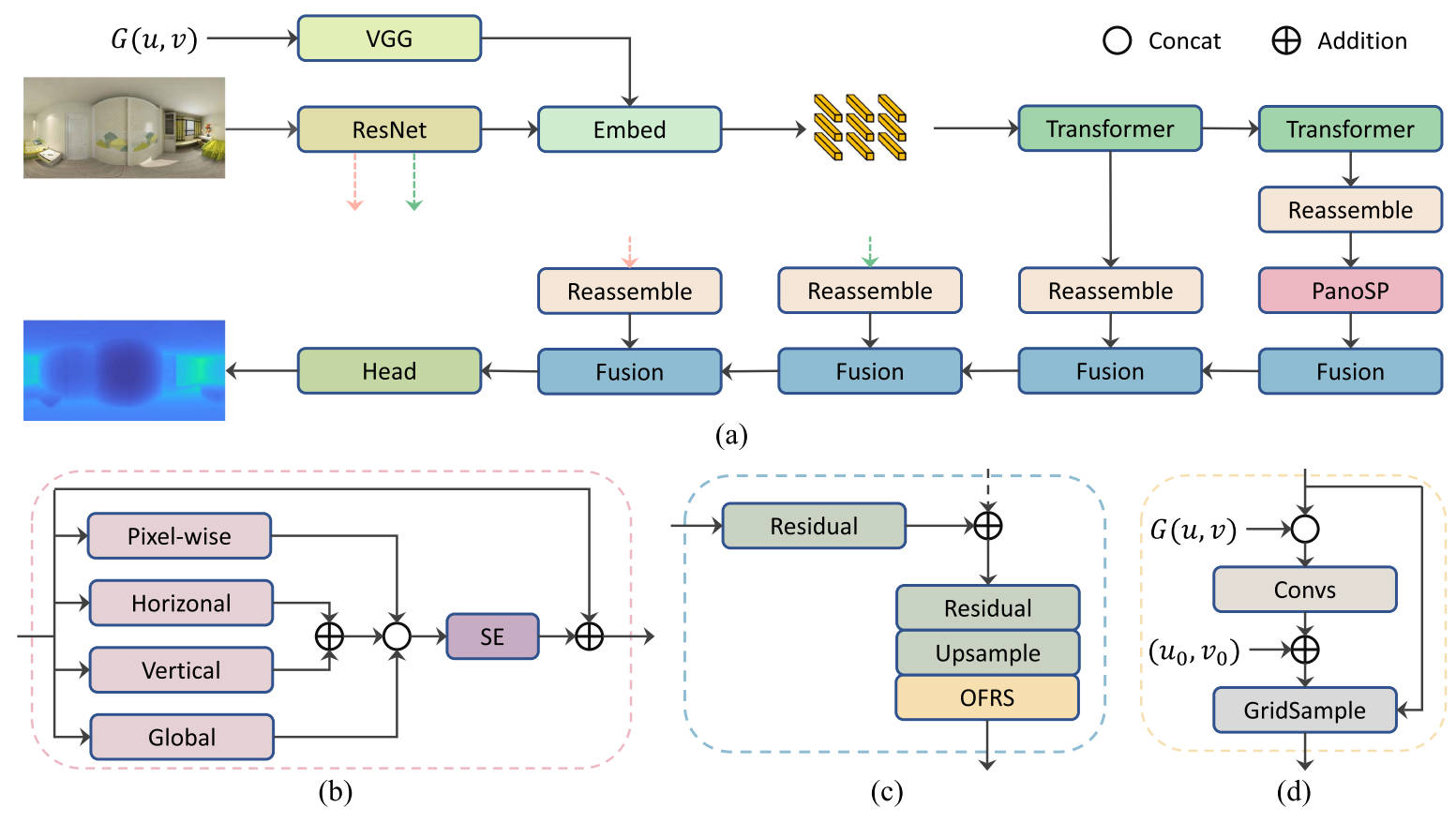
球面几何引导采样:构造 (sin u, cos u, sin v, cos v, cos u·cos v) 五维球面几何图并与特征图拼接,仅用两个卷积层预测偏移场 (Δu, Δv),
论文信息
- 论文:SPDET: Edge-Aware Self-Supervised Panoramic Depth Estimation Transformer With Spherical Geometry
- 出处:IEEE TPAMI 2023
核心痛点
全景图像用等距柱状投影(ERP)展开自带球面畸变,常规双线性上采样只在 ERP 网格上均匀取点,采样位置不对应球面特征空间的最优点,容易混淆相邻特征,导致深度图边缘模糊、物体粘连;切 tangent patch 再融合还要额外对齐,费时费力。
模块亮点
- 球面几何引导采样:构造 (sin u, cos u, sin v, cos v, cos u·cos v) 五维球面几何图并与特征图拼接,仅用两个卷积层预测偏移场 (Δu, Δv),在球面坐标下重采样上采样后的特征(即论文中的 OFRS 模块)
- 深度边缘更锐利:消融实验中该模块重建出更细粒度、边界更清晰的深度图;可视化中能把相邻的沙发、桌子分开
- 整体性能领先:整体模型在 3D60 全集上 AbsRel 领先第二名 13.5%、MAE 领先 15.6%,取得自监督单目全景深度估计 SOTA;141.9M 参数、19.8 fps 推理,全程在 ERP 特征上操作,无需 patch 间对齐
适用场景
领域为 360° 全景单目深度估计(自监督、面向室内 3D 重建);原文在 3D60、PNVS、PanoSUNCG 数据集上验证;可迁移到全景语义分割、全景光流等 ERP 特征重采样环节。
插入位置建议
- 替换 U 型解码器或 DPT 式融合块中的双线性上采样,先插值放大再做偏移场重采样
- 接在任意 ERP 全景网络的卷积层之后,作为带球面几何先验的重采样单元
- 放在多尺度融合阶段,对逐级上采样的特征分别重采样后再送入预测头
适用任务
- 360° 全景单目深度估计
完整代码
ofu.py
# import torch
# import torch.nn as nn
# import torch.nn.functional as F
# import numpy as np
# from collections import OrderedDict
# from packaging.version import Version

# """TPAMI2023

# 1. 球面几何特征的生成
# 首先,在 OFU 模块中,我们通过一个函数 uv_grid 来生成球面坐标。这一步非常关键,因为我们处理的是全景图像,而全景图像本身在球面坐标系下有特定的几何特性。uv_grid 函数通过计算每个像素在球面上的坐标来生成 u 和 v,其中 u 代表水平角度,v 代表垂直角度。这些球面坐标帮助我们将二维图像映射到球面上。

# 2. 球面几何特征与特征图的结合
# 接下来,球面几何特征会与输入的特征图结合。具体来说,我们通过 register_embed 函数,将球面坐标经过一系列的 sin 和 cos 运算,生成了一个带有球面几何特征的网格。这个网格会扩展到与输入特征图相同的尺寸,并用于后续的重新采样过程。

# 3. 偏移场与特征重新采样
# 然后,我们在 wraped_sample 函数中,将球面几何特征和输入的特征图拼接在一起,形成一个新的输入。通过 ofu 模块,我们可以得到一个偏移场,这个偏移场将帮助我们更好地对输入特征图进行采样。具体来说,偏移场会告诉我们特征图中每个像素点的正确位置,使得我们可以在球面坐标系下进行合理的采样。

# 最后,我们使用 spherical_grid_sample 函数来完成特征的重新采样。这个函数会根据球面几何特征对输入特征图进行采样,输出一个在球面坐标系下优化过的特征图。这一过程帮助我们在全景图像处理任务中,提升了对图像细节的捕捉,特别是在边缘和深度估计等方面效果显著。
# """

# # Initialize the global _args variable
# def _init_global():
#     global _args
#     _args = OrderedDict({
#         'model': {
#             'padding': 'circpad'  # Default padding value
#         }
#     })

# def spherical_grid_sample(x,grid,clip=False,inplace=False,indexing='ij'):
#     B,C,H,W = x.shape
#     assert len(grid.shape) == 4 and grid.shape[-1] == 2
#     # assert tuple(grid.shape) == (B,H,W,2)

#     if clip:
#         grid = spherical_reminder(grid,[H,W],inplace=inplace,indexing=indexing)
#     if indexing == 'ij':
#         grid_h = grid[...,0]
#         grid_w = grid[...,1]
#     else:
#         grid_h = grid[...,1]
#         grid_w = grid[...,0]

#     x = torch.cat([x,x[...,:1]],dim=-1)
#     grid = torch.stack([grid_w/W*2-1,grid_h/(H-1)*2-1],dim=-1)
#     y = torch.nn.functional.grid_sample(x,grid,align_corners=True)
#     return y

# def _make_norm(norm,layers,**kargs):
#     if norm is None or norm == 'idt' or norm == 'none':
#         return nn.Identity()
#     elif norm == 'bn':
#         return nn.BatchNorm2d(layers)
#     elif norm == 'inst':
#         return nn.InstanceNorm2d(layers)
#     elif norm == 'gn':
#         if not 'groups' in kargs:
#             return nn.GroupNorm(32,layers)
#         else:
#             return nn.GroupNorm(kargs['groups'],layers)
#     else:
#         raise NotImplementedError

# def _make_act(act,**kargs):
#     if act is None or act == 'idt':
#         return nn.Identity()
#     elif act == 'relu':
#         return nn.ReLU(inplace=True)
#     elif act == 'lrelu':
#         return nn.LeakyReLU(negative_slope=0.01,inplace=True)
#     elif act == 'orelu':
#         return nn.ReLU(inplace=False)
#     elif act == 'olrelu':
#         return nn.LeakyReLU(negative_slope=0.01,inplace=False)
#     elif act == 'prelu':
#         return nn.PReLU()
#     elif act == 'gelu':
#         return nn.GELU()
#     else:
#         raise NotImplementedError

# def _set_value(key, value):
#     _args[key] = value

# def _get_value(key):
#     try:
#         return _args[key]
#     except:
#         print('error!')
#         exit(-1)

# # _make_pad function to handle padding selection based on _args
# def _make_pad(padding=0, pad=None, **kargs):
#     if pad is None and 'padding' in _args['model']:
#         pad = _args['model']['padding']
#     if pad == 'circpad':
#         return nn.ReflectionPad2d(padding)  # Replace with custom CircPad if necessary
#     elif pad == 'lrpad':
#         return nn.ReplicationPad2d(padding)  # Replace with actual implementation
#     elif pad == 'zeropad':
#         return nn.ZeroPad2d(padding)
#     else:
#         return nn.ReflectionPad2d(padding)  # Default to ReflectionPad2d

# # Functions for grid creation
# def xy_grid(h, w, dim=0):
#     if Version(torch.__version__) >= Version('1.10.0'):
#         y, x = torch.meshgrid(torch.arange(h), torch.arange(w), indexing='ij')
#     else:
#         y, x = torch.meshgrid(torch.arange(h), torch.arange(w))
#     return torch.stack([x.cuda(), y.cuda()], dim=dim)

# def uv_grid(h, w, dim=0):
#     if Version(torch.__version__) >= Version('1.10.0'):
#         y, x = torch.meshgrid(torch.arange(h), torch.arange(w), indexing='ij')
#     else:
#         y, x = torch.meshgrid(torch.arange(h), torch.arange(w))
#     u = (x.cuda().type(torch.float32) - (w - 1) / 2) / w * (2 * np.pi)
#     v = -(y.cuda().type(torch.float32) - (h - 1) / 2) / h * np.pi
#     return torch.stack([u, v], dim=dim)

# class OFU(nn.Module):
#     def __init__(self, in_channels, out_channels=None, scale=2, ofu_grid='geo', norm=None, act='gelu', force=False):
#         super().__init__()
#         out_channels = out_channels or in_channels // 2
#         mid_channels = 32
#         self.scale = scale
#         self.ofu_grid_type = ofu_grid
#         self.ofu_grid = None
#         self.xy_grid = None
#         self.pad = _make_pad(1)

#         grid_channels = 5

#         self.of = nn.Sequential(
#             _make_pad(1),
#             nn.Conv2d(in_channels + grid_channels, mid_channels, kernel_size=3, bias=not norm),
#             _make_norm(norm, mid_channels),
#             _make_act(act),
#             nn.Conv2d(mid_channels, 2, 1)
#         )
#         if in_channels == out_channels and not force:
#             self.conv = nn.Identity()
#         else:
#             self.conv = nn.Conv2d(in_channels, out_channels, 1)

#     def register_embed(self, shape):
#         b, _, h, w = shape
#         uv = uv_grid(h, w).view(1, 2, h, w)
#         grid = torch.cat([torch.sin(uv[:, :1]), torch.cos(uv[:, :1]), torch.sin(uv[:, 1:]), torch.cos(uv[:, 1:]),
#                           torch.cos(uv[:, :1]) * torch.cos(uv[:, 1:])], dim=1)
#         self.ofu_grid = grid.expand([b, -1, -1, -1])

#     def wraped_sample(self, x):
#         b, _, h, w = x.shape

#         if self.ofu_grid is None or not self.ofu_grid.shape[0] == b or not tuple(self.ofu_grid.shape[-2:]) == tuple(x.shape[-2:]):
#             self.register_embed(x.shape)

#         if self.xy_grid is None or not tuple(self.xy_grid.shape[-2:]) == tuple(x.shape[-2:]):
#             self.xy_grid = xy_grid(h, w).view(1, 2, h, w)

#         of_input = torch.cat([x, self.ofu_grid], dim=1)
#         of = self.of(of_input)  # [b, 2, h, w]
#         of = of + self.xy_grid  # [b, 2, h, w]

#         of = of.permute([0, 2, 3, 1])  # [b, h, w, 2]
#         y = spherical_grid_sample(x, of, inplace=False, indexing='xy')

#         return y

#     def forward(self, x):

#         # original_size = x.size()  # 保存输入的原始大小

#         x = self.pad(x)
#         x = F.interpolate(x, scale_factor=self.scale, mode='bilinear', align_corners=False)
#         x = x[:, :, self.scale:-self.scale, self.scale:-self.scale]
#         y = self.wraped_sample(x)
#         y = self.conv(y)

#         # # 添加反向插值,将输出缩回到原始大小
#         # y = F.interpolate(y, size=(original_size[2], original_size[3]), mode='bilinear', align_corners=False)

#         return y


# # Main function to test the OFU block
# if __name__ == '__main__':
#     _init_global()  # Initialize _args

#     block = OFU(in_channels=3, out_channels=3).cuda()

#     input_tensor = torch.rand(1, 3, 64, 64).cuda()

#     output_tensor = block(input_tensor)

#     print("Input size:", input_tensor.size())
#     print("Output size:", output_tensor.size())
环境与依赖
Python 3.9+
继续浏览
下一篇OS-block 全尺度模块素数覆盖全尺度:借鉴哥德巴赫猜想,前两层用从 1 到 pk 的素数核、第三层只用 1 和 2 的核,覆盖全部整数感受野;pk 按序列长度自动取最小素数,核大小零调参相关资源
模块2026-11-20
BCN 批通道归一化
统一 BN 与 LN:对同一份特征分别沿 batch 维(BN 式)和样本内通道维(LN 式)归一化,再用可学习的逐通道权重加权融合,初始等价 BN,训练中自动学出每个通道更信 BN 还是 LN
归一化BCN计算机视觉
计算机视觉MIT
模块2026-11-20
SSPCAB 自监督预测卷积注意力模块
重建写进卷积核:感受野中心被遮挡、只保留四角子核,逼网络用上下文"脑补"中心信息;膨胀率 d 控制上下文从局部到全局
计算机视觉异常检测SSPCAB
计算机视觉MIT
模块2026-11-20
AFW 自适应帧加权模块
按质量给帧打分:对每一帧特征估计"帧质量",经 Softmax 得到权重,动态突出信息量大的帧、压低模糊 / 遮挡帧
计算机视觉姿态估计AFW
计算机视觉MIT